Commemoration of the Great Calcutta Killings and Partition History
Source:ommcom-news ↗
Why It Matters
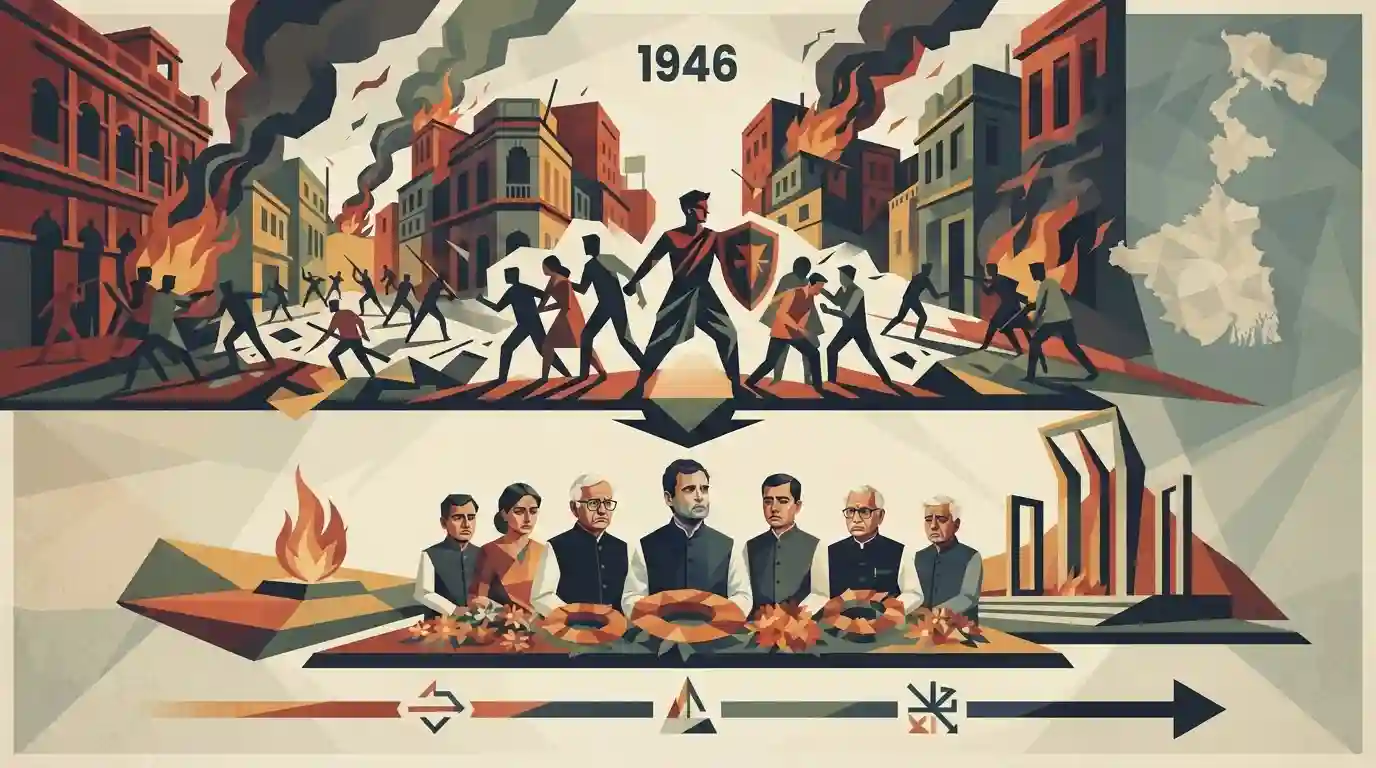
Direct Action Day and the Great Calcutta Killings are pivotal events in modern Indian history that catalyzed the partition of India. Understanding these events, including key local figures like Gopal Mukherjee and the political circumstances surrounding the Muslim League's call for Direct Action, is essential for WBCS Prelims and Mains historical analysis.
Summary
The article details the commemoration of the victims of 'The Great Calcutta Killings' of August 16, 1946, also known as 'Direct Action Day'. Political leaders in West Bengal paid homage to those who lost their lives in the four-day communal riots that devastated Kolkata. The commemoration highlighted the role of Gopal Mukherjee (Gopal Pantha), who organized resistance to protect local Bengalis during the violence. The event serves as a historical reminder of the tragic consequences of the communal division preceding India's partition.
Key Points
- On August 16, 1946, the Great Calcutta Killings (also known as Direct Action Day) began in Calcutta (now Kolkata), leading to widespread communal violence and the loss of thousands of lives.
- The Muslim League, led by Muhammad Ali Jinnah, declared August 16, 1946, as Direct Action Day to demand a separate Muslim homeland (Pakistan) after rejecting the Cabinet Mission Plan.
- Gopal Mukherjee, popularly known as 'Gopal Pantha' due to his mutton shops, is remembered for organizing resistance to protect Hindu Bengalis in Kolkata during the four-day riots.
- Political leaders paid homage to the victims of the 1946 killings, cautioning against 'appeasement politics' and highlighting the importance of remembering historical events like the Calcutta Killings and the 1971 Bangladesh genocide.
Important Terms
Muslim League

A political party formed in 1906 that played a pivotal role in the Indian independence movement. Under Muhammad Ali Jinnah's leadership, it successfully advocated for the partition of British India and the creation of Pakistan.
UPSC context
Core topic in Modern Indian History (Paper III), essential for questions on the freedom struggle, communalism, and Partition.
Bharatiya Janata Party (BJP)
Founded in 1980 as the successor to the Bharatiya Jana Sangh, it is one of India's major political parties. It advocates for cultural nationalism and is a dominant force in contemporary Indian politics.
UPSC context
Relevant for Indian Polity (Paper V) and current affairs, specifically concerning India's party system and post-independence political history.
Direct Action Day
A day of protest declared by the Muslim League on August 16, 1946, demanding a separate Muslim homeland. It triggered the "Great Calcutta Killings," resulting in massive communal violence and thousands of casualties.
UPSC context
Highly tested in the Indian National Movement (Paper III); focuses on the events leading to Partition and communal politics.
Gopal Mukherjee (Gopal Pantha)
A local leader in Kolkata who organized an armed resistance group to protect Hindus during the 1946 Great Calcutta Killings. He remains a prominent, albeit debated, historical figure in Partition-era communal violence.
UPSC context
Important for Bengal-specific history in WBCS Paper III, relevant to the local dynamics of the 1946 communal riots.
Indo-Asian News Service (IANS)
An independent, privately owned Indian news agency established in 1986. Originally founded to serve the Indian diaspora in North America, it now provides syndicated news and multimedia content across the subcontinent.
UPSC context
Appears in General Knowledge and Current Affairs regarding media institutions, though of lower priority compared to historical topics.
Prelims Trap
Direct Action Day was announced in response to the Mountbatten Plan.
The Muslim League called for Direct Action Day (Aug 1946) after withdrawing its acceptance of the Cabinet Mission Plan, not the Mountbatten Plan (1947).
Static Concepts Connected
What were the core features of the Cabinet Mission Plan (1946)?
- Rejected Pakistan: It explicitly rejected the Muslim League's demand for a separate sovereign state of Pakistan, leading to ultimate dissatisfaction.
- Provincial Grouping: Proposed dividing provinces into three distinct groups (A, B, C), which became the main bone of contention between Congress and the League.
- Constituent Assembly: Established the framework for forming a Constituent Assembly to draft the Constitution for a united India.
Who held key administrative roles in Bengal during the 1946 Killings?
- Bengal Premier: H.S. Suhrawardy (Muslim League) was the Premier (Chief Minister) and faced massive backlash for allowing the administrative machinery to collapse.
- British Governor: Sir Frederick John Burrows was the British Governor, heavily criticized for declaring August 16 a holiday and delaying military deployment.
Cross-Topic Patterns
1946 Chronology: Mission to Action
The strict chronological sequence from the Cabinet Mission (March) to Direct Action (August) and Interim Government (September) is a recurring WBCS Prelims and Mains trap.
Pre-Partition Bengal Premiers
Suhrawardy's tenure connects to the broader timeline of Bengal's provincial governments, frequently tested alongside A.K. Fazlul Huq's Krishak Praja Party and the 1937 elections.

Direct Action Day's immediate trigger (Cabinet Mission rejection) and Bengal's leadership in 1946 are prime targets for WBCS Mains.
Linked PYQs · 3
Linked PYQs · 3
- 2019WBCS_PRELIMSGS1
Which day was declared as the Direct Action Day by the Muslim League?
- 2017WBCS_PRELIMSGS1
Which Party gave a call for 'Direct Action' and which date was chosen as the 'Direct Action Day'?
- 2002WBCS_PRELIMSGS1
Which was the date of the 'Direct Action' of the Muslim League?
