Judicial Austerity Measures Amid Global Energy Crisis
Source:The Hindu ↗
Why It Matters
This article highlights the administrative functioning of the Supreme Court, the practical integration of e-courts (video-conferencing), and judicial reforms (partial working days) amidst mounting pendency. It also demonstrates how global geopolitical issues (energy crises) can directly impact the domestic functioning of India's apex institutions.
Summary
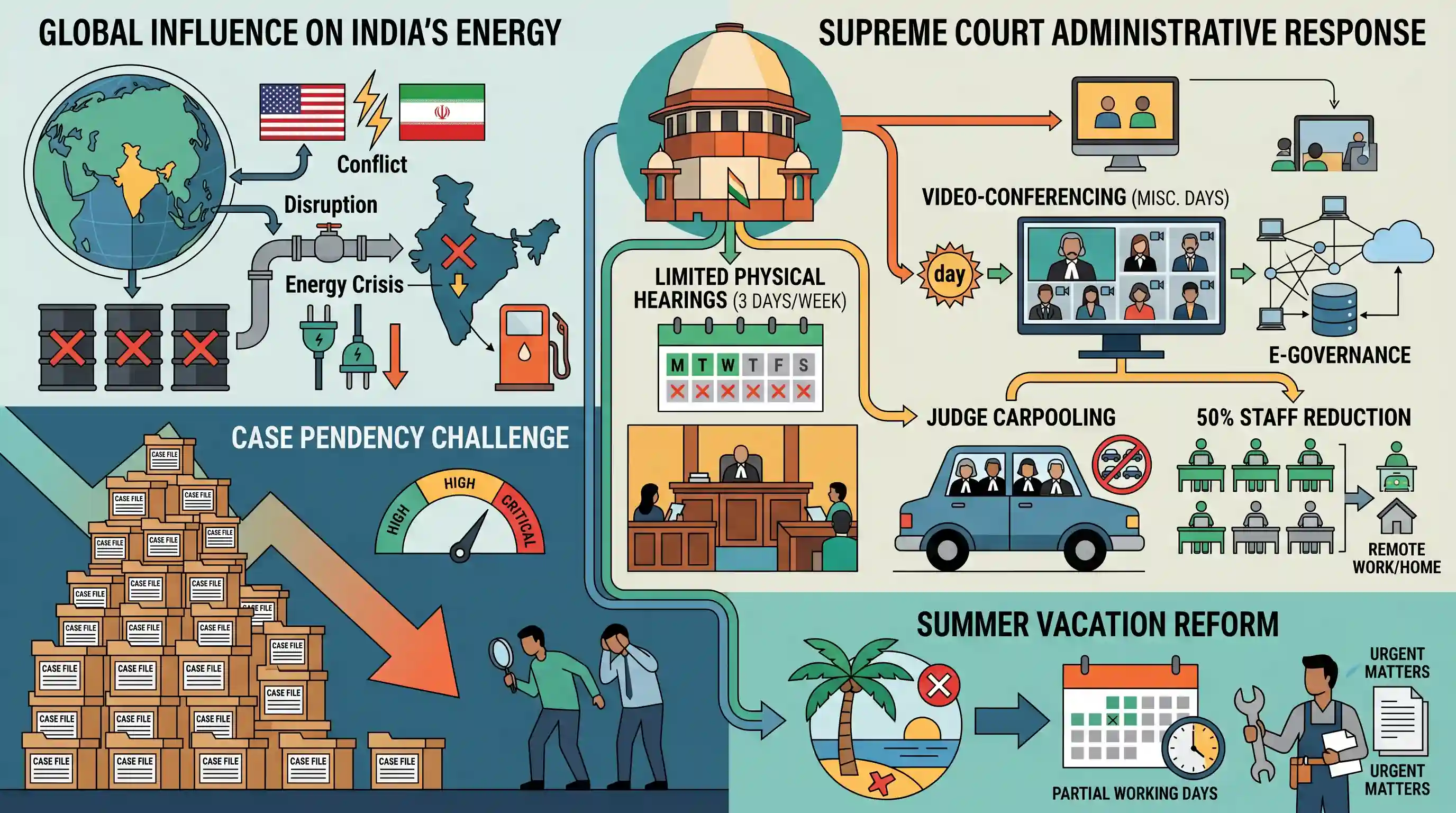
Prompted by the government's call for energy conservation amid an energy crisis fueled by the U.S.-Iran conflict, the Supreme Court of India has announced significant austerity measures. These include limiting physical hearings to three days a week, shifting 'miscellaneous days' to video-conferencing, implementing judge carpooling, and reducing physical staff presence by 50%. This administrative shift coincides with the Court facing a mounting case pendency of over 93,000 cases and an ongoing institutional effort to replace traditional summer vacations with 'partial working days' to handle urgent matters.
Key Points
- The Supreme Court of India has implemented austerity measures in response to a fuel crisis exacerbated by the U.S.-Iran conflict, following an appeal from the Prime Minister.
- Physical hearings are restricted to Tuesdays, Wednesdays, and Thursdays, while Mondays and Fridays (miscellaneous days) will shift entirely to video-conferencing.
- Supreme Court judges have unanimously decided to carpool, and physical staff presence has been cut by 50% to allow for work-from-home arrangements.
- The austerity drive occurs against a backdrop of increasing case pendency in the Supreme Court, which has now crossed 93,000 cases.
- The traditional "summer vacation" has been replaced with "partial working days," ensuring more benches remain active to hear urgent matters like bail and habeas corpus.
Important Terms
Supreme Court of India

The highest judicial court under the Constitution of India, acting as the final court of appeal and the guardian of fundamental rights.
UPSC context
GS Paper II: Structure, organization, and functioning of the Judiciary; key constitutional body analysis.
Judicial Pendency
The backlog of unresolved cases in the legal system; currently exceeding 93,000 in the Supreme Court per the article context.
UPSC context
GS Paper II: Judicial reforms and issues related to the delivery of timely justice.
Energy Security
Ensuring uninterrupted availability of energy sources at an affordable price, vital for India’s strategic autonomy and economic growth.
UPSC context
GS Paper II (International Relations) and GS Paper III (Infrastructure and Energy).
E-Governance (Judiciary)
Integration of IT tools like video-conferencing and digital filings to improve judicial transparency, accessibility, and administrative efficiency.
UPSC context
GS Paper II: Governance applications and the use of technology in streamlining public institutions.
Court Vacations
Traditional periods of recess for courts; recently scrutinized as a 'colonial legacy' with calls for replacement by working rotations.
UPSC context
GS Paper II: Functioning of the Judiciary; balancing judge well-being with case disposal rates.
Austerity Measures
Institutional policies designed to reduce expenditure or resource consumption during crises, such as carpooling and reduced physical staff presence.
UPSC context
GS Paper II/III: Governance and response to economic or resource-based emergencies.
Prelims Trap
Parliament enacts laws to determine the working days and vacations of the Supreme Court.
Under Article 145, the Supreme Court frames its own rules regulating practice, procedure, and vacations, subject to the President's approval, not Parliament directly.
Static Concepts Connected
How are the Supreme Court's working days and procedures regulated?
- Article 145: Grants the Supreme Court power to make rules regarding its practice and procedure, including vacations, subject to Presidential approval.
- Master of Roster: The Chief Justice of India administratively allocates cases and constitutes benches, including vacation benches for urgent matters.
- Malimath Committee: Historically recommended curtailing judicial holidays and increasing court working days to address systemic pendency.
Which landmark judgment established the right to a speedy trial?
- Hussainara Khatoon (1979): Ruled that a speedy trial is an integral part of the fundamental right to life and personal liberty under Article 21.
- Urgent cases: Habeas corpus and bail petitions are historically prioritized during judicial breaks or 'partial working days' to protect this constitutional right.
Cross-Topic Patterns
Middle East geopolitics & domestic austerity
The transmission of US-Iran tensions into Supreme Court operational cuts illustrates how India's energy dependency directly dictates domestic administrative policies and institutional continuity.
Crisis driving e-Courts Phase III
The austerity-driven shift of miscellaneous days to video-conferencing accidentally accelerates the e-Courts Mission Mode Project's goal of establishing a seamless, digital, and paperless judicial infrastructure.

Article 145 (SC rule-making) and the shift from 'summer vacations' to 'partial working days' are prime targets for a 2026 Polity MCQ.
Linked PYQs · 4
Linked PYQs · 4
- 2025MainsGS2
"Energy security constitutes the dominant kingpin of India's foreign policy, and is linked with India's overarching influence in Middle Eastern countries.” How would you integrate energy security with India's foreign policy trajectories in the coming years?
- 2017MainsGS2
The question of India's Energy Security constitutes the most important part of India's economic progress. Analyze India's energy policy cooperation with West Asian countries.
- 2025MainsGS2
Comment on the need of administrative tribunals as compared to the court system. Assess the impact of the recent tribunal reforms through rationalization of tribunals made in 2021.
- 2014MainsGS2
Instances of President's delay in commuting death sentences has come under public debate as denial of justice. Should there be a time limit specified for the President to accept/reject such petitions ? Analyse.
