India evolving trade strategy and Free Trade Agreements
Source:The Hindu ↗
Why It Matters
FTAs are critical to India's ambition of increasing its export share and integrating into global value chains. The topic directly overlaps with GS3 (Indian Economy) and GS2 (International Relations), where candidates are frequently asked to analyze the outcomes of India's trade policies, protectionist trends globally, and the implications of mechanisms like CBAM or mega-regionals like RCEP.
Summary
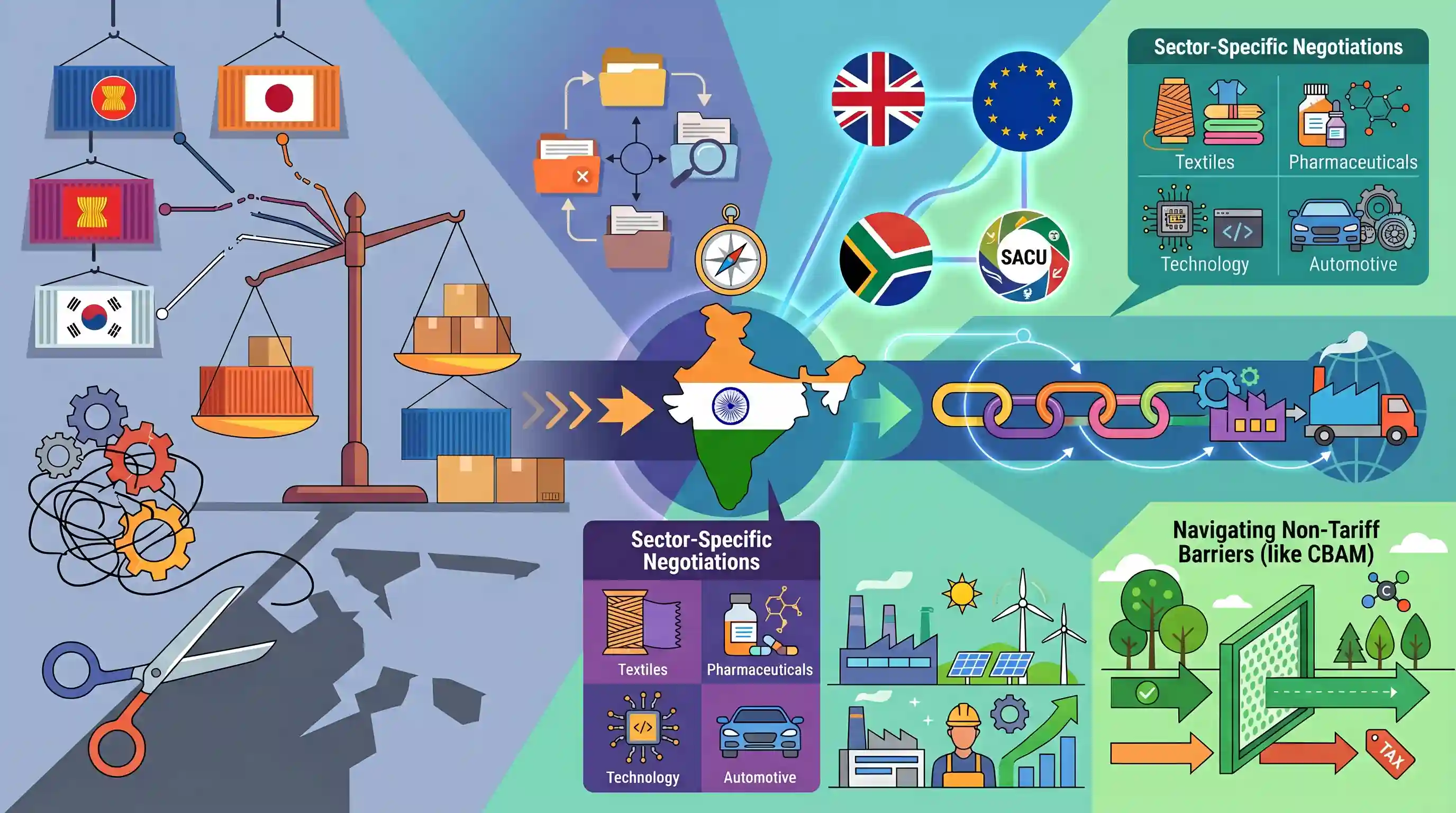
The editorial examines India's evolving strategy regarding Free Trade Agreements (FTAs) as it pursues new pacts with partners like the UK, EU, and SACU while reviewing older agreements. Historically, India's FTAs with ASEAN, Japan, and South Korea widened its trade deficit, largely due to structural flaws and neglect of non-tariff barriers. The article highlights that to avoid past mistakes and integrate effectively into global value chains, India must shift away from broad-brush tariff concessions towards sector-specific negotiations. It also points to the necessity of boosting domestic productivity and navigating modern non-tariff barriers, such as the EU's Carbon Border Adjustment Mechanism (CBAM), to ensure mutually beneficial trade outcomes.
Key Points
- India is actively negotiating new Free Trade Agreements (FTAs) with several partners, including the UK, EU, SACU, and a recently effective pact with EFTA.
- India has opted to keep channels open for consultative discussions on RCEP, though it remains hesitant to formally accede due to underlying concerns over China's economic dominance.
- Historical FTAs (such as those with ASEAN, Japan, and South Korea) have resulted in widened trade deficits for India, partly due to structural issues like failing to negotiate non-tariff barriers and standard concessions rather than ones tailored to India's strengths.
- To succeed in contemporary trade pacts, India must increase domestic productivity and enhance its integration into global value chains rather than relying solely on tariff protection.
- Emerging challenges like the EU's Carbon Border Adjustment Mechanism (CBAM) pose new non-tariff hurdles that require specific sector-level strategic negotiations for carbon-intensive industries.
Important Terms
Carbon Border Adjustment Mechanism (CBAM)

EU policy imposing a carbon price on imports of carbon-intensive goods (like steel and cement) to prevent 'carbon leakage' and ensure environmental parity with EU-based producers.
UPSC context
GS3 (Environment/Economy): High relevance for environmental protectionism, WTO compliance, and its impact on India's metal exports.
Free Trade Agreements (FTAs)
Treaties between two or more countries to reduce or eliminate trade barriers like tariffs and quotas, aimed at fostering smoother cross-border commerce and economic integration.
UPSC context
GS2/GS3 (IR/Economy): Fundamental for understanding India's trade policy, export strategy, and bilateral economic relations.
Comprehensive Economic Partnership Agreement (CEPA)
A deep trade pact covering goods, services, investment, and intellectual property. It represents a higher level of integration than a standard FTA (e.g., India-UAE or India-Japan).
UPSC context
GS3 (Economy): Tests knowledge of different trade agreement types and India's 'comprehensive' approach to strategic partnerships.
Global Value Chains (GVCs)
The international fragmentation of production, where different stages of manufacturing or service delivery occur in different countries before reaching the final consumer.
UPSC context
GS3 (Economy): Key for industrial growth and manufacturing topics; tests understanding of modern trade interdependencies.
Non-Tariff Barriers (NTBs)
Trade restrictions such as technical standards, sanitary regulations, or licensing requirements that impede imports without using direct taxes (tariffs).
UPSC context
GS3 (Economy): Critical for analyzing trade deficits and why tariff-free access doesn't always lead to export growth.
Southern African Customs Union (SACU)
The world's oldest customs union, comprising South Africa, Botswana, Lesotho, Namibia, and Eswatini; currently negotiating a preferential trade agreement with India.
UPSC context
GS2 (IR): Relevant for India-Africa relations and trade diversification away from traditional Western markets.
ASEAN (Association of Southeast Asian Nations)
A 10-member regional bloc in SE Asia. India's 2010 FTA with it is under review to address a ballooning trade deficit and market access issues.
UPSC context
GS2 (IR): Vital for 'Act East Policy' and evaluating the long-term outcomes of India's earlier trade pacts.
Prelims Trap
India recently signed a Trade and Economic Partnership Agreement with the European Union guaranteeing $100 billion investment.
UPSC often swaps EFTA (Iceland, Liechtenstein, Norway, Switzerland) with the EU. The $100 billion investment pact (TEPA) is with EFTA, while the India-EU FTA is still being negotiated.
Static Concepts Connected
What is the difference between CECA and CEPA in India's trade vocabulary?
- CECA scope: Covers mainly tariff reduction or elimination on goods. It is generally less comprehensive and often serves as a stepping stone to a broader partnership.
- CEPA scope: Broader in scope, covering trade in goods, services, investments, intellectual property, and competition. Examples include India's pacts with Japan, South Korea, and the UAE.
What are the major types of Non-Tariff Barriers (NTBs) in international trade?
- Sanitary & Phytosanitary (SPS): Measures to protect human, animal, or plant health from risks arising from additives, contaminants, or diseases (e.g., EU pesticide residue limits on Indian crops).
- Technical Barriers to Trade (TBT): Technical regulations, standards, and conformity assessment procedures that create obstacles to international trade, such as specific packaging or electronics safety rules.
- Environmental measures: Imposing domestic environmental benchmarks on imports, such as the EU's Carbon Border Adjustment Mechanism (CBAM), which acts as a carbon tax on imported goods.
Cross-Topic Patterns
Climate policies as trade barriers
Climate policies are increasingly doubling as trade barriers. The EU's CBAM bridges GS3 Environment with GS3 Economy by penalizing developing nations' carbon-intensive exports like steel and aluminum.
PLI schemes + GVC integration
Domestic manufacturing boosts via PLI schemes must be paired with export-oriented FTAs to plug India into Global Value Chains. Protectionist tariffs defeat PLI's export goals.
EFTA TEPA + FDI mandates
The India-EFTA pact uniquely ties trade concessions to a binding $100 billion FDI commitment, marking a strategic shift from traditional goods-centric FTAs to investment-led partnerships.

Expect a 2026 prelims question contrasting the India-EFTA investment-linked trade pact with unilateral non-tariff barriers like the EU CBAM.
Linked PYQs · 4
Linked PYQs · 4
- 2025MainsGS3
What are the challenges before the Indian economy when the world is moving away from free trade and multilateralism to protectionism and bilateralism? How can these challenges be met?
- 2017MainsGS3
Account for the failure of manufacturing sector in achieving the goal of labour-intensive exports. Suggest measures for more labour-intensive rather than capital-intensive exports.
- 2016PrelimsGS1
The term 'Regional Comprehensive Economic Partnership' often appears in the news in the context of the affairs of a group of countries known as
- 2018PrelimsGS1
Consider the following countries: 1. Australia 2. Canada 3. China 4. India 5. Japan 6. USA Which of the above are among the 'free-trade partners' of ASEAN?
