India UK Free Trade Agreement and Textile Sector Growth Potential
Source:Indian Express ↗
Why It Matters
Understanding the intersection of international trade agreements (FTAs) and domestic manufacturing is crucial for UPSC candidates, particularly in addressing challenges related to labour-intensive exports and employment generation.
Summary
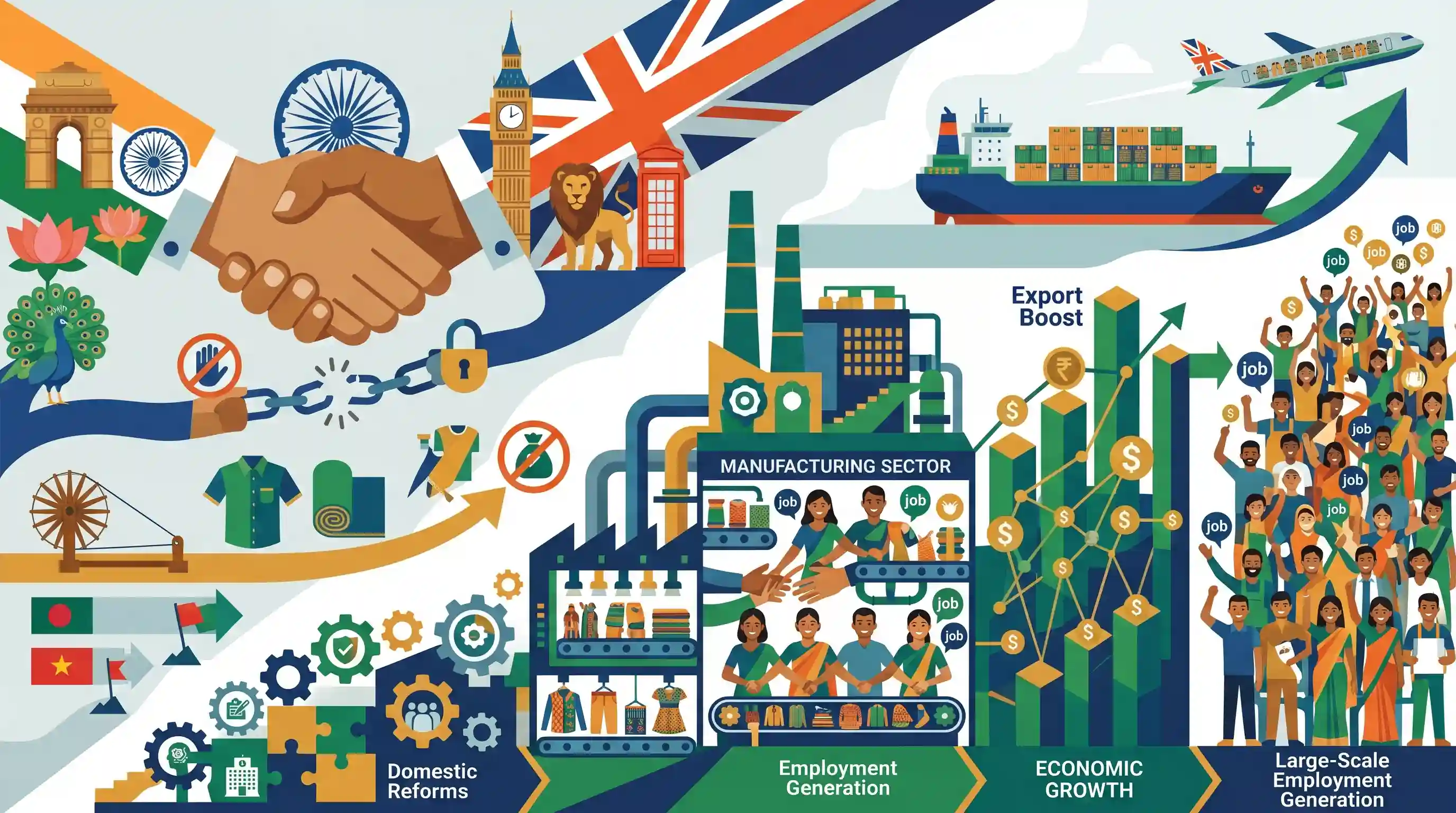
The article emphasizes the strategic importance of finalizing the Free Trade Agreement (FTA) with the UK to revitalize India's textile and apparel sector. By securing tariff concessions, Indian textile exporters can achieve a level playing field against competitors like Bangladesh and Vietnam, who currently enjoy preferential access. An export boost in textiles is crucial for realizing India's manufacturing potential, driving economic growth, and generating large-scale employment, given the highly labour-intensive nature of the industry. Leveraging trade agreements alongside domestic reforms is necessary to boost labour-intensive exports.
Key Points
- The proposed India-UK FTA presents a critical opportunity to enhance market access for Indian textile and apparel exports.
- Tariff reductions will help Indian exporters compete effectively against nations like Bangladesh and Vietnam that already benefit from preferential or duty-free market access to Western economies.
- The textile sector is a significant engine for labour-intensive job creation, particularly for women, making its growth essential for inclusive economic development.
- Aligning trade agreements with domestic initiatives like the PLI scheme is vital to overcoming structural bottlenecks and increasing the manufacturing sector's share in GDP.
Important Terms
India-UK Free Trade Agreement (FTA)

A bilateral trade pact reducing/eliminating tariffs on goods (notably textiles) and services to enhance economic cooperation and market access between India and the United Kingdom.
UPSC context
GS Paper 2 (IR) & Paper 3 (Economy); tests bilateral trade diplomacy and export competitiveness.
Production Linked Incentive (PLI) Scheme for Textiles
A fiscal initiative offering 4-15% incentives on incremental sales to boost domestic manufacturing of Man-Made Fiber (MMF) and technical textiles.
UPSC context
GS Paper 3 (Industrial Policy); tests strategies for manufacturing self-reliance and "Atmanirbhar Bharat."
PM MITRA Scheme
Mega-parks establishing integrated textile value chains (from spinning to garments) at single locations to reduce logistics costs via the "Farm to Foreign" (5F) vision.
UPSC context
GS Paper 3 (Infrastructure); tests sectoral infrastructure development and cooperative federalism in industrial policy.
Rules of Origin (RoO)
Legal criteria in trade agreements used to determine the "economic nationality" of a product, preventing third-party countries from unfairly exploiting preferential tariff rates.
UPSC context
GS Paper 3 (Economy); tests technical knowledge of trade barriers and anti-circumvention measures in FTAs.
Labour-Intensive Industry
Sectors requiring a high proportion of human labor relative to capital, such as apparel, making them vital for large-scale employment generation.
UPSC context
GS Paper 3 (Employment); central to debates on "jobless growth" and inclusive economic development.
RoDTEP Scheme
A WTO-compliant scheme that refunds embedded central, state, and local taxes/duties to Indian exporters to ensure global price competitiveness.
UPSC context
GS Paper 3 (Economy); tests export promotion mechanisms and fiscal support for trade.
Prelims Trap
The PLI scheme for textiles incentivizes production across all segments, including traditional cotton and jute.
The PLI for textiles is highly targeted; it exclusively applies to Man-Made Fibre (MMF) apparel, MMF fabrics, and technical textiles, explicitly excluding traditional cotton.
Static Concepts Connected
What is the "Rules of Origin" clause in Free Trade Agreements?
- Definition: Criteria used to determine the exact national source of a product for international trade purposes.
- Core purpose: Prevents non-partner countries (like China) from routing cheap goods through an FTA partner to exploit zero-duty benefits.
- Negotiation hurdle: A critical sticking point in India-UK negotiations to ensure only genuinely British or Indian goods receive tariff concessions.
What are Technical Textiles in India's industrial policy?
- Function over form: Textile products manufactured primarily for functional and technical performance rather than aesthetic or decorative characteristics.
- Key applications: Used extensively in infrastructure (geotextiles), healthcare (medical textiles like PPE), and agriculture (agro-textiles).
- Policy push: Heavily incentivized under both the ₹10,683-crore PLI scheme and the dedicated National Technical Textiles Mission (NTTM).
Cross-Topic Patterns
Bangladesh's impending LDC graduation
Bangladesh currently uses LDC status for duty-free access. Its upcoming graduation will revoke these perks, creating a critical window for Indian textiles to capture Western market share via FTAs.
Female LFPR and export manufacturing
With women making up 65% of the apparel workforce, reviving textile exports is structurally vital for improving India’s historically low Female Labour Force Participation Rate (FLFPR) in the formal sector.

Expect a GS3 Mains question linking FTA tariff concessions, the PLI scheme for MMF, and female labour force participation in manufacturing.
Linked PYQs · 3
Linked PYQs · 3
- 2017MainsGS3
Account for the failure of manufacturing sector in achieving the goal of labour-intensive exports. Suggest measures for more labour-intensive rather than capital-intensive exports.
- 2023MainsGS3
Faster economic growth requires increased share of the manufacturing sector in GDP, particularly of MSMEs. Comment on the present policies of the Government in this regard.
- 2025MainsGS3
Discuss the rationale of the Production Linked Incentive (PLI) scheme. What are its achievements? In what way can the functioning and outcomes of the scheme be improved?
