Electronics Export Competitiveness and Global Value Chains
Source:Indian Express ↗
Why It Matters
This article is critical for understanding the intersection of domestic industrial policy (Make in India, PLI) and international economic diplomacy (FTAs). It highlights structural bottlenecks in India's export ecosystem, which is a highly relevant theme for GS3 Economy and GS2 International Relations.
Summary
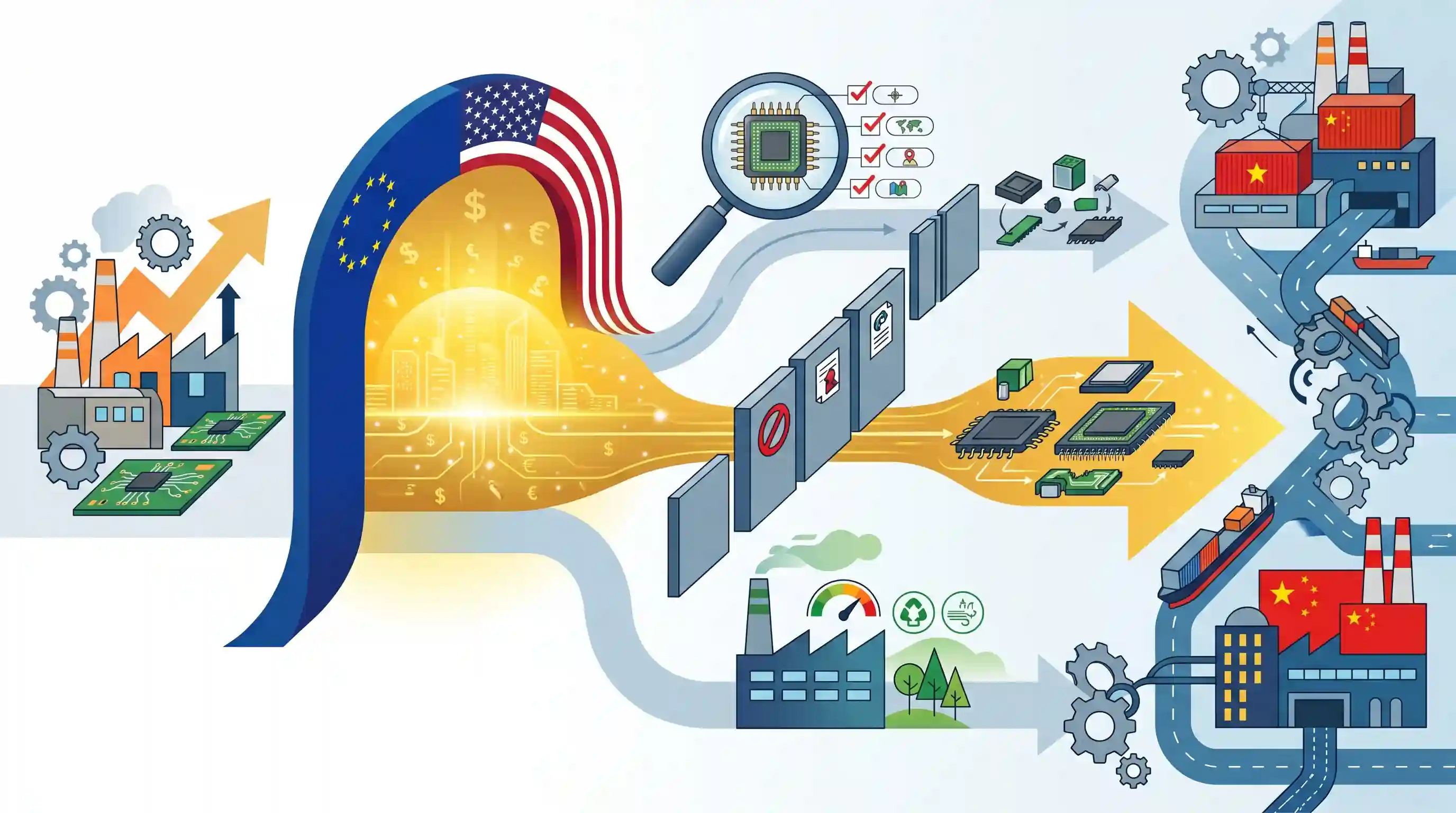
The article evaluates the potential of Free Trade Agreements (FTAs) with major markets like the EU and the US to significantly boost India's electronics exports, conceptually opening a $1 trillion economic window. However, capitalizing on this opportunity involves navigating critical caveats. While domestic initiatives like the PLI scheme have increased manufacturing capacity, Indian exporters face hurdles such as strict 'rules of origin', non-tariff barriers, and new environmental standards (like carbon taxes). Furthermore, India must transition from low-value assembly to deep-tier component manufacturing to effectively compete with entrenched global supply chain hubs like Vietnam and China.
Key Points
- India seeks to unlock a massive $1 trillion window for electronics exports by leveraging Free Trade Agreements (FTAs) with major global markets like the European Union and the United States.
- While schemes like Production Linked Incentive (PLI) have boosted domestic manufacturing, true integration into Global Value Chains (GVCs) requires a shift from mere final assembly to deeper domestic value addition and component manufacturing.
- Significant caveats to this export potential include stringent 'Rules of Origin' clauses, non-tariff barriers, and emerging compliance standards such as environmental taxes (like the EU's CBAM) and labor regulations.
- To fully capitalize on the 'China Plus One' strategy, India must navigate intense competition from established manufacturing alternatives like Vietnam and Malaysia, which already boast highly integrated electronics ecosystems.
Important Terms
Free Trade Agreements (FTAs)

Formal pacts between two or more nations to reduce or eliminate tariffs and non-tariff barriers on goods and services, fostering economic integration.
UPSC context
GS II (International Relations) & GS III (Economy); relevant for trade policy, market access, and global supply chain integration.
Production Linked Incentive (PLI) Scheme
A performance-linked incentive strategy providing financial rewards to companies based on incremental sales from products manufactured in domestic units to boost manufacturing.
UPSC context
GS III (Economy); tests knowledge of industrial policy, import substitution, and the Atmanirbhar Bharat initiative.
Carbon Border Adjustment Mechanism (CBAM)
An EU mechanism imposing carbon prices on imported goods (like steel and cement) to match costs paid by domestic producers, preventing carbon leakage.
UPSC context
GS II & III (IR/Economy/Environment); tests understanding of non-tariff barriers and climate-linked trade policies impacting Indian exports.
Information Technology Agreement (ITA)
A WTO plurilateral agreement aimed at eliminating all import duties and other charges on a wide range of information technology products.
UPSC context
GS II & III (IR/Economy); covers digital trade rules and their impact on India’s hardware manufacturing competitiveness.
World Trade Organization (WTO)
The only global international organization dealing with the rules of trade between nations, ensuring trade flows smoothly, predictably, and freely.
UPSC context
GS II (IR) & GS III (Economy); essential for understanding multilateralism, rules-based trade, and dispute settlement mechanisms.
Prelims Trap
"Any electronic product assembled in India automatically qualifies for preferential tariffs under its FTAs."
FTAs contain strict 'Rules of Origin' clauses. Simple assembly of imported components does not meet the 'substantial transformation' threshold required for duty-free access.
Static Concepts Connected
What are 'Rules of Origin' and why are they critical in FTAs?
- Definition: The criteria needed to determine the national economic source of a product, ensuring it qualifies for preferential trade tariffs.
- Purpose: Prevents 'trade deflection' where a non-FTA country (like China) routes its goods through an FTA member to evade duties.
- Substantial Transformation: For FTA benefits, simple assembly isn't enough; the product must undergo substantial transformation or meet specific domestic value-addition thresholds.
What is the difference between Tariffs and Non-Tariff Barriers (NTBs)?
- Tariffs: Direct customs duties or taxes levied on imported goods to make them more expensive and protect domestic industries.
- Non-Tariff Barriers: Indirect trade restrictions such as import quotas, sanitary standards, embargoes, or environmental regulations (e.g., carbon taxes).
- WTO Stance: While tariffs are bound and progressively reduced under WTO rules, NTBs are harder to regulate and often used as disguised protectionism.
Cross-Topic Patterns
PLI Schemes vs. Global Value Chains
PLI success heavily relies on importing cheap components for assembly, but securing FTA benefits requires deep domestic value addition (Rules of Origin), creating a structural policy paradox.
Climate Norms as Trade Barriers
Environmental regulations like the EU's Carbon Border Adjustment Mechanism (CBAM) are increasingly functioning as non-tariff barriers, fusing ecology with international trade and impacting developing world exports.

Expect a 2026 multi-statement Prelims question interlinking PLI-driven assembly, Rules of Origin under FTAs, and CBAM as a trade barrier.
Linked PYQs · 3
Linked PYQs · 3
- 2025MainsGS3
Discuss the rationale of the Production Linked Incentive (PLI) scheme. What are its achievements? In what way can the functioning and outcomes of the scheme be improved?
- 2014MainsGS2
The aim of Information Technology Agreements (ITAs) is to lower all taxes and tariffs on information technology products by signatories to zero. What impact would such agreements have on India's interests?
- 2020PrelimsGS1
With reference to Trade-Related Investment Measures (TRIMS), which of the following statements is/are correct? 1. Quantitative restrictions on imports by foreign investors are prohibited. 2. They apply to investment measures related to trade in both goods and services. 3. They are not concerned with the regulation of foreign investment. Select the correct answer using the code given below:
