FSSAI Nationwide Inspection Drive and Food Safety Enforcement
Source:The Hindu ↗
Why It Matters
This article highlights critical regulatory enforcement actions by the FSSAI against food adulteration, directly tying into GS3 syllabus components regarding food processing, supply chain management, and regulatory frameworks for consumer safety.
Summary
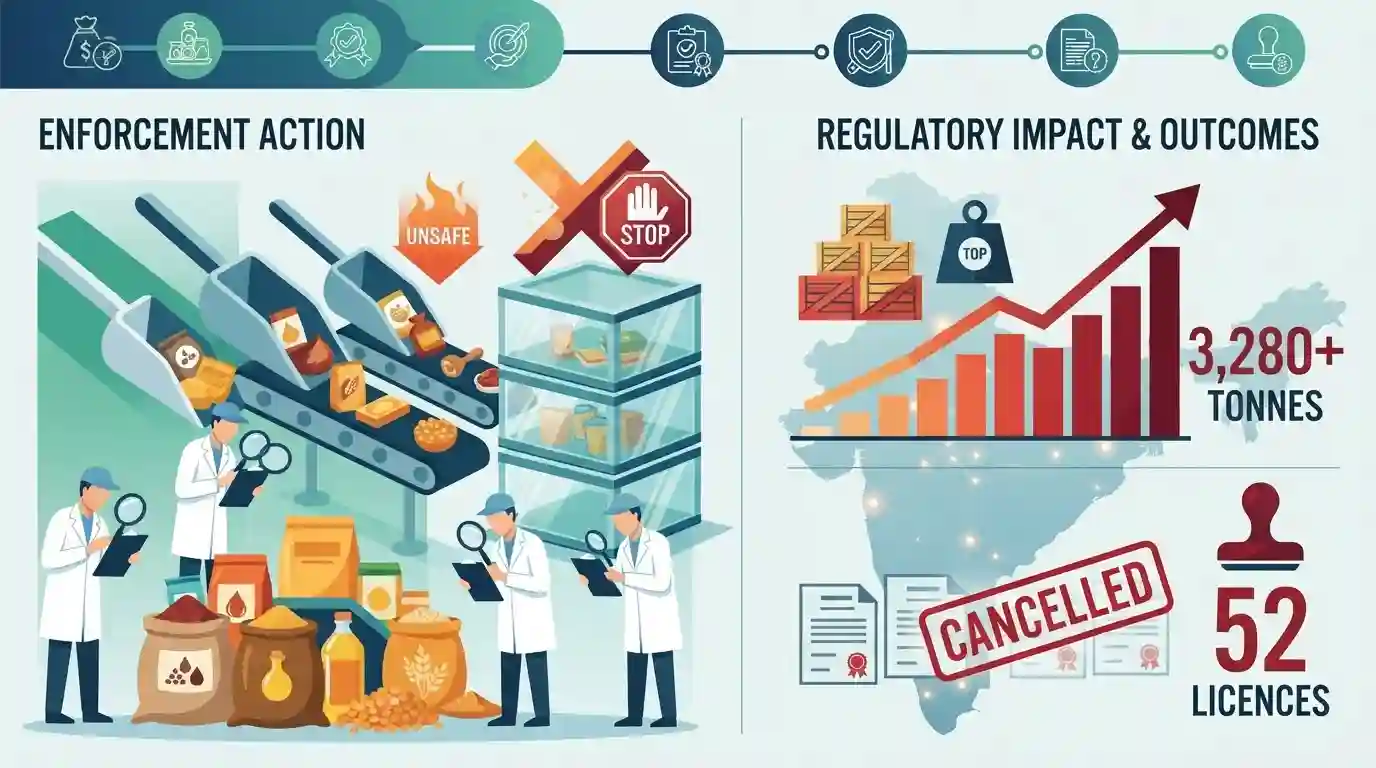
A nationwide inspection drive by the Food Safety and Standards Authority of India (FSSAI) resulted in the seizure of over 3,280 tonnes of unsafe food items and the cancellation of 52 licences. The enforcement action underscores ongoing challenges in food adulteration, regulatory monitoring, and consumer health protection within India's food sector.
Key Points
- FSSAI conducted a nationwide inspection drive targeting food safety and quality compliance.
- Authorities seized 3,280 tonnes of unsafe and adulterated food items across various states.
- 52 food business operator licences were cancelled and numerous legal notices and enforcements were initiated.
- Highlights systemic challenges in food safety enforcement, consumer health protection, and regulatory compliance in India's food processing and distribution sectors.
Important Terms
Food Safety and Standards Act 2006

A comprehensive central legislation enacted in 2006 to consolidate various food laws, establish science-based standards, and regulate the manufacturing, storage, distribution, and sale of food products across India.
UPSC context
GS Paper III (Food Processing, Regulatory Framework); tests candidate knowledge of India's food safety laws and consumer protection architecture.
Food Safety and Standards Authority of India (FSSAI)
The apex statutory regulatory body established under the Ministry of Health and Family Welfare to lay down science-based standards for food articles and regulate their manufacturing, storage, distribution, and sale.
UPSC context
GS Paper II/III (Statutory Bodies, Consumer Protection); tests understanding of regulatory enforcement, food safety, and public health governance.
Prelims Trap
FSSAI functions under the administrative control of the Ministry of Consumer Affairs, Food and Public Distribution.
Aspirants often confuse FSSAI as being under the Ministry of Consumer Affairs, Food and Public Distribution, whereas it operates under the Ministry of Health and Family Welfare.
Static Concepts Connected
What are the key structural and statutory features of the FSSAI under the Food Safety and Standards Act, 2006?
- Statutory Origin: Statutory status created under the Food Safety and Standards Act, 2006, consolidating various acts like the Prevention of Food Adulteration Act, 1954.
- Nodal Ministry: Functions under the administrative control of the Ministry of Health and Family Welfare, Government of India.
- Core Mandate: Lays down science-based standards for articles of food and regulates manufacturing, storage, distribution, sale, and import to ensure safety.
- FBO Licensing: Mandates licensing and registration for all Food Business Operators (FBOs) to maintain traceability and quality accountability across supply chains.
Cross-Topic Patterns
Food Adulteration & Consumer Welfare Linkages
Large-scale seizure of unsafe food exposes regulatory bottlenecks in supply chains, bridging consumer protection under the Consumer Protection Act with agricultural marketing and cold-chain infrastructure gaps.

FSSAI powers under the Food Safety and Standards Act 2006 (statutory status, nodal ministry) are a frequent prelims matching target.
Linked PYQs · 2
Linked PYQs · 2
- 2022MainsGS3
Elaborate the scope and significance of the food processing industry in India.
- 2018PrelimsGS1
Consider the following statements: 1. The Food Safety and Standards Act, 2006 replaced the Prevention of Food Adulteration Act, 1954. 2. The Food Safety and Standards Authority of India (FSSAI) is under the charge of Director General of Health Services in the Union Ministry of Health and Family Welfare. Which of the statements given above is/are correct?
