FSSAI Crackdown on Misleading Food Claims and Regulatory Compliance
Source:The Hindu ↗
কেন এটি গুরুত্বপূর্ণ
Understanding the role of FSSAI and its enforcement mechanisms is crucial for GS Paper 2 (Statutory, Regulatory and various Quasi-judicial Bodies). It also relates to consumer protection and public health governance, frequently tested in UPSC regarding the regulation of the food industry and deceptive marketing.
সারসংক্ষেপ
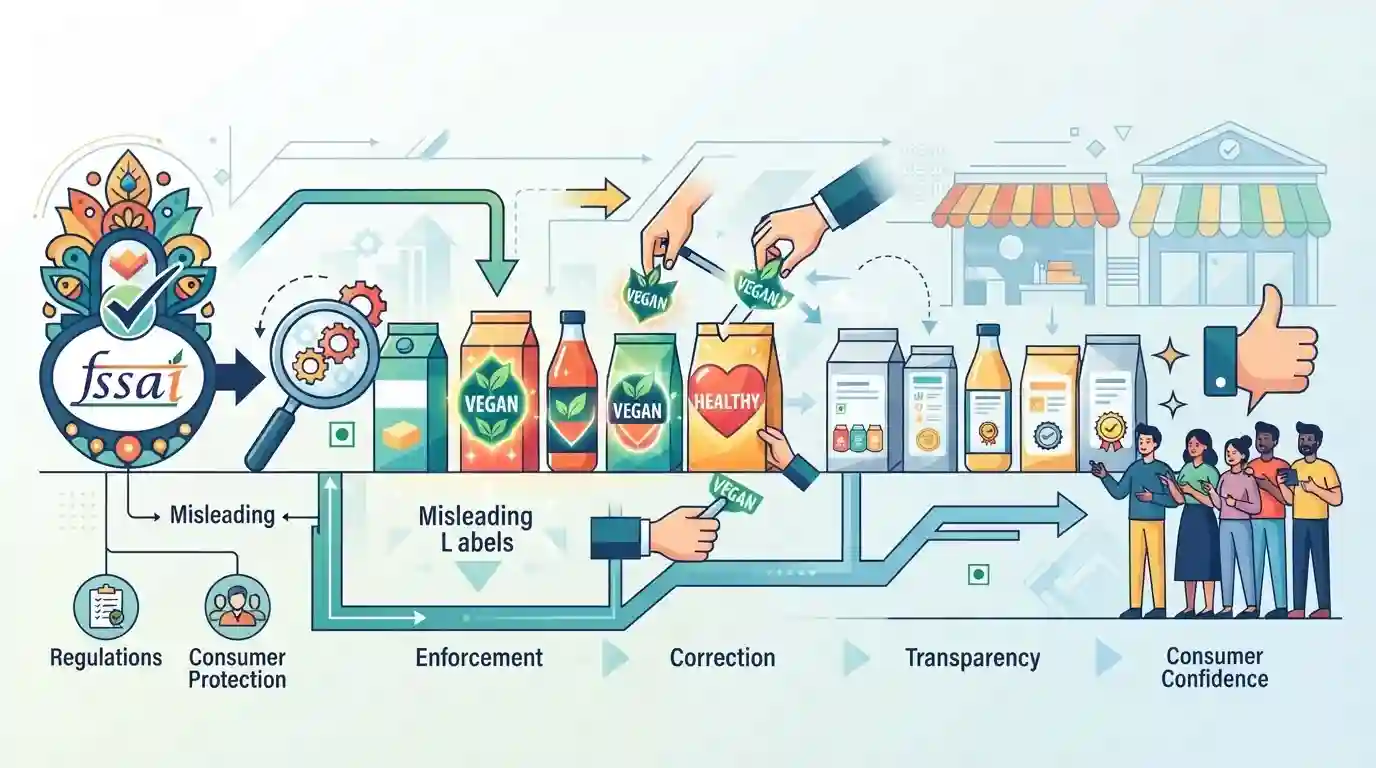
The Food Safety and Standards Authority of India (FSSAI) has successfully compelled six food companies to rectify misleading claims and trade marks on their product packaging. Following a regulatory crackdown, these companies withdrew unsubstantiated labels such as "vegan" and "healthy" to comply with food safety standards. This enforcement action underscores FSSAI's mandate to protect consumer rights, ensure transparency in food labeling, and prevent deceptive marketing within the food industry.
মূল বিষয়
- The Food Safety and Standards Authority of India (FSSAI) took strict action against six food business operators for printing misleading claims and trade marks on their labels.
- The companies rectified their packaging by withdrawing unsupported claims such as "vegan" and "healthy".
- The crackdown highlights FSSAI's commitment to enforcing food safety regulations and preventing deceptive marketing practices.
- The move is aimed at empowering consumers to make informed choices and ensuring that food labels comply with statutory standards.
গুরুত্বপূর্ণ শব্দ
Food Safety and Standards Authority of India (FSSAI)

A statutory body established under the Ministry of Health and Family Welfare, responsible for protecting and promoting public health through the regulation and supervision of food safety in India.
UPSC context
GS Paper 2 (Statutory Bodies) & GS Paper 3 (Food Security). Tests knowledge of India's regulatory framework, quality standards, and consumer protection mechanisms.
Livyor Ventures Pvt. Ltd.
A food business operator cited by FSSAI for unsubstantiated 'vegan' and 'healthy' claims on its edamame beans, illustrating regulatory action against deceptive front-of-pack labeling.
UPSC context
GS Paper 2 (Consumer Protection) & GS Paper 3 (Food Safety). Exemplifies corporate accountability and regulatory enforcement against misleading marketing in India.
Honest Innovations For You Pvt. Ltd.
An Indian food enterprise compelled by the FSSAI to revise its trademarks, demonstrating the regulator's proactive enforcement against branding that creates a misleading impression of health benefits.
UPSC context
GS Paper 3 (Food Processing & Safety). Relevant as a case study for evaluating the effectiveness of statutory bodies in curbing deceptive food marketing.
Iota Nanotechnology Pvt. Ltd.
A company that removed misleading product claims and halted the production of non-standardized water following FSSAI notices, reflecting stricter compliance enforcement in the packaged food sector.
UPSC context
GS Paper 3 (Food Safety). Demonstrates enforcement actions by national food regulators to ensure standard compliance and protect consumers from false nutritional claims.
প্রিলিমস ফাঁদ
"FSSAI is a statutory body under the Ministry of Consumer Affairs, Food and Public Distribution."
FSSAI functions under the Ministry of Health and Family Welfare, not the Ministry of Consumer Affairs, which is a frequent misconception given its consumer-facing regulatory role.
সংযুক্ত স্থির ধারণা
What is the statutory backing and mandate of FSSAI?
- Statutory Basis: Established under the Food Safety and Standards Act, 2006, replacing older laws like the Prevention of Food Adulteration Act, 1954.
- Nodal Ministry: Operates under the administrative control of the Ministry of Health and Family Welfare.
- Core Mandate: Lays down science-based standards for food items and regulates their manufacture, storage, distribution, sale, and import.
How are misleading food advertisements regulated in India?
- FSSAI Regulations: FSS (Advertisements and Claims) Regulations, 2018 prohibit FBOs from using deceptive or unscientific health claims without empirical substantiation.
- CCPA Jurisdiction: The Central Consumer Protection Authority (under CPA 2019) has concurrent jurisdiction to penalize brands for misleading advertisements and unfair trade practices.
আন্তঃবিষয় প্যাটার্ন
Trademarks vs. Food Safety Standards
The use of deceptive trademarks in food packaging intersects with IP laws, demonstrating that a registered trademark cannot override statutory food safety and mandatory labeling requirements.
Vegan Labeling and Climate Action
The strict 2022 FSSAI definition for 'vegan food' aligns with global shifts toward plant-based diets, a recurring theme in environmental discussions around agricultural emissions and sustainable food systems.

Expect a multi-statement question testing the overlapping jurisdiction of FSSAI's labeling rules and CCPA over misleading ads.
সংযুক্ত PYQ · 1
সংযুক্ত PYQ · 1
- 2018PrelimsGS1
Consider the following statements: 1. The Food Safety and Standards Act, 2006 replaced the Prevention of Food Adulteration Act, 1954. 2. The Food Safety and Standards Authority of India (FSSAI) is under the charge of Director General of Health Services in the Union Ministry of Health and Family Welfare. Which of the statements given above is/are correct?
