FSSAI Front of Pack Food Labelling and Health Warnings
Source:Indian Express ↗
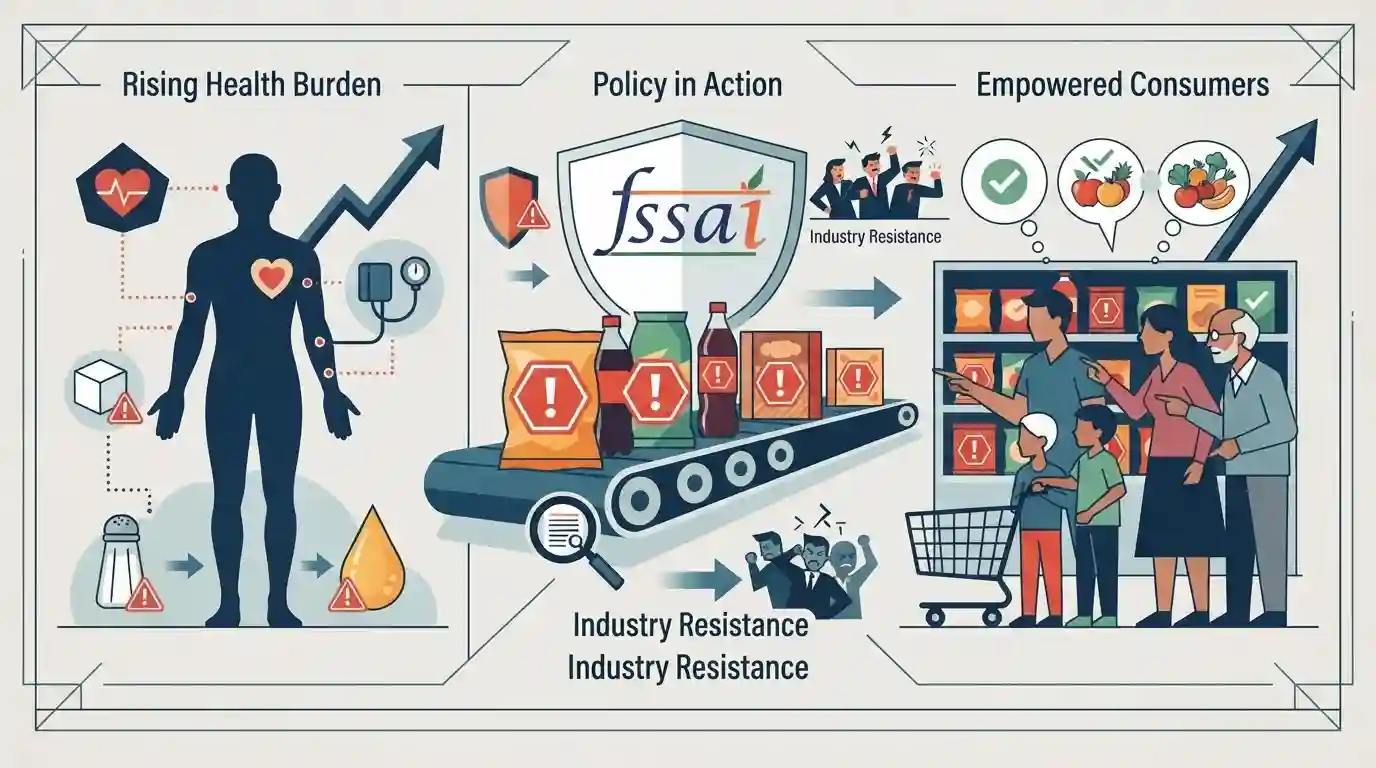
Why It Matters
It addresses critical issues of food safety regulation, public health policy, and consumer rights in the context of rising non-communicable diseases, directly aligning with GS2 syllabus requirements on health and statutory regulatory bodies.
Summary
The editorial examines the significance of FSSAI's front-of-pack food labelling (FoPL) policies, focusing on the proposed red hexagon warning signs for unhealthy packaged foods high in fat, sugar, and salt. It highlights the rising burden of non-communicable diseases in India, the necessity of overcoming industry resistance, and the imperative to empower consumers with clear, accessible nutritional information for better public health outcomes.
Key Points
- The editorial discusses the Food Safety and Standards Authority of India's (FSSAI) proposed front-of-pack food labelling (FoPL) rules, specifically advocating for warning labels like a red hexagon to highlight high fat, sugar, and salt (HFSS) content.
- Rising non-communicable diseases (NCDs) like obesity, diabetes, and hypertension in India necessitate transparent, easily comprehensible consumer information to curb the consumption of ultra-processed foods.
- Industry pushback often delays strict labeling norms; however, effective public health governance demands prioritizing consumer right-to-know and preventive healthcare over commercial interests.
- Clear warning labels help bridge information asymmetries in the packaged food market, enabling informed dietary choices at a glance.
Important Terms
Food Safety and Standards Authority of India (FSSAI)

An apex statutory body established under the Ministry of Health and Family Welfare to lay down science-based standards for food articles and regulate their manufacture, storage, distribution, sale, and import in India.
UPSC context
UPSC Prelims/Mains (GS Paper II/III): Important statutory bodies, food security governance, and public health policy frameworks in India.
Food Safety and Standards Act 2006
Landmark legislation enacted in 2006 to consolidate various central food laws, establish a unified single reference point for food safety, and create the FSSAI to regulate the entire food chain.
UPSC context
UPSC Mains (GS Paper III): Key legislation related to agriculture, food processing industries, regulatory mechanisms, and consumer protection in India.
Static Concepts Connected
What are the core mandates and structural setup of the FSSAI under the Food Safety and Standards Act, 2006?
- Statutory Origin: Statutory body established under the Food Safety and Standards Act, 2006, consolidating various acts and orders handling food safety.
- Parent Ministry: Operates under the administrative control of the Ministry of Health and Family Welfare.
- Core Mandate: Mandated to lay down science-based standards for articles of food and to regulate their manufacture, storage, distribution, sale, and import.
Cross-Topic Patterns
Food Labelling + Fiscal Health Cesses
Rising NCD burdens intersect with fiscal policy when sugary/fatty foods are evaluated for public health-driven sin taxes or health cess.
Right to Health + Statutory Regulation
Judicial activism invoking the Right to Health (Article 21) increasingly drives administrative standard-setting in independent statutory bodies like FSSAI.

FSSAI front-of-pack warnings, ICMR-NIN guidelines, and Right to Health (Article 21) will be tested via multi-statement prelims.
Linked PYQs · 2
Linked PYQs · 2
- 2018PrelimsGS1
Consider the following statements: 1. The Food Safety and Standards Act, 2006 replaced the Prevention of Food Adulteration Act, 1954. 2. The Food Safety and Standards Authority of India (FSSAI) is under the charge of Director General of Health Services in the Union Ministry of Health and Family Welfare. Which of the statements given above is/are correct?
- 2024MainsGS2
In a crucial domain like the public healthcare system the Indian State should play a vital role to contain the adverse impact of marketisation of the system. Suggest some measures through which the State can enhance the reach of public healthcare at the grassroots level.
