Centre Urged to Address Ladakh Political and Ecological Demands
Source:Indian Express ↗
Why It Matters
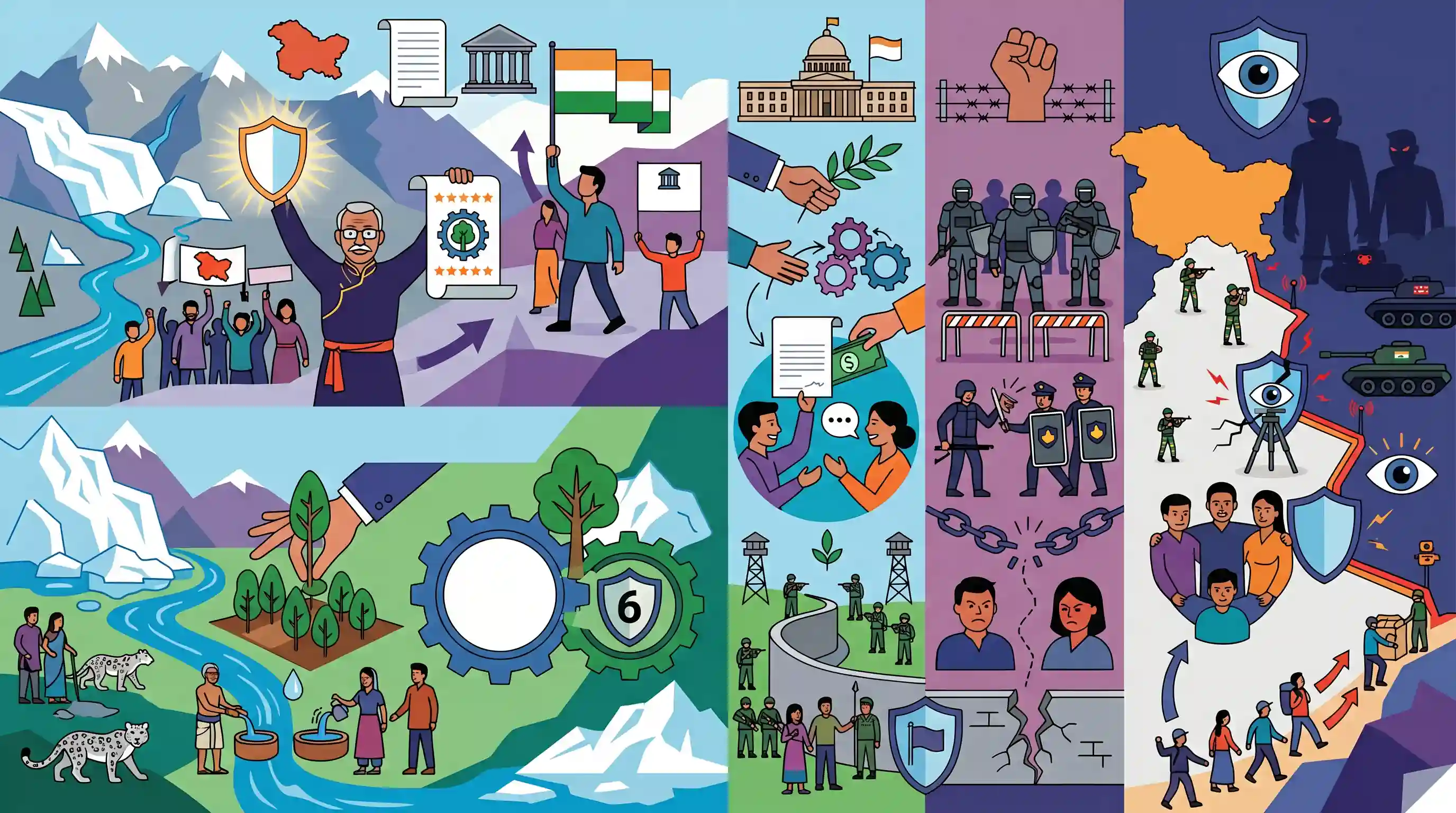
The issue perfectly intertwines Constitutional provisions (Sixth Schedule, UT vs. Statehood) with national security (border management against China) and environmental ethics (fragile Himalayan ecosystem), making it a prime multidimensional case study for GS2 and GS3.
Summary
The article highlights the ongoing political unrest in Ladakh, where locals, led by figures like Sonam Wangchuk, are demanding statehood and inclusion in the Sixth Schedule of the Constitution. The author emphasizes that Ladakh is a strategically critical and environmentally fragile frontier. Consequently, the Centre's response to these protests must be empathetic and imaginative rather than heavy-handed. Alienating a historically loyal population could prove detrimental to India's border security and strategic interests vis-à-vis China. Empowering local communities through constitutional safeguards is presented as a necessary step for both ecological preservation and effective border management.
Key Points
- Protests in Ladakh, led by figures like Sonam Wangchuk, are rooted in demands for statehood and constitutional safeguards under the Sixth Schedule.
- Ladakh is an environmentally fragile region and a strategically vital frontier bordering China, requiring specialized attention.
- The local population has historically been loyal and cooperative with security forces; alienating them through heavy-handed tactics undermines national security.
- The Centre must handle these political and ecological anxieties with empathy and imagination, as empowering local communities aids both environmental conservation and border management.
Important Terms
Sixth Schedule of the Indian Constitution

Provisions under Articles 244(2) and 275(1) for administering tribal areas in Northeast India through Autonomous District Councils (ADCs) with legislative, executive, and judicial powers.
UPSC context
GS II (Polity) and GS III (Internal Security). Tests knowledge of tribal governance and regional autonomy.
Ladakh Autonomous Hill Development Council (LAHDC)
Local governing bodies in Leh and Kargil created to provide administrative autonomy. They manage development and land but currently lack the legislative powers granted to Sixth Schedule councils.
UPSC context
GS II (Governance). Relevant for democratic decentralization and local self-government in sensitive regions.
Article 371
Provisions (371A–J) offering special safeguards for land, culture, and employment in specific states. The Centre proposed this as an alternative to Ladakh's Sixth Schedule demand.
UPSC context
GS II (Polity). Tests understanding of asymmetrical federalism and special constitutional protections for diverse regions.
Statehood
The status of a constituent unit of the Indian Union with its own elected legislature. Ladakh demands this to regain political representation lost post-2019.
UPSC context
GS II (Federalism). Pertains to the reorganization of states and the federal distribution of power.
Border Management
Strategically securing national boundaries through infrastructure, surveillance, and community engagement. In Ladakh, it involves managing tensions along the Line of Actual Control (LAC).
UPSC context
GS III (Internal Security). Focuses on national security challenges in disputed frontier regions.
Ecologically Fragile Zone
Sensitive regions like the Himalayas where biodiversity and ecosystems are highly vulnerable to climate change, tourism, and rapid infrastructure development.
UPSC context
GS III (Environment). Tests knowledge of sustainable development and conservation in high-altitude frontiers.
Prelims Trap
Ladakh's existing Autonomous Hill Development Councils (LAHDCs) derive their powers directly from the Sixth Schedule of the Constitution.
LAHDCs operate under local statutes (J&K LAHDC Act, 1995), not the Constitution. The Sixth Schedule currently applies exclusively to Assam, Meghalaya, Tripura, and Mizoram.
Static Concepts Connected
How do Sixth Schedule ADCs differ from Fifth Schedule advisory bodies?
- Legislative powers: Sixth Schedule ADCs can make laws on land, forests, and customs. Fifth Schedule Tribes Advisory Councils (TACs) are merely advisory to the state government.
- Judicial powers: Sixth Schedule ADCs can constitute village courts to try cases involving tribes, whereas Fifth Schedule areas do not grant such specialized judicial autonomy.
- Geographic scope: The Sixth Schedule applies strictly to Assam, Meghalaya, Tripura, and Mizoram (AMTM). The Fifth Schedule covers Scheduled Areas in the rest of India.
What is the strategic role of civilian populations in border management?
- Human Intelligence: Nomadic grazers like the Changpas in Ladakh act as the 'eyes and ears', providing early detection of incursions along the un-demarcated LAC.
- Countering Xiaokang: Sustaining thriving border villages prevents demographic vacuums, effectively countering China's aggressive establishment of dual-use 'Xiaokang' (well-off) border defense villages.
Cross-Topic Patterns
Constitutional shields for fragile ecology
Using tribal land protections (Sixth Schedule) to restrict commercial exploitation of a cold desert ecosystem. This mirrors debates around Forest Rights Act implementation and mining in Central India.
Internal alienation vs. border security
Alienating frontier populations undermines localized intelligence. The 'first line of defense' concept links GS2 federal grievances directly to GS3 border management challenges against China.

Expect a 2026 Prelims question comparing powers of 5th/6th Schedule ADCs with LAHDCs, or a Mains GS3 question on border infra vs ecology.
Linked PYQs · 4
Linked PYQs · 4
- 2022MainsGS2
“While the national political parties in India favour centralisation, the regional parties are in favour of State autonomy.” Comment.
- 2024MainsGS3
India has a long and troubled border with China and Pakistan fraught with contentious issues. Examine the conflicting issues and security challenges along the border. Also give out the development being undertaken in these areas under the Border Area Development Programme (BADP) and Border Infrastructure and Management (BIM) Scheme.
- 2015PrelimsGS1
The provisions in Fifth Schedule and Sixth Schedule in the Constitution of India are made in order to
- 2017MainsGS3
'Climate change' is a global problem. How India will be affected by climate change? How Himalayan and coastal states of India will be affected by climate change?
