FSSAI proposes single-phase food nutritional labelling rollout
Source:The Hindu ↗
ఇది ఎందుకు ముఖ్యం
It highlights the enforcement of public health regulations, the role of statutory regulatory bodies like FSSAI in consumer protection, and judicial oversight in expediting critical health policy rollouts.
సారాంశం
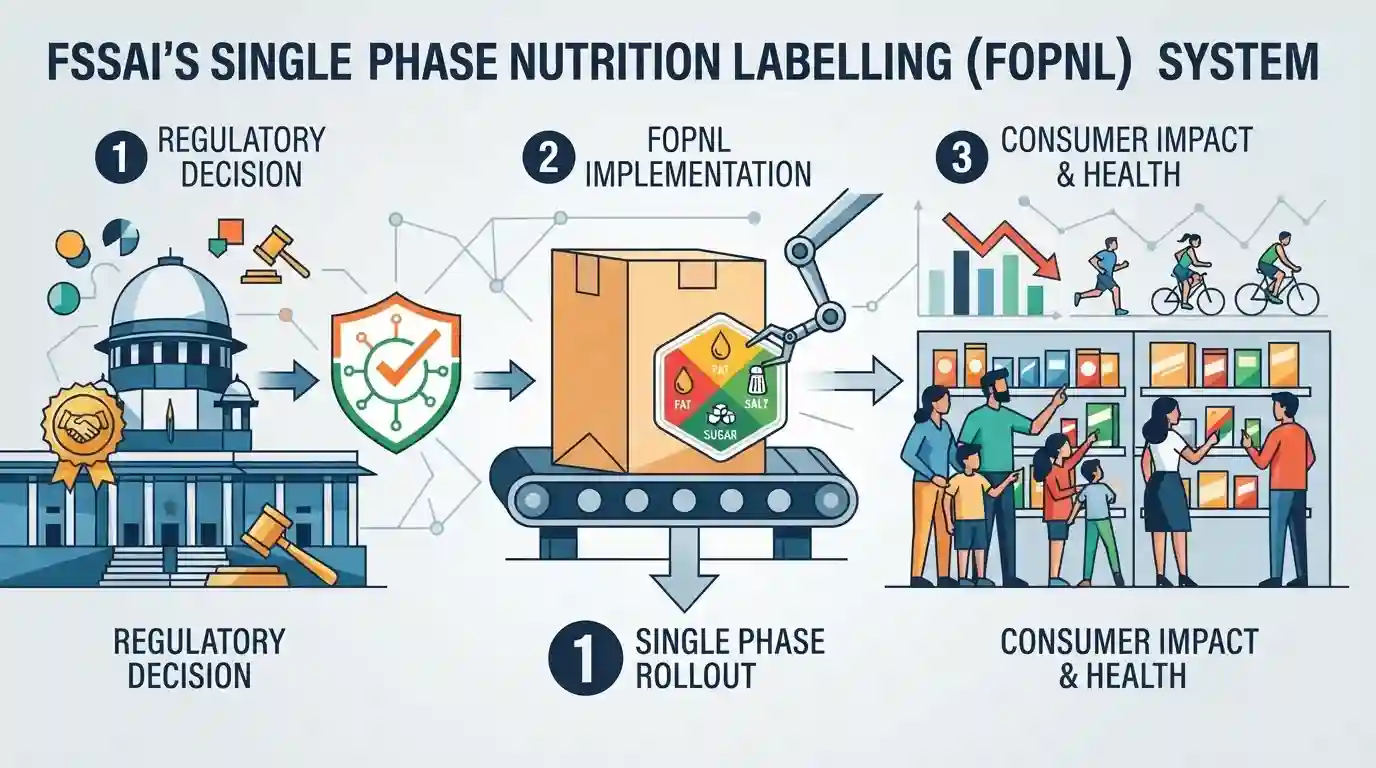
The FSSAI has informed the Supreme Court that its proposed Front-of-Pack Nutrition Labelling (FOPNL) system for packaged foods will be rolled out in a single phase. The policy is designed to combat lifestyle diseases by enabling consumers to easily identify high fat, sugar, and salt content on food packaging.
ముఖ్య అంశాలు
- The Food Safety and Standards Authority of India (FSSAI) informed the Supreme Court that the Front-of-Pack Nutrition Labelling (FOPNL) system will be implemented in a single phase rather than multiple phases.
- FOPNL aims to help consumers quickly identify packaged foods high in fat, sugar, and salt (HFSS) to combat rising rates of lifestyle diseases and obesity.
- The single-phase rollout ensures nation-wide uniform compliance without giving staggered timelines to different segments of the food industry.
- This regulatory move aligns with judicial push for stronger public health safeguards and consumer information transparency.
ముఖ్యమైన పదాలు
Food Safety and Standards Authority of India (FSSAI)

An apex statutory body established under the Ministry of Health and Family Welfare to lay down science-based standards for food articles and regulate their manufacturing, storage, distribution, sale, and import.
UPSC context
UPSC Prelims/Mains (GS Paper II - Governance/Health): Tests knowledge of statutory bodies, regulatory mechanisms, and food safety policies in India.
Food Safety and Standards Act 2006
Comprehensive legislation that consolidated multiple archaic food laws into a single framework, establishing FSSAI and laying down the legal basis for food safety governance and standards in India.
UPSC context
UPSC Prelims/Mains (GS Paper II - Polity & Governance): Important for questions on statutory acts, public welfare regulations, and administrative law.
Supreme Court of India
The highest judicial forum of India under the Constitution, tasked with constitutional interpretation, judicial review, and ensuring fundamental rights, frequently intervening in public health and regulatory delays.
UPSC context
UPSC Prelims/Mains (GS Paper II - Indian Constitution & Polity): Tests understanding of judicial activism, public interest litigation (PIL), and institutional checks.
అనుసంధానమైన స్థిర భావనలు
What is the statutory framework and governing structure of the Food Safety and Standards Authority of India (FSSAI)?
- Statutory Basis: Statutory Body established under the Food Safety and Standards Act, 2006, under the Ministry of Health and Family Welfare.
- Consolidation: Consolidates multiple Acts and orders (like Prevention of Food Adulteration Act, 1954) that handled food safety across various ministries earlier.
- Composition: Headquartered in New Delhi, headed by a Chairperson and a Chief Executive Officer, with a 22-member scientific panel.
అంతర-అంశ నమూనాలు
Food Labelling + WTO Technical Barriers
FSSAI regulations intersect with WTO TBT (Technical Barriers to Trade) agreements when mandatory labelling norms are challenged as non-tariff barriers by trading partners.
Public Health Policy + Fiscal Burden of NCDs
Rising lifestyle diseases and high out-of-pocket expenditure on NCDs link food regulatory policy directly to national health security and fiscal management.

FSSAI statutory powers + FOPNL single-phase implementation mechanics could feature in a statement-based prelims question.
అనుసంధాన PYQలు · 1
అనుసంధాన PYQలు · 1
- 2018PrelimsGS1
Consider the following statements: 1. The Food Safety and Standards Act, 2006 replaced the Prevention of Food Adulteration Act, 1954. 2. The Food Safety and Standards Authority of India (FSSAI) is under the charge of Director General of Health Services in the Union Ministry of Health and Family Welfare. Which of the statements given above is/are correct?
