FSSAI Front of Package Labelling and Public Health Regulation
Source:The Hindu ↗
Why It Matters
Provides crucial insights into the regulation of the food industry, public health challenges (non-communicable diseases), and the role of statutory bodies like FSSAI. It is highly relevant for GS Paper 2 (Health & Governance) and GS Paper 3 (Food Processing).
Summary
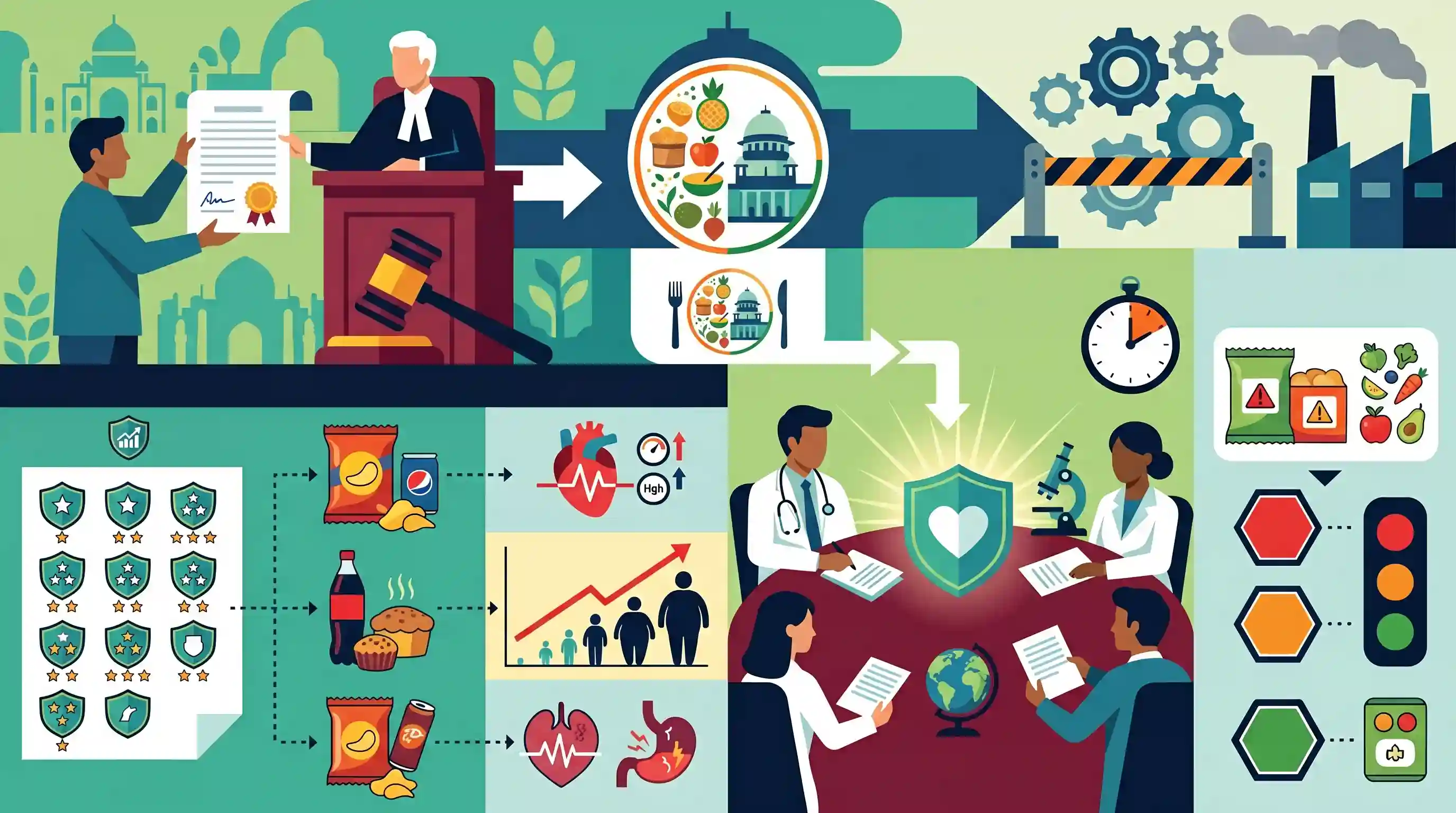
The Supreme Court of India has ordered the Food Safety and Standards Authority of India (FSSAI) to determine the implementation of front-of-package labelling (FOPL) on packaged foods within the next year. This follows a public interest petition advocating for mandatory warning labels on products high in sugar, salt, and saturated fats to combat rising non-communicable diseases. An ICMR study highlights a severe health crisis, indicating alarming rates of diabetes, hypertension, and obesity in India. The petitioners contested FSSAI's earlier 'Indian Nutrition Rating' system, arguing it obscured critical health warnings through a star-rating algorithm. A recently constituted expert committee will now draft the FOPL guidelines, tasked with prioritizing public health over industry resistance.
Key Points
- The Supreme Court has directed the Food Safety and Standards Authority of India (FSSAI) to take a decision on front-of-package labelling (FOPL) for packaged foods within a year.
- A public interest litigation requested mandatory warning labels on packaged foods high in sugar, salt, and saturated fat to enable informed consumer choices.
- The 2023 ICMR-INDIAB study reveals a looming public health crisis in India, with 101 million suffering from diabetes, 315 million from hypertension, and 254 million with abdominal obesity.
- The petitioner criticized FSSAI's proposed 'Indian Nutrition Rating' model, arguing that star ratings derived via complex algorithms are misleading and do not provide clear health warnings as per globally accepted standards.
- FSSAI has formed a 10-member expert committee in 2024 to formulate a new FOPL draft, which must now balance industry concerns with critical public health outcomes.
Important Terms
Indian Nutrition Rating

A proposed front-of-package labelling (FOPL) system in India assigning star ratings (0.5 to 5) to packaged foods based on an algorithm evaluating sugar, salt, fats, and positive nutrients.
UPSC context
GS Paper II (Regulatory Bodies) & GS Paper III (Food Processing/Health); tests understanding of food labelling controversies and health regulations.
Food Safety and Standards Authority of India (FSSAI)
The apex statutory body under the Ministry of Health and Family Welfare responsible for setting science-based food standards and regulating the manufacture, storage, and sale of food.
UPSC context
GS Paper II (Statutory Bodies) & GS Paper III (Food Processing Industry); central to questions on food safety and public health governance.
Food Safety and Standards Act, 2006
The primary legislation in India that consolidated various food laws to ensure the availability of safe and wholesome food, establishing the FSSAI as its regulatory authority.
UPSC context
GS Paper II (Government Policies & Interventions); tests knowledge of the legal framework governing food safety and consumer protection.
Indian Council of Medical Research (ICMR)
India's premier biomedical research organization (under MoHFW) that formulates, coordinates, and promotes medical research, including critical studies on non-communicable diseases and nutritional standards.
UPSC context
GS Paper II (Health) & GS Paper III (Science & Tech); relevant for disease burden evidence and public health research infrastructure.
3S and Our Health Society
A public charitable trust and non-profit organization that filed the Public Interest Litigation (PIL) seeking mandatory front-of-package warning labels on high-sugar, salt, and fat foods.
UPSC context
GS Paper II (Judiciary/NGOs); illustrates the role of civil society and PILs in shaping public health policy and regulatory accountability.
Prelims Trap
"FSSAI operates under the Ministry of Consumer Affairs or Ministry of Food Processing Industries."
FSSAI is a statutory body under the Ministry of Health and Family Welfare, not Consumer Affairs. Aspirants often misattribute it due to its consumer-facing role.
Static Concepts Connected
What is the statutory basis and mandate of FSSAI?
- Statutory Genesis: Established under the Food Safety and Standards Act, 2006, which consolidated older laws like the Prevention of Food Adulteration Act, 1954.
- Nodal Ministry: Functions under the Ministry of Health and Family Welfare (MoHFW).
- Core Mandate: To lay down science-based standards for food items and regulate their manufacture, storage, distribution, sale, and import.
What is 'Nudge Theory' in the context of public policy?
- Behavioral Tool: A behavioral economics concept using positive reinforcement and indirect suggestions to influence decision-making without restricting choices.
- Health Application: FOPL acts as a nudge by reducing information asymmetry, empowering consumers to make healthier choices without the government outright banning junk food.
- Indian Precedents: Other successful policy nudges include the 'Give It Up' LPG campaign, Swachh Bharat Abhiyan, and visual warnings on tobacco products.
Cross-Topic Patterns
Article 21 vs. Corporate Economic Interests
The push for mandatory FOPL highlights the constitutional friction between citizens' Right to Health (Article 21) and the food processing industry's economic interests and right to trade (Article 19).
NCDs and India's Demographic Dividend
Rising NCDs (diabetes, obesity) recorded by ICMR directly threaten India's demographic dividend by driving up out-of-pocket health expenditure (OOPE) and eroding long-term workforce productivity.

FSSAI's statutory powers, MoHFW affiliation, and 'Nudge theory' in FOPL are highly likely to form a mixed-statement Prelims 2026 question.
Linked PYQs · 3
Linked PYQs · 3
- 2018PrelimsGS1
Consider the following statements: 1. The Food Safety and Standards Act, 2006 replaced the Prevention of Food Adulteration Act, 1954. 2. The Food Safety and Standards Authority of India (FSSAI) is under the charge of Director General of Health Services in the Union Ministry of Health and Family Welfare. Which of the statements given above is/are correct?
- 2024MainsGS2
Poverty and malnutrition create a vicious cycle, adversely affecting human capital formation. What steps can be taken to break the cycle ?
- 2022MainsGS3
Elaborate the scope and significance of the food processing industry in India.
