Agentic AI systems accelerate battery lifespan prediction processes
Source:Indian Express ↗
Why It Matters
The article showcases a highly consequential application of Artificial Intelligence (agentic AI) in material sciences and energy. This is directly relevant for GS Paper 3 (Science and Tech), as it touches upon AI applications, renewable energy storage (crucial for India's climate goals), and innovations in EV battery technology.
Summary
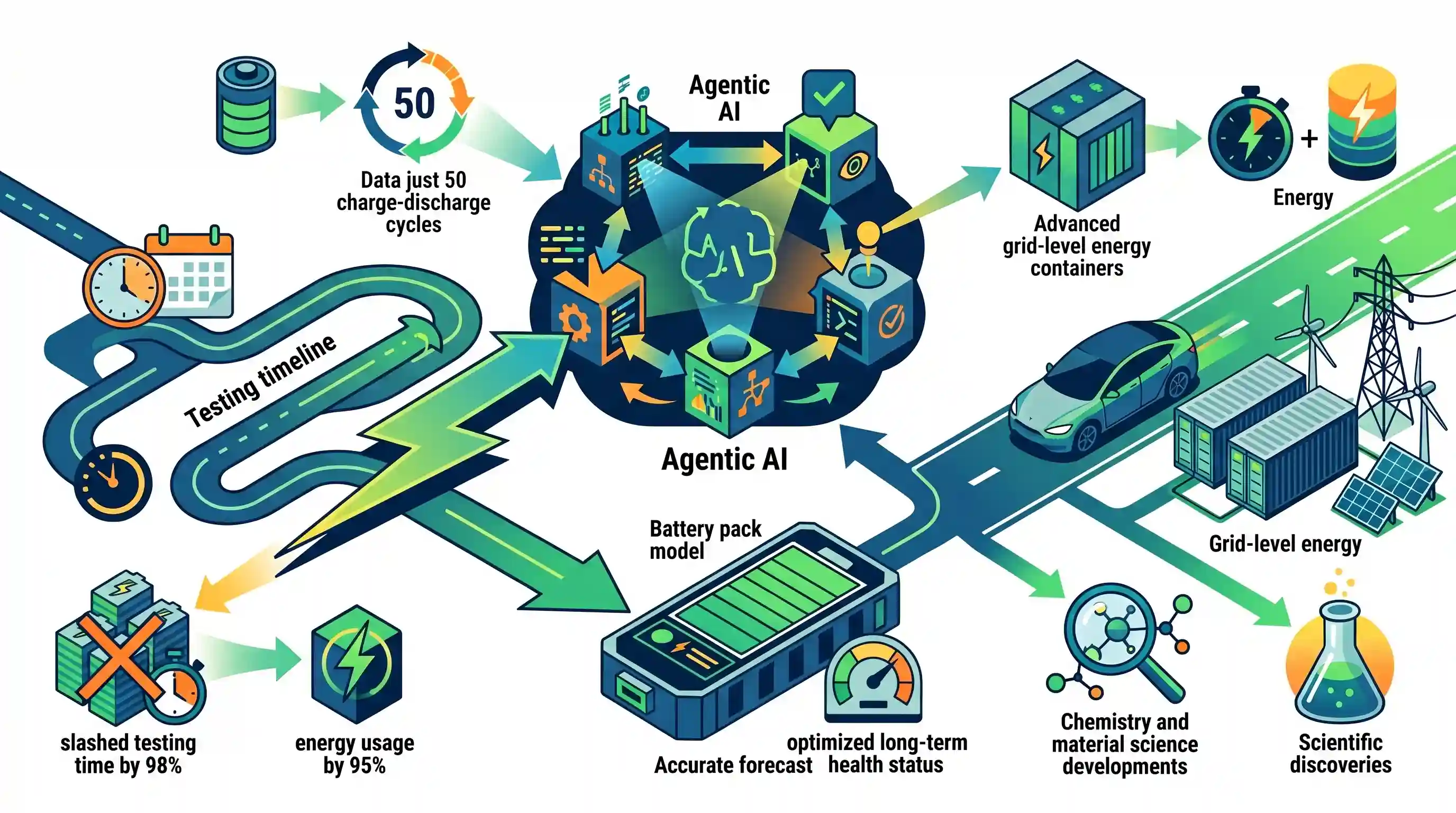
Researchers at the University of Michigan have developed a novel 'agentic AI' system that dramatically accelerates the process of predicting battery life. By using a team of AI agents that collaborate and use 'discovery learning', researchers can accurately forecast a battery's long-term health using data from just 50 charge-discharge cycles. This innovation slashes testing time by 98% and energy usage by 95% compared to traditional months-long testing. Beyond energy storage and electric vehicles, the AI architecture holds potential for speeding up discoveries in fields like chemistry and materials science.
Key Points
- Researchers at the University of Michigan have developed a collaborative team of 'agentic AI' models to predict battery lifespan.
- The AI system requires only 50 charge-discharge cycles to predict a battery's lifetime health, cutting testing time by 98% and energy consumption by 95%.
- The agents utilize 'discovery learning', where they share data, test hypotheses, and iteratively refine predictions without constant human oversight.
- This approach accelerates battery research for EVs and renewables, and its framework can be adapted for broader applications in materials science and chemistry.
Important Terms
Agentic AI

Autonomous, goal-oriented AI systems capable of reasoning, planning, and executing complex tasks independently or collaboratively with minimal human oversight.
UPSC context
GS-III: Science and Tech; tests knowledge of emerging autonomous technologies and their industrial/governance applications.
Advanced Chemistry Cell (ACC)
Next-generation battery technologies that store electrical energy as electrochemical or chemical energy, offering superior energy density and lifespan compared to traditional cells.
UPSC context
GS-III: Infrastructure and Economy; critical for India's energy security and transition to clean mobility.
Battery Management System (BMS)
An electronic system that monitors and manages a battery's state (charge, health, temperature) to ensure safe operation, prevent damage, and optimize lifespan.
UPSC context
GS-III: Science and Tech; essential for understanding EV safety, reliability, and technical challenges in energy storage.
PLI Scheme for ACC Battery Storage
A ₹18,100 crore central incentive program aimed at establishing 50 GWh of domestic giga-scale battery manufacturing to reduce import dependence.
UPSC context
GS-III: Government Policies and Industrial Growth; tests understanding of 'Make in India' and self-reliance in critical tech.
Discovery Learning (AI)
In AI, an approach where systems autonomously explore data and simulate scenarios to identify new scientific laws or hypotheses without explicit human instruction.
UPSC context
GS-III: Science and Tech; relates to advancements in machine learning methodologies and automated scientific research.
Prelims Trap
"Agentic AI models function primarily as passive assistants that require continuous human prompting and oversight."
Agentic AI refers to autonomous systems that can set goals, plan workflows, and execute complex tasks with minimal human intervention, unlike passive generative AI.
Static Concepts Connected
What defines Advanced Chemistry Cell (ACC) battery technology under India's PLI scheme?
- Electrochemical storage: Stores electric energy as electrochemical or chemical energy, converting it back to electricity on demand.
- High density: Encompasses next-generation technologies (like solid-state) offering significantly higher energy density and life cycles than traditional lithium-ion batteries.
- Import reduction: Promoted via an ₹18,100 crore PLI scheme to establish domestic gigafactories and reduce supply-chain vulnerability to imports.
How does Agentic AI fundamentally differ from traditional Generative AI?
- Goal autonomy: Agentic AI can independently perceive environments, set operational goals, and plan multi-step workflows without constant human input.
- Self-correction: It utilizes methodologies like 'discovery learning' to share data, autonomously test scientific hypotheses, and iteratively refine predictions.
Cross-Topic Patterns
AI expediting critical mineral alternatives
Accelerated AI battery testing speeds up the R&D for lithium and cobalt alternatives, directly addressing India's critical mineral import dependency and related geopolitical vulnerabilities.
Green R&D and climate commitments
By slashing battery testing energy by 95%, this demonstrates how AI can mitigate the massive carbon footprint of scientific research itself, an emerging theme in global climate discourse.

Expect a Prelims question differentiating Agentic AI from Generative AI, or a GS3 Mains query on AI accelerating green tech indigenization.
Linked PYQs · 4
Linked PYQs · 4
- 2023MainsGS3
Introduce the concept of Artificial Intelligence (AI). How does Al help clinical diagnosis? Do you perceive any threat to privacy of the individual in the use of Al in healthcare?
- 2020PrelimsGS1
With the present state of development, Artificial Intelligence can effectively do which of the following? 1. Bring down electricity consumption in industrial units 2. Create meaningful short stories and songs 3. Disease diagnosis 4. Text-to-Speech Conversion 5. Wireless transmission of electrical energy Select the correct answer using the code given below:
- 2025PrelimsGS1
Consider the following statements: I. It is expected that Majorana 1 chip will enable quantum computing. II. Majorana 1 chip has been introduced by Amazon Web Services (AWS). III. Deep learning is a subset of machine learning. Which of the statements given above are correct?
- 2024PrelimsGS1
Consider the following statements: I. It is expected that Majorana 1 chip will enable quantum computing. II. Majorana 1 chip has been introduced by Amazon Web Services (AWS). III. Deep learning is a subset of machine learning. Which of the statements given above are correct?
