Bareilly Family Resistance Against Moral Policing and Vigilantism
Source:Indian Express ↗
Why It Matters
This article provides a compelling real-life case study for GS Paper 1 (Secularism, Society), GS Paper 2 (Constitutional Morality, Vigilantism), and GS Paper 4 (Role of family in instilling values, Moral courage, Tolerance). It can be cited in Mains answers or Essays to illustrate how ordinary citizens uphold pluralism against majoritarian prejudice.
Summary
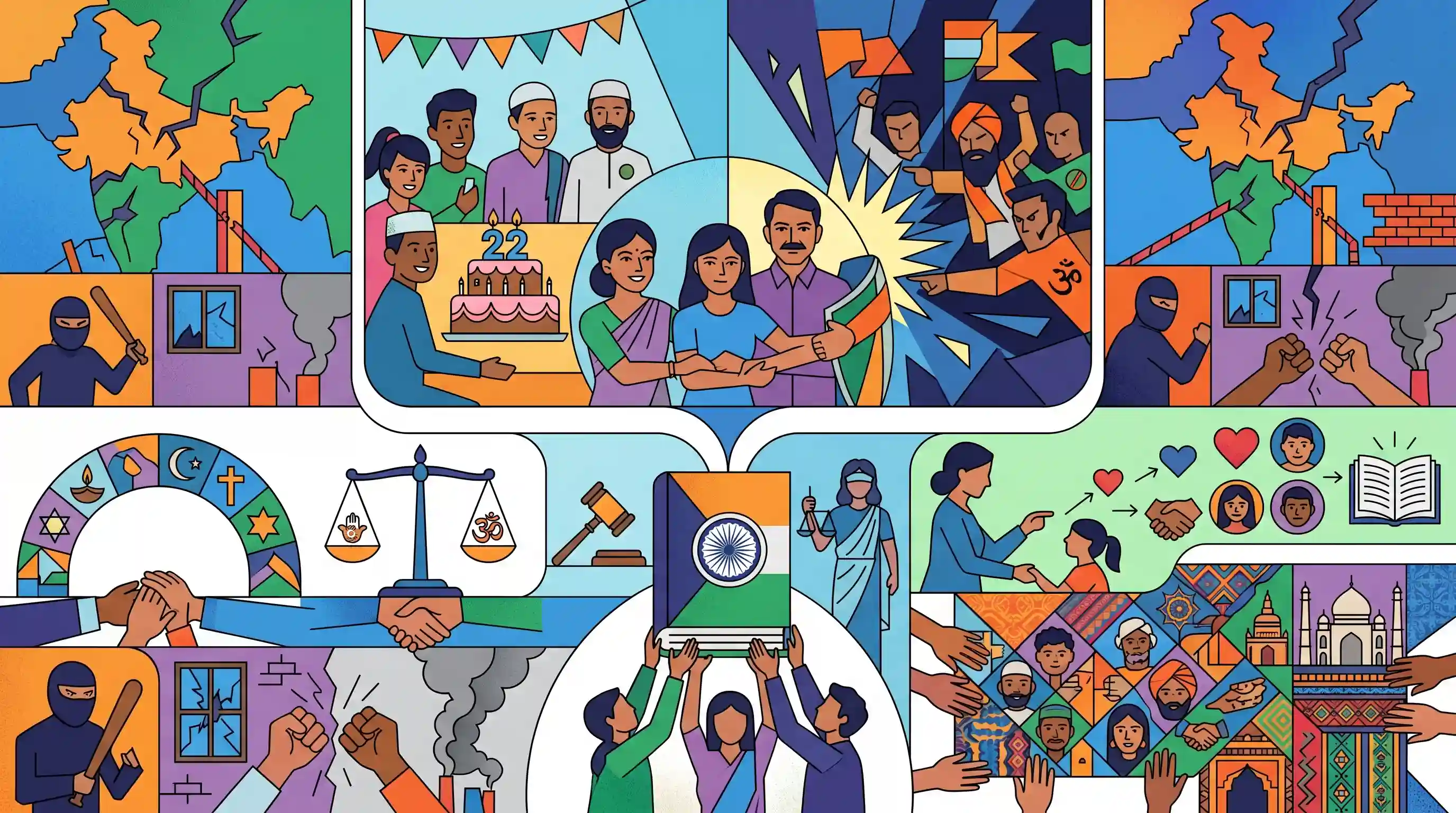
The editorial praises the resilience of a 22-year-old woman and her parents in Bareilly, who firmly stood against right-wing vigilantes who disrupted her birthday party over the presence of Muslim friends. By refusing to let religious bigotry dictate their personal lives, the family exemplifies the everyday courage needed to uphold constitutional values and secularism. The piece contrasts this localized act of tolerance with broader national challenges of hate crimes and polarization, emphasizing the critical role of the family in nurturing pluralistic values and defending India's social fabric.
Key Points
- A recent incident in Bareilly saw vigilantes disrupt a 22-year-old woman's birthday party solely because some of her friends were Muslim.
- The young woman and her parents demonstrated moral courage by standing their ground and asserting that friendship transcends religious boundaries.
- The editorial highlights this family's stance as a beacon of hope for India's 'middle space' against rising tide of shrill polarization, intolerance, and hate.
- This incident is contextualized alongside other targeted attacks on minorities, such as vandalism of churches, violence against Kashmiri vendors, and the killing of a student from Tripura.
- It underscores the crucial role of the family in instilling progressive, secular values and insulating the youth from societal prejudices and majoritarian vigilantism.
Prelims Trap
Constitutional Morality is explicitly defined under Part III of the Constitution of India.
It is not explicitly defined in the text. It is a judicial construct evolved by the Supreme Court to prioritize constitutional values over social norms.
Static Concepts Connected
How does Constitutional Morality differ from Public Morality?
- Core Basis: Constitutional morality relies on constitutional principles (liberty, equality); public morality relies on prevailing societal customs and traditions.
- Judicial Supremacy: Supreme Court rulings (e.g., Navtej Johar, Sabarimala) establish that constitutional morality overrides regressive majoritarian public morality.
- Individual Rights: It actively protects individual choice, autonomy, and minority rights from the dictates or tyranny of the mob.
What are the key SC directives against vigilantism (Tehseen Poonawalla case)?
- Nodal Officers: States must appoint an SP-rank nodal police officer in each district to prevent mob violence and lynching.
- Fast-Track Courts: Specially designated fast-track courts must be established on a priority basis to hold trials for mob violence.
- Victim Compensation: State governments must formulate a victim compensation scheme in accordance with Section 357A of the CrPC.
Cross-Topic Patterns
Vigilantism + GS4 Value Inculcation
The family acts as the primary socializing agent. Upholding inter-faith friendships demonstrates how primary social institutions can practically counter radicalization and majoritarian bigotry.
Fraternity and Article 51A(e)
Vigilantism violates the Fundamental Duty to promote harmony and brotherhood transcending religious diversities. This makes 'Fraternity' a potent Constitutional defense in GS2 and GS4 answers.

Expect a Mains GS4 case study or GS2 question exploring the conflict between majoritarian 'public morality' and 'constitutional morality'.
Linked PYQs · 5
Linked PYQs · 5
- 2022MainsGS1
Are tolerance, assimilation and pluralism the key elements in the making of an Indian form of secularism? Justify your answer.
- 2023MainsGS1
Discuss the impact of post-liberal economy on ethnic identity and communalism.
- 2021MainsGS2
‘Constitutional Morality’ is rooted in the Constitution itself and is founded on its essential facets. Explain the doctrine of ‘Constitutional Morality’ with the help of relevant judicial decisions.
- 2016MainsGS4
Our attitudes towards life, work, other people and society are generally shaped unconsciously by the family and the social surroundings in which we grow up. Some of these unconsciously acquired attitudes and values are often undesirable in the citizens of a modern democratic and egalitarian society.
- 2016MainsGS4
Our attitudes towards life, work, other people and society are generally shaped unconsciously by the family and the social surroundings in which we grow up. Some of these unconsciously acquired attitudes and values are often undesirable in the citizens of a modern democratic and egalitarian society. Discuss such undesirable values prevalent in today's educated Indians.
