Space research spin-off technologies in healthcare
Source:The Hindu ↗
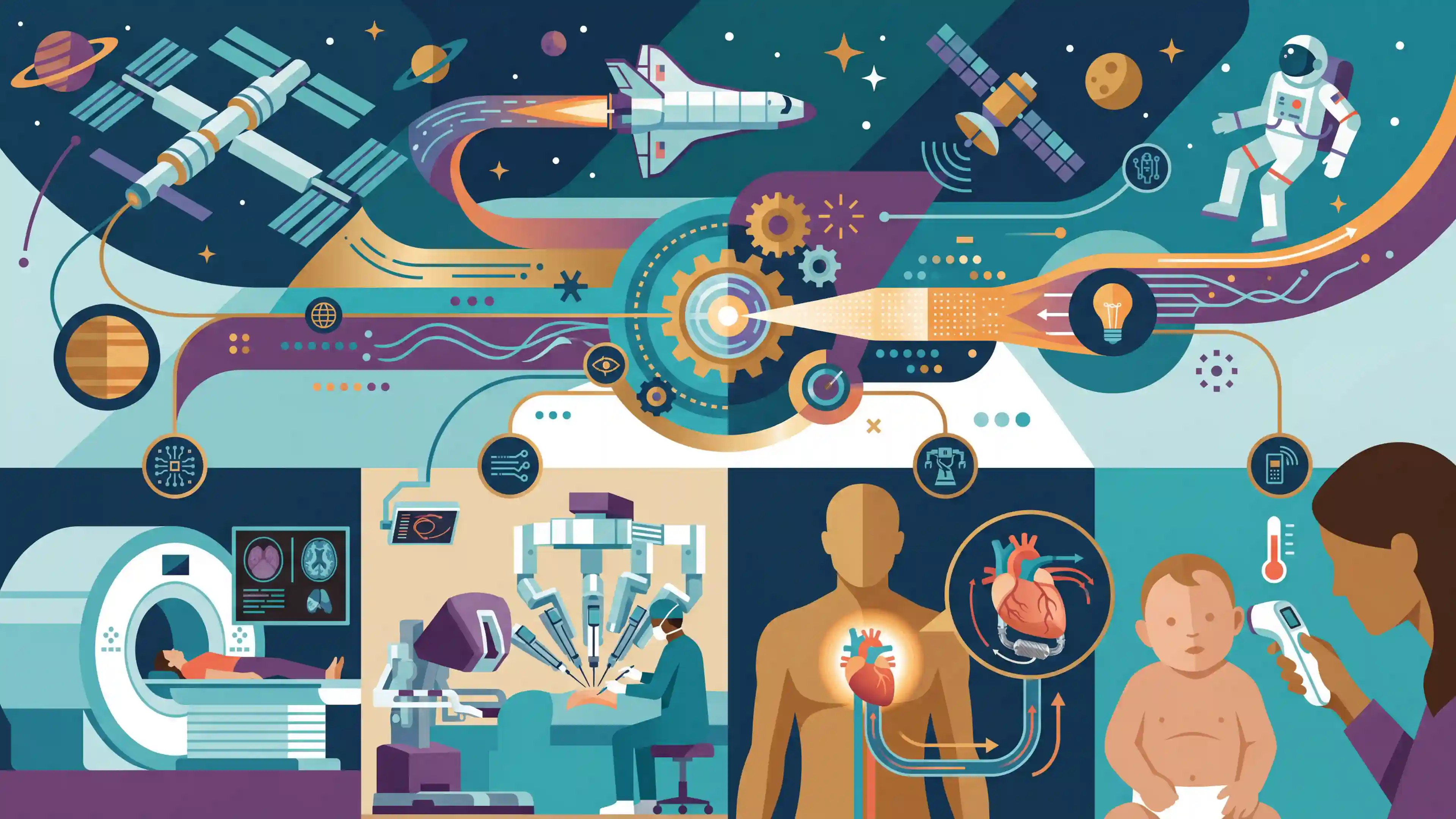
Why It Matters
Provides compelling, concrete examples of 'spin-off' technologies that justify investments in space exploration. These examples are highly relevant for GS-3 mains answers when discussing the socio-economic and medical benefits derived from space science.
Summary
The article details how space research, primarily driven by agencies like NASA, has led to critical 'spin-off' technologies that have transformed modern healthcare. Innovations originally designed for navigating, surviving, and operating in space have been successfully adapted into everyday medical marvels such as MRI machines, robotic surgical assistants, heart pumps (LVADs), and infrared thermometers.
Key Points
- Digital image processing, originally developed to enhance pictures of the Moon during the Apollo missions, was later adapted to create CT scans and MRIs for non-invasive medical imaging.
- Expertise in fluid dynamics for rocket fuel pumps enabled the design of Left Ventricular Assist Devices (LVADs) to keep heart transplant patients alive.
- Robotic technologies derived from the space shuttle's mechanical arm (Canadarm) paved the way for precision robotic surgeries, significantly reducing patient trauma.
- Other notable health spin-offs from space research include invisible dental braces, infrared ear thermometers, advanced bone density scanners, and memory foam.
Important Terms
Space Spinoffs

Commercial products or processes originally developed for space missions that find civilian applications on Earth, particularly in medicine, transportation, and public safety.
UPSC context
GS Paper 3 (Science & Technology). Tests awareness of the everyday socio-economic utility of scientific research and technology transfer.
NASA (National Aeronautics and Space Administration)
The United States' space agency; a pioneer in 'spinoff' technology, documenting over 2,000 innovations including infrared thermometers and digital imaging software used in MRIs.
UPSC context
GS Paper 3. Important for comparative analysis of global space programs and international technological cooperation.
ISRO (Indian Space Research Organisation)
India's national space agency, which has transferred 350+ technologies to industry, including low-cost heart pumps, bionic limbs, and satellite-based telemedicine modules.
UPSC context
GS Paper 3. Key for topics on indigenization of technology and S&T-led societal development in India.
Apollo Program
A series of NASA missions (1961–1972) that landed humans on the Moon, leading to breakthroughs in water purification, fire-resistant textiles, and dialysis machines.
UPSC context
GS Paper 3. A historical benchmark for space-to-medicine technology transfers and global scientific milestones.
Telemedicine
Remote healthcare delivery using telecommunications; originally developed to monitor astronauts, it is now vital for rural Indian healthcare via ISRO’s VSAT satellite networks.
UPSC context
GS Paper 2 (Health) and GS 3. Crucial for understanding digital health and bridging the urban-rural medical divide.
Left Ventricular Assist Device (LVAD)
A mechanical pump supporting weak hearts; its design evolved from NASA’s rocket fuel-pump fluid dynamics and ISRO’s lightweight titanium rocket materials.
UPSC context
GS Paper 3. High-impact example of cross-disciplinary innovation (Space-Bio-Tech) and indigenous medical manufacturing.
Digital Image Processing
The use of algorithms to enhance and analyze digital photos; techniques designed for NASA's lunar and planetary images are now foundational for MRI and CT scans.
UPSC context
GS Paper 3. Demonstrates the application of space observation tools in modern clinical diagnostics.
Prelims Trap
"LVADs are artificial hearts that completely replace the patient's biological heart."
LVADs do not replace the heart; they are mechanical pumps that assist a failing left ventricle in pumping blood to the rest of the body while the biological heart remains.
Static Concepts Connected
What are the physiological effects of long-term exposure to microgravity?
- Bone mass loss: Osteoblasts slow down, leading to rapid bone density reduction (space-induced osteoporosis) due to the lack of mechanical stress.
- Fluid shifts: Blood and bodily fluids move toward the upper body and head, increasing intracranial pressure and potentially impairing vision.
- Muscle atrophy: The lack of gravity significantly reduces the load on postural and locomotor muscles, leading to muscle degradation.
How do different medical imaging technologies function?
- CT Scans: Uses rotating X-ray machines (ionizing radiation) and digital processing to create cross-sectional 3D images of bones and tissues.
- MRI: Employs strong magnetic fields and radio waves (non-ionizing radiation) to generate highly detailed images, exceptionally useful for soft tissues.
Cross-Topic Patterns
ISRO spin-offs and commercialization
Like NASA, ISRO transfers space spin-offs (e.g., medical ventilators, Li-ion batteries, silica aerogel) to Indian industries, managed by NSIL to boost the domestic private space and tech sector.
Robotic surgery + 5G telecom
Space-derived precision robotics (originating from Canadarm), when combined with the ultra-low latency of 5G telecom networks, enables telesurgery, revolutionizing remote healthcare access.

Expect a 'match the following' on everyday tech applications linking space spin-offs (LVADs, MRIs) or imaging types in Prelims 2026.
Linked PYQs · 1
Linked PYQs · 1
- 2016MainsGS3
Discuss India's achievements in the field of Space Science and Technology. How the application of this technology has helped India in its socio-economic development?
