Geopolitical Shifts for India from West Asia Crisis
Source:Indian Express ↗
Why It Matters
This article is highly significant for UPSC GS-2 (International Relations) as it explains the shift in India's West Asia policy from a passive, energy-centric posture to an active, security-centric contributor. Understanding the structural limitations of legacy transit routes (such as Chabahar) and the rising importance of plurilateral frameworks like I2U2 and IMEC amidst regional polarization is crucial for current affairs-based analytical questions.
Summary
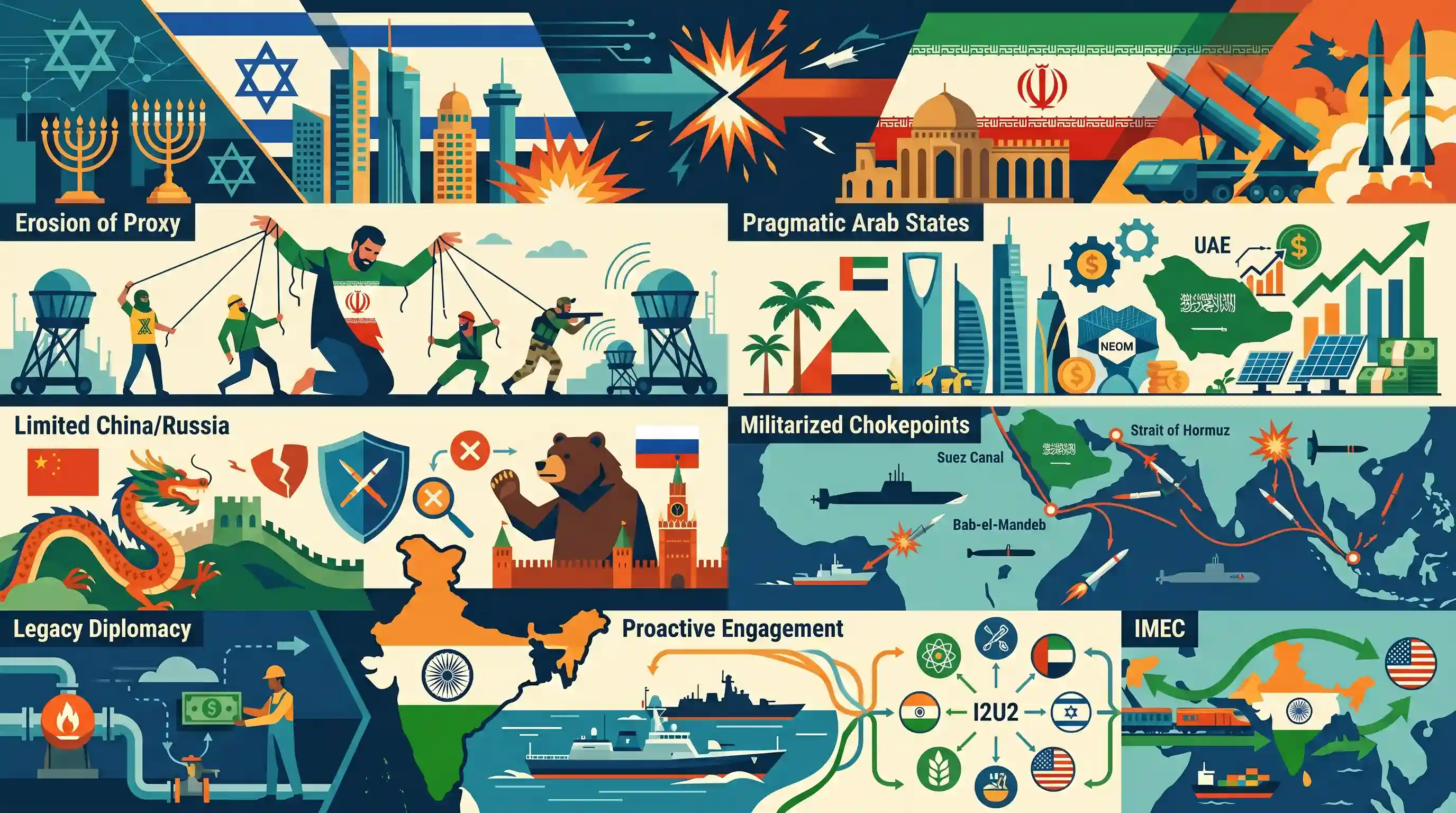
In this opinion piece, geopolitical expert C. Raja Mohan analyzes the structural shifts in West Asian geopolitics triggered by the escalating direct conflict between Israel and Iran. He argues that India must look beyond its legacy diplomatic frameworks—which traditionally focused on energy security and labor remittances—to address four profound shifts: the erosion of Iran's proxy deterrence, the pragmatic developmental focus of Arab states, the limited role of China and Russia as regional security guarantors, and the active militarization of critical maritime chokepoints in the Western Indian Ocean. To secure its national interest, India must adopt a proactive maritime security posture and deepen its engagement with Western and regional partners through frameworks like I2U2 and IMEC.
Key Points
- Degradation of Iran's Asymmetric Deterrence: Israel's technological and intelligence dominance has demonstrated that high-tech state militaries can systematically degrade non-state proxies (Hamas, Hezbollah), undermining Iran's traditional proxy-based deterrence model.
- Arab Pragmatism Over Ideology: Major Arab powers like Saudi Arabia and the UAE are prioritizing national economic diversification, modernization, and stability over revolutionary confrontation, refusing to break off diplomatic paths with Israel or support Iran's regional escalation.
- Limits of Sino-Russian Patronage: Despite Iran's deep ties with Beijing and Moscow, neither has the willingness or capacity to serve as a military shield or security guarantor for Tehran, whereas the US has re-established its role as the indispensable security actor in West Asia.
- Militarization of Trade Chokepoints: Houthi attacks in the Red Sea have directly threatened Indian maritime trade, signaling that India can no longer treat West Asia solely through the lens of 'oil and remittances' and must actively participate in regional maritime security.
- Strategic Realignment for India: The instability of Iran-centric corridors (Chabahar, INSTC) makes plurilateral frameworks like I2U2 and stable transit routes like IMEC more critical for India's long-term geopolitical and economic interests.
Important Terms
India-Middle East-Europe Economic Corridor (IMEC)

A proposed multimodal transit network connecting India to Europe via the Gulf region, combining sea routes, rail corridors, and digital/energy pipelines. Conceived at the 2023 G20 summit to boost trade and bypass traditional chokepoints.
UPSC context
GS Paper II: Bilateral and regional groupings affecting India's interests; tests infrastructure diplomacy, supply chain resilience, and counter-BRI strategies.
I2U2 Grouping
A strategic partnership formed by India, Israel, the UAE, and the US (referred to as the "West Asian Quad") focusing on joint investments in water, energy, transportation, space, health, and food security.
UPSC context
GS Paper II: Regional groupings involving India; tests understanding of India's multi-alignment strategy and economic cooperation in West Asia.
Abraham Accords
A series of landmark US-brokered agreements signed in 2020 that normalized diplomatic and economic relations between Israel and several Arab nations, including the UAE, Bahrain, Morocco, and Sudan.
UPSC context
GS Paper II: Effect of policies of developed and developing countries; tests understanding of shifting geopolitical dynamics in West Asia.
International North-South Transport Corridor (INSTC)
A 7,200 km multimodal transport network initiated by India, Iran, and Russia to connect the Indian Ocean and Persian Gulf to the Caspian Sea and Northern Europe, drastically reducing trade transit times and costs.
UPSC context
GS Paper II: Bilateral and regional agreements; tests understanding of Eurasian connectivity, Central Asian trade, and India's strategic autonomy.
Houthis
A Zaydi Shia militant group based in Yemen. Supported by Iran as part of the "Axis of Resistance," they have actively militarized critical shipping lanes in the Red Sea and Bab-el-Mandeb Strait.
UPSC context
GS Paper II: Important international events; tests understanding of West Asian conflict dynamics and threats to global maritime transit.
Indian Navy
The maritime branch of the Indian Armed Forces. It acts as a primary security partner and first responder in the Western Indian Ocean, safeguarding Sea Lanes of Communication against piracy, smuggling, and drone strikes.
UPSC context
GS Paper III: Security challenges and their management; tests concepts of maritime domain awareness, Net Security Provider role, and sea lane protection.
Prelims Trap
Chabahar Port is situated inside the Persian Gulf, safeguarding Indian trade from disruptions in the Strait of Hormuz.
Chabahar is on the Makran coast facing the Gulf of Oman, strictly outside the Persian Gulf. This allows shipping to completely bypass the volatile Strait of Hormuz chokepoint, which is its primary geopolitical utility for India.
Static Concepts Connected
What are the primary maritime chokepoints in West Asia?
- Strait of Hormuz: Connects the Persian Gulf to the Gulf of Oman; handles over 20% of global petroleum liquids. Bordered by Iran and Oman.
- Bab-el-Mandeb: Connects the Red Sea to the Gulf of Aden; critical bottleneck for Europe-Asia trade via the Suez Canal. Bordered by Yemen and Djibouti.
- Suez Canal: An artificial Egyptian waterway connecting the Mediterranean Sea directly to the Red Sea, separating Africa from Asia.
How do the INSTC and IMEC corridors geopolitically and geographically differ?
- INSTC (Continental-North): A 7,200 km multimodal route connecting India to Russia via Iran (Chabahar/Caspian Sea); focuses on Eurasian continental integration.
- IMEC (Maritime-Rail-West): A G20-backed economic corridor connecting India to Europe via UAE, Saudi Arabia, Jordan, and Israel; bypasses Iran/Russia entirely.
- Geopolitical Alignment: INSTC leans on an Iran-Russia axis, whereas IMEC is supported by the US/G7 and aligns with Arab-Israeli normalization efforts.
Cross-Topic Patterns
West Asian de-hyphenation & corridors
India's shift from delicate balancing of Iran-Arab rivalries to pragmatically utilizing Arab-Israeli economic corridors (IMEC/I2U2) to secure trade transit lanes.
Maritime security + Energy logistics
Houthi asymmetric warfare in Bab-el-Mandeb transforms India’s traditional passive energy-import dependency into an active maritime-policing and escort mandate in the Arabian Sea.

INSTC vulnerability vs. IMEC viability amid persistent West Asian proxy warfare will be framed as a GS-2 comparative analysis in 2026.
Linked PYQs · 3
Linked PYQs · 3
- 2025MainsGS2
"Energy security constitutes the dominant kingpin of India's foreign policy, and is linked with India's overarching influence in Middle Eastern countries.” How would you integrate energy security with India's foreign policy trajectories in the coming years?
- 2022MainsGS2
How will I2U2 (India, Israel, UAE and USA) grouping transform India's position in global politics?
- 2026PrelimsGS1
Ships from which of the following countries have to cross the Strait of Hormuz to reach out to the Indian Ocean ? 1. Bahrain 2. Syria 3. Qatar 4. Egypt Select the answer using the code given below :
