Geopolitical shifts in West Asia and foreign policy strategy for India
Source:Indian Express ↗
Why It Matters
West Asia is India's 'extended neighborhood' and is crucial for India's energy security, maritime trade, and the livelihood of over 8.5 million Indian expats. This article explains the ongoing shift in Indian foreign policy from a defensive balancing act to a proactive, interest-based alignment in a changing Middle East, which is a highly recurrent theme in the UPSC civil services mains examination.
Summary
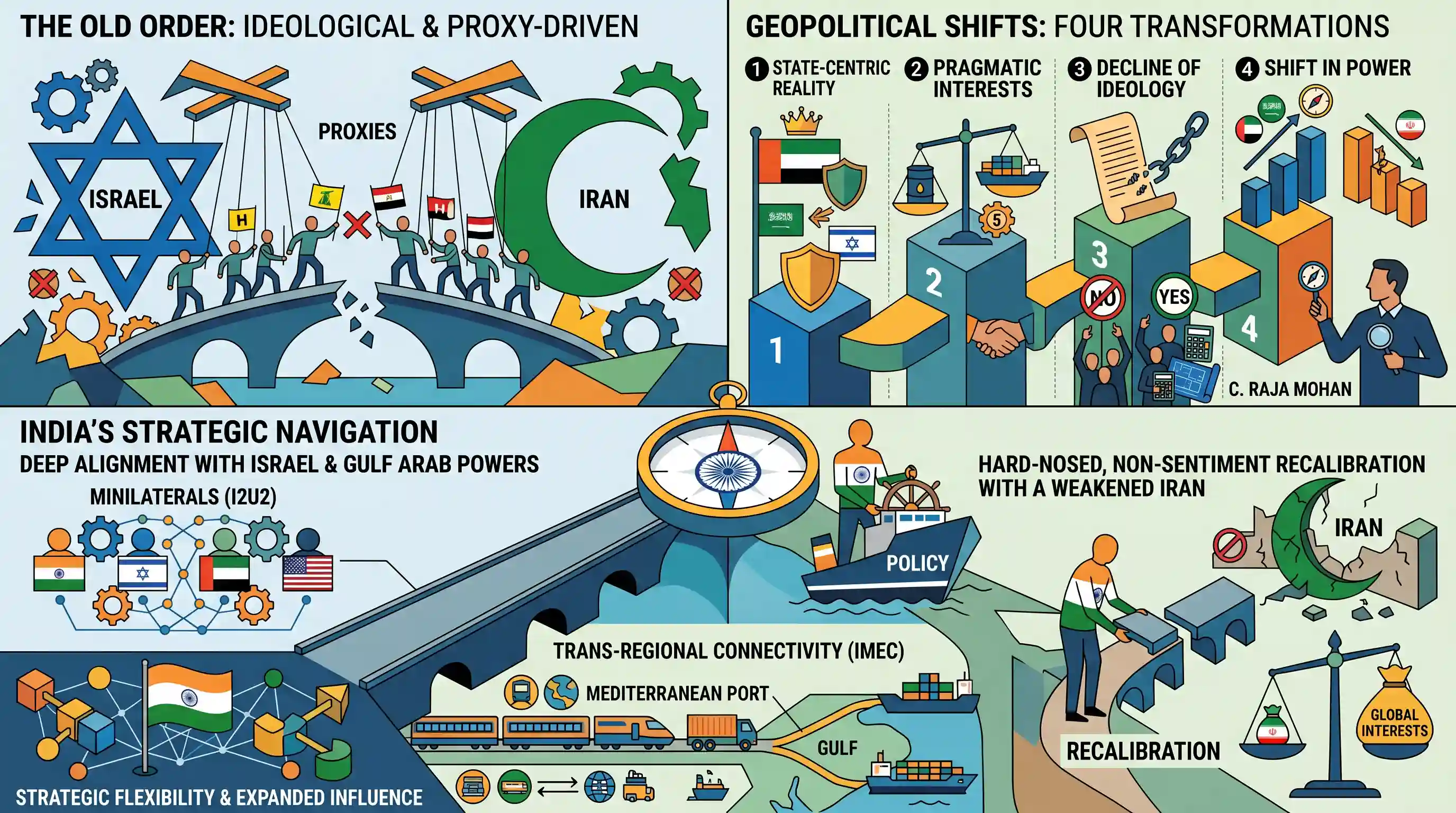
In this opinion piece, C. Raja Mohan analyzes the deep geopolitical shifts in West Asia arising from the escalating conflict between Israel and Iran, outlining four distinct transformations that India must strategically navigate. These shifts represent a transition from the region's older ideological and proxy-driven order to a pragmatic, state-centric, and interest-driven framework. For India, these changes expand strategic flexibility, allowing deeper alignment with Israel and Gulf Arab powers through minilaterals (I2U2) and trans-regional connectivity projects (IMEC), while demanding a hard-nosed, non-sentimental recalibration of its relationship with a weakened Iran.
Key Points
- Limits of Iran's Proxy-War Model: The direct conflict has demonstrated that Iran's 'Axis of Resistance' (proxies like Hamas and Hezbollah) cannot establish effective deterrence against Israel's conventional and technological military dominance, backed by the West.
- Rise of Pragmatic Arab Realism: Traditional Gulf monarchies, led by Saudi Arabia and the UAE, are prioritizing national economic modernization (such as Vision 2030) and regional stability over pan-Islamic ideological solidarity, actively seeking de-escalation.
- Enduring US Security Architecture: Despite debates about its withdrawal, the United States remains the indispensable security guarantor in West Asia, while Russia and China's roles are limited to transactional military cooperation (Russia-Iran) and economic arbitrage (China-Gulf).
- Expansion of India's Strategic Choices: India has moved away from its traditional defensive, non-aligned posture. By aligning with both pragmatic Arab states and Israel, India is actively shaping regional connectivity (IMEC) and minilateral diplomacy (I2U2).
- Realistic Appraisal of Iran: India's relationship with Iran is being reframed pragmatically. While Chabahar and regional transit remain important, India is tempering its romanticized civilizational view due to Iran's severe economic isolation and strategic fragility.
Important Terms
India-Middle East-Europe Economic Corridor (IMEC)

A multimodal ship-to-rail transit network proposed at the 2023 G20 Summit to connect India, the Arabian Gulf, and Europe, boosting trade, digital, and clean energy infrastructure.
UPSC context
GS Paper II (Bilateral & Regional Groupings); tests connectivity, supply-chain resilience, and strategic alternatives to China's Belt and Road Initiative.
Abraham Accords
A series of US-brokered normalization agreements signed from 2020 onwards, establishing formal diplomatic and economic relations between Israel and several Arab nations, including the UAE and Bahrain.
UPSC context
GS Paper II (Bilateral & Regional Groupings); tests comprehension of changing West Asian alignments and expanded diplomatic flexibility for India.
I2U2 Grouping
A geo-economic partnership of India, Israel, the UAE, and the USA, focusing on collaborative investments in water, energy, space, transport, health, and food security.
UPSC context
GS Paper II (Bilateral & Regional Groupings); evaluates India's Act West policy, strategic depth, and multilateral economic diplomacy in the Middle East.
Axis of Resistance
An informal, Iran-led military-political coalition of Shia and Sunni militant groups, including Hezbollah, Hamas, and the Houthis, committed to countering Western and Israeli influence in West Asia.
UPSC context
GS Paper II (International Relations); tests understanding of proxy warfare, regional instability, and security threats to Indian maritime trade.
Houthis
A Zaydi Shia political and armed insurgent group in Yemen backed by Iran, controlling parts of northern Yemen and actively disrupting Red Sea global shipping routes.
UPSC context
GS Paper II (International Relations); evaluates maritime security threats, global supply-chain vulnerabilities, and regional conflicts impacting Indian commerce.
Hezbollah
A powerful Lebanon-based Shia Islamist political party and heavily armed militant group, founded in 1982 with Iranian support to resist Israeli occupation and Western influence.
UPSC context
GS Paper II (Effect of foreign policies); tests regional conflict dynamics, the role of non-state actors, and security challenges in West Asia.
Hamas
A Palestinian Sunni militant and political organization founded in 1987, currently governing the Gaza Strip and actively opposing the existence of Israel through armed resistance.
UPSC context
GS Paper II (International Relations); tests historical roots of the Israel-Palestine issue and its impact on India's strategic balancing in West Asia.
Prelims Trap
Chabahar Port is situated inside the Persian Gulf, requiring ships to navigate through the Strait of Hormuz to access the Indian Ocean.
Chabahar is on the Gulf of Oman, outside the Strait of Hormuz. This allows ships to bypass the chokepoint completely, which is its primary geopolitical advantage.
Static Concepts Connected
What is the International North-South Transport Corridor (INSTC)?
- Definition: A 7,200-km multi-modal transportation network linking India, Iran, Azerbaijan, and Russia for freight transit.
- Strategic Route: Connects Mumbai to Iranian ports (Chabahar and Bandar Abbas), extending north to Baku and St. Petersburg, bypassing the Suez Canal.
- Efficiency Gain: Reduces container transit time by nearly 40% and carriage costs by 30% compared to traditional maritime routes.
What are the structural objectives of the I2U2 Grouping?
- Core Sectors: Focuses on joint investments across six key sectors: water, energy, transportation, space, health, and food security.
- Synergistic Model: Combines India's scale/manpower, Israel's technological depth, and the financial capital of the US and UAE for regional infrastructure.
Cross-Topic Patterns
IMEC vs. Belt and Road Initiative
Shows how India's West Asian connectivity initiatives act as strategic, G7-supported alternatives to counter China's Belt and Road infrastructure footprint.
Strategic de-hyphenation in foreign policy
Illustrates India's shift from non-aligned ideological solidarity to pragmatic bilateralism, balancing partnerships with historical rivals Israel, Iran, and Saudi Arabia.

Expect a 2026 question mapping Chabahar, INSTC, and IMEC transit routes against critical West Asian maritime chokepoints.
Linked PYQs · 5
Linked PYQs · 5
- 2022MainsGS2
How will I2U2 (India, Israel, UAE and USA) grouping transform India's position in global politics?
- 2018MainsGS2
“India’s relations with Israel have, of late, acquired a depth and diversity, which cannot be rolled back.” Discuss.
- 2025MainsGS2
"Energy security constitutes the dominant kingpin of India's foreign policy, and is linked with India's overarching influence in Middle Eastern countries.” How would you integrate energy security with India's foreign policy trajectories in the coming years?
- 2026PrelimsGS1
Ships from which of the following countries have to cross the Strait of Hormuz to reach out to the Indian Ocean ? 1. Bahrain 2. Syria 3. Qatar 4. Egypt Select the answer using the code given below :
- 2022PrelimsGS1
The term "Levant" often heard in the news roughly corresponds to which of the following regions?
