Structural Employment Challenges and Macroeconomic Planning Gaps
Source:Indian Express ↗
Why It Matters
Provides a critical evaluation of the Union Budget and highlights the dichotomy between headline GDP growth and structural unemployment, which is highly relevant for GS-3 answers on economic planning, employment generation, and industrial policy.
Summary
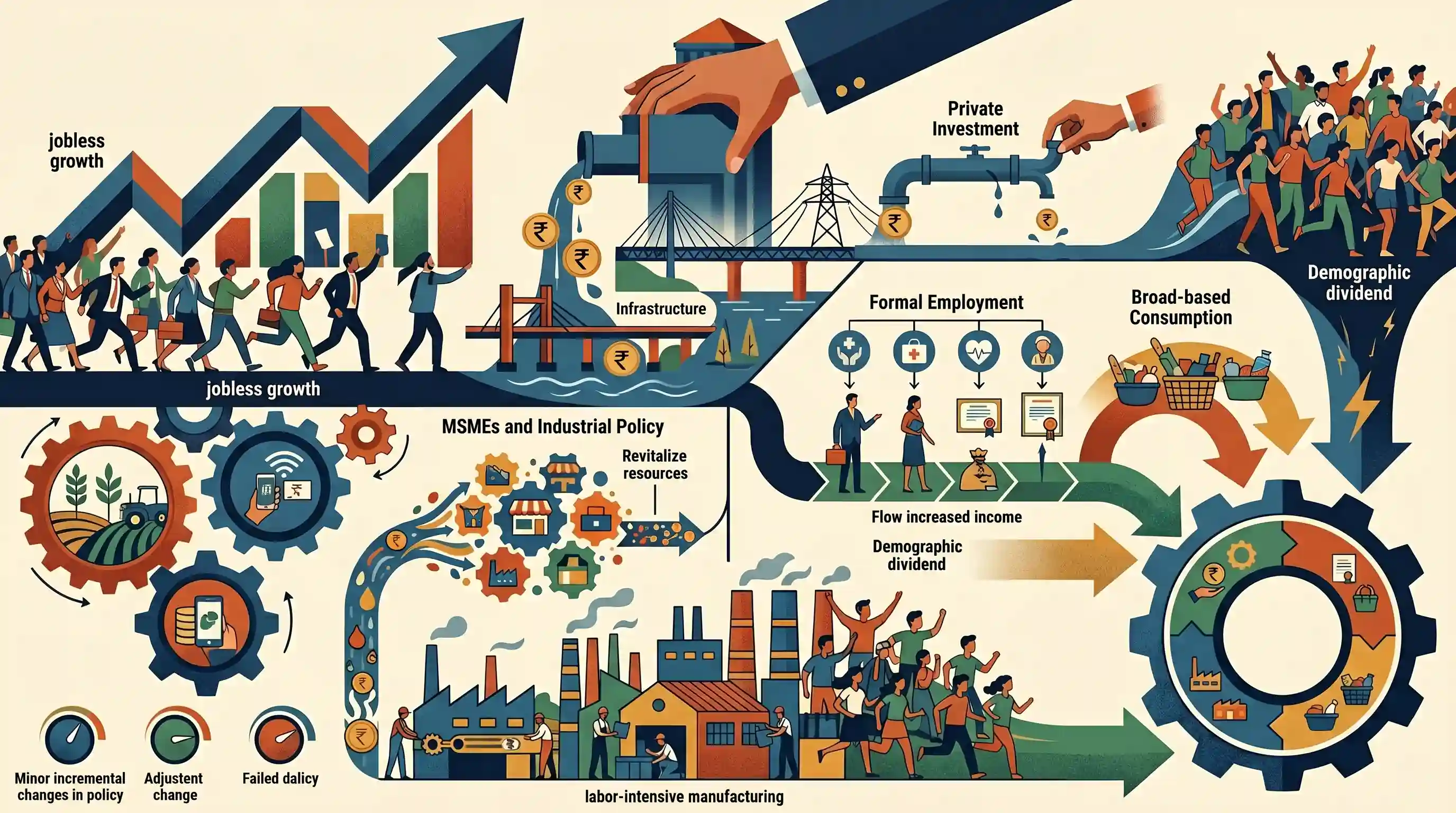
The article critically analyzes the Union Budget, arguing that it lacks a comprehensive macroeconomic strategy to address India's persistent structural economic issues. While headline growth remains steady, the economy is plagued by 'jobless growth,' weak private investment, and an over-reliance on public capital expenditure. The author emphasizes that without a definitive industrial policy focused on labor-intensive manufacturing and the revitalization of MSMEs, incremental fiscal measures will be insufficient. Ultimately, generating mass formal employment is essential to spur broad-based consumption and harness India's demographic dividend.
Key Points
- Despite stable headline GDP growth, the Indian economy suffers from structural challenges, particularly 'jobless growth' and insufficient private investment.
- The Union Budget focuses on fiscal consolidation and public capital expenditure but falls short of providing a comprehensive macroeconomic plan or industrial policy.
- Private capital expenditure has remained sluggish, indicating that corporate tax cuts and supply-side incentives have not fully translated into broad-based capacity expansion.
- There is a pressing need to revitalize the manufacturing sector—especially MSMEs and labor-intensive industries—to create formal employment and absorb the expanding workforce.
- Without a strategic plan for job creation and skill enhancement, India risks squandering its demographic dividend.
Important Terms
Union Budget

The 'Annual Financial Statement' (Article 112) presented to Parliament, detailing the estimated receipts and expenditure of the Government of India for a specific financial year.
UPSC context
GS Paper III (Government Budgeting); tests understanding of fiscal policy, resource allocation, and macroeconomic stability.
MSMEs
Enterprises classified by the MSMED Act, 2006 based on investment and turnover; they are vital for employment, contributing significantly to India's GDP and exports.
UPSC context
GS Paper III (Industrial Policy); critical for inclusive growth and labor-intensive manufacturing topics.
Jobless Growth
An economic paradox where a country's GDP expands robustly without a corresponding or proportional increase in formal employment opportunities.
UPSC context
GS Paper III (Growth, Development, and Employment); tests ability to analyze structural bottlenecks in the Indian economy.
Capital Expenditure (Capex)
Government spending directed toward creating long-term physical or financial assets, such as infrastructure, or reducing liabilities, known for its high multiplier effect on growth.
UPSC context
GS Paper III (Investment Models); focuses on the role of public spending in 'crowding-in' private investment.
Demographic Dividend
The economic growth potential arising from a shift in population age structure, particularly when the working-age population (15-64) exceeds the dependent population.
UPSC context
GS Paper I (Population) and GS Paper III (Economy); tests human capital development and employment strategy.
Prelims Trap
"Increased government capital expenditure always crowds out private investment."
UPSC frequently tests this macroeconomic relationship. In developing economies with severe infrastructure deficits, targeted public capex is actually designed to "crowd in" private investment by lowering logistics costs.
Static Concepts Connected
What drives 'Jobless Growth' in the Indian macroeconomic context?
- Service-led trajectory: India's growth has been largely driven by skill-intensive services (like IT) rather than labor-intensive manufacturing, limiting mass job creation.
- Rising Capital Intensity: Even within manufacturing, there has been an increasing reliance on automation and capital-intensive technologies over labor-intensive methods.
- Structural Bottlenecks: Rigidities in labor laws and lack of credit access for MSMEs restrict the expansion of sectors with the highest employment elasticity.
How does the 'Crowding In' effect operate through public capital expenditure?
- Concept Definition: When government spending on infrastructure drives up private sector investment by creating a more favorable business environment.
- Mechanism: Public investments in roads, ports, and power lower logistics costs and improve profitability for private firms, encouraging them to expand capacity.
- Contrast with Crowding Out: Unlike "crowding out" where government borrowing depletes loanable funds, crowding in utilizes public money to act as a catalyst for private capital.
Cross-Topic Patterns
PLI Schemes vs. MSME GVC Integration
While the PLI scheme and corporate tax cuts target large-scale capital investments, real employment generation requires integrating labor-intensive MSMEs into Global Value Chains (GVCs), bridging industrial policy with trade strategy.
Demographic Dividend & Social Sector Skilling
Jobless growth directly threatens India's demographic dividend. Without simultaneous improvements in NEP 2020 outcomes and targeted skilling (e.g., Skill India), the surplus agricultural workforce becomes a demographic liability.

Mains 2026 will likely test the "crowding in" effect of public capex and analyze why corporate tax cuts failed to spur private investment.
Linked PYQs · 5
Linked PYQs · 5
- 2023MainsGS3
Faster economic growth requires increased share of the manufacturing sector in GDP, particularly of MSMEs. Comment on the present policies of the Government in this regard.
- 2023MainsGS3
Most of the unemployment in India is structural in nature. Examine the methodology adopted to compute unemployment in the country and suggest improvements.
- 2022MainsGS3
Economic growth in the recent past has been led by increase in labour productivity." Explain this statement. Suggest the growth pattern that will lead to creation of more jobs without compromising labour productivity.
- 2013PrelimsGS1
To obtain full benefits of demographic dividend, what should India do?
- 2017MainsGS3
Account for the failure of manufacturing sector in achieving the goal of labour-intensive exports. Suggest measures for more labour-intensive rather than capital-intensive exports.
