Uttar Pradesh government combat against encephalitis in Gorakhpur
Source:opindia ↗
Why It Matters
Understanding the eradication and control models of vector-borne diseases like Japanese Encephalitis is crucial for GS2 (Public Health Policy) and General Science. The 'Dastak' campaign serves as an excellent case study of inter-departmental synergy and state-led health interventions for PCS aspirants.
Summary
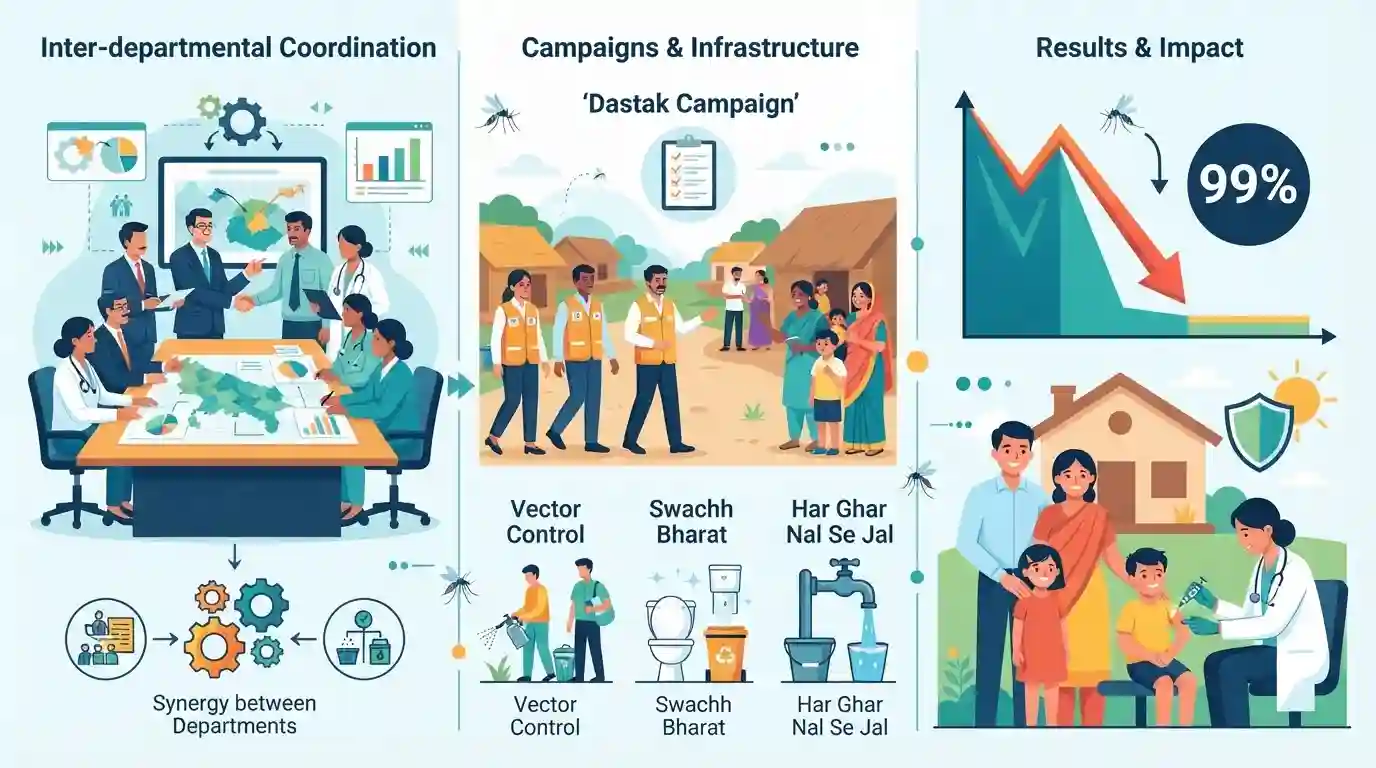
The article details the Uttar Pradesh government's successful campaign against Japanese Encephalitis (JE) and Acute Encephalitis Syndrome (AES) in the Gorakhpur region. By launching the Dastak campaign and integrating it with broader sanitation and clean water schemes like Swachh Bharat and Har Ghar Nal Se Jal, the state achieved a 99% drop in AES cases and significantly reduced mortality. The model highlights the effectiveness of robust public health policy, vaccination, and inter-departmental coordination.
Key Points
- Gorakhpur, once the epicenter of Japanese Encephalitis (JE) and Acute Encephalitis Syndrome (AES) in India, has seen a 99% reduction in AES cases under the Yogi Adityanath administration.
- The 'Dastak' campaign, launched in 2018 in collaboration with UNICEF and WHO, was pivotal in spreading door-to-door awareness and ensuring high immunization coverage.
- The government integrated vector control and immunization with national schemes like Swachh Bharat Abhiyan (for sanitation) and Har Ghar Nal Se Jal (for clean drinking water) to tackle the root causes of the disease.
- Inter-departmental coordination involving Health, Panchayati Raj, and Urban Development departments, along with the establishment of Pediatric Intensive Care Units (PICUs) across districts, strengthened the healthcare infrastructure.
Important Terms
Dastak Campaign

A multi-departmental, door-to-door public health campaign launched in 2018 by Uttar Pradesh with UNICEF, successfully targeting the eradication of Japanese Encephalitis and Acute Encephalitis Syndrome in endemic districts.
UPSC context
GS Paper II (Health/Governance); tests public health policies, multi-departmental coordination, and community-driven healthcare delivery models.
Har Ghar Nal Se Jal
A key program under India's Jal Jeevan Mission (launched 2019) aiming to provide Functional Household Tap Connections (FHTCs) with safe drinking water to all rural households.
UPSC context
GS Paper II & III (Welfare Schemes/Infrastructure); tests clean water access, sustainable sanitation, and rural developmental policies.
Swachh Bharat Abhiyan
A national campaign launched in 2014 to eliminate open defecation, improve solid waste management, and drive behavioral change toward public health and sanitation.
UPSC context
GS Paper II (Social Justice/Health); tests developmental policies, sanitation-driven public health outcomes, and civic behavioral change programs.
UNICEF
The United Nations Children’s Fund, a global agency that partners with governments to secure children's rights, healthcare, sanitation, and immunization.
UPSC context
GS Paper II (International Relations); tests the efficacy and role of international organizations in regional social welfare and child protection.
BRD Medical College
The Baba Raghav Das Medical College in Gorakhpur; a state-run tertiary healthcare facility that served as the regional frontline in managing acute encephalitis syndrome outbreaks.
UPSC context
GS Paper II (Health Infrastructure); tests critical bottlenecks in public health delivery, pediatric emergency response, and healthcare management.
Prelims Trap
A single universal vaccine under the Universal Immunization Programme (UIP) covers all causative agents of Acute Encephalitis Syndrome (AES).
AES is a broad clinical "basket term" (including non-infectious toxins like hypoglycin A and various pathogens). Only Japanese Encephalitis (JE), a specific viral cause, is vaccine-preventable under the UIP.
Static Concepts Connected
Distinction between AES and Japanese Encephalitis (JE)
- AES clinical definition: AES is an umbrella clinical 'basket term' characterized by acute-onset fever and neurological distress, coined by the WHO to capture multiple underlying diseases.
- JE viral etiology: Japanese Encephalitis is a specific zoonotic viral disease caused by JEV (a flavivirus), which is one of the chief viral etiologies of AES.
- Prevention profiles: JE is vaccine-preventable and covered under India's Universal Immunization Programme, whereas AES as a whole has no single vaccine due to diverse causes.
The Transmission Cycle of Japanese Encephalitis Virus (JEV)
- Vector transmission: JEV is transmitted to humans through the bite of infected Culex mosquitoes, primarily Culex tritaeniorhynchus, which breed in flooded rice fields.
- Reservoirs and Amplifiers: Ardeid birds serve as natural reservoirs, while domestic pigs act as amplifying hosts where the virus replicates rapidly without causing clinical disease.
- Dead-end hosts: Humans and horses are accidental "dead-end" hosts because they do not develop high enough viremia to transmit the virus back to feeding mosquitoes.
Cross-Topic Patterns
WASH Infrastructure as Preventive Medicine
Integrating the Jal Jeevan Mission and Swachh Bharat with disease control proves that environmental sanitation is as critical to disease eradication as clinical medicine.
One Health Framework in Action
Coordinating vector control (entomology), pig husbandry (veterinary), and pediatric care (human medicine) highlights the practical application of a cross-sectoral One Health strategy.

Vector-borne disease transmission cycles (pigs as amplifying hosts for JEV) and AES etiologies likely to feature in 2026 GS3 Sci-Tech.
Linked PYQs · 3
Linked PYQs · 3
- 2008UPPSC_PRELIMSGS1
The factor of the Japanese encephalitis is
- 2021UPPSC_PRELIMSGS1
Which of the following is NOT mosquito borne disease ?
- 2023UPPSC_PRELIMSGS1
Which of the following scheme/s is/are related to Uttar Pradesh? (1) Anuthee Uphar Scheme (2) Matra Shakti Udyamita Scheme (3) Kaushalya Matritva Scheme (4) Stree Nidhi Scheme Select the 'correct' answer using the code given below -
