Nature Connectedness Index highlights trade-offs in conservation
Source:Indian Express ↗
Why It Matters
Provides a novel conceptual framework (Nature Connectedness Index) to analyze the environment vs. development debate. It highlights the limits of purely technocratic 'Ease of Doing Business' models and emphasizes the role of environmental ethics and spirituality, offering rich fodder for GS3 (Conservation), GS4 (Environmental Ethics), and Essay topics.
Summary
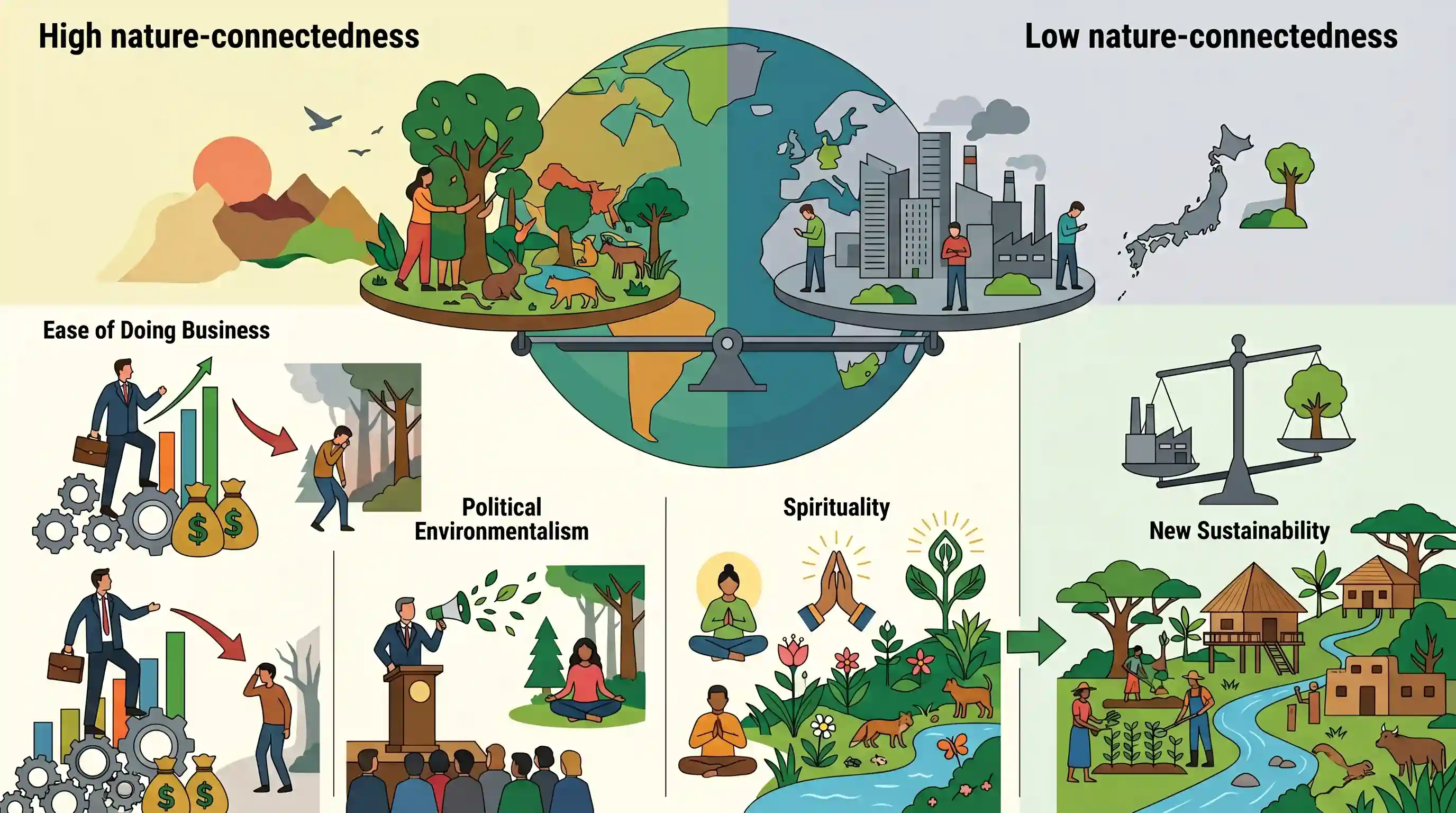
The editorial discusses the 'nature-connectedness index' from a study in the journal Ambio, which measures the psychological relationship between humans and their natural environment across 61 countries. The findings reveal a stark contrast: nations like Nepal, Iran, South Africa, and Bangladesh rank the highest, while developed countries like the UK, Japan, and Germany sit at the bottom. India ranks 22nd. Notably, high rankings on the World Bank's Ease of Doing Business index negatively correlate with nature connectedness, and strong political environmentalism (like Green parties) does not necessarily translate to a deeper personal connection with nature. Conversely, spirituality shows a positive correlation. The piece concludes that the traditional environment versus economy binary is outdated; true sustainability requires learning from communities that live in harmony with nature rather than merely imposing top-down 'green' technocratic models.
Key Points
- The 'Nature Connectedness Index' from a recent study published in Ambio assesses the psychological and cultural ties between people and nature across 61 countries.
- Developing nations with traditional or spiritual ties to nature (e.g., Nepal, Iran, Bangladesh) rank the highest, with India ranking 22nd.
- Developed nations (e.g., UK, Japan, Germany) rank at the bottom, despite having strong formal environmental policies and political Green movements.
- The study found a negative correlation between a country's ranking on the World Bank’s Ease of Doing Business Index and its level of nature connectedness.
- Spirituality correlates positively with an intrinsic connection to nature.
- The editorial argues against the traditional 'environment vs. development' binary, suggesting policymakers learn from communities historically connected to nature before designing technocratic 'green' projects.
Important Terms
Nature Connectedness Index

A psychological metric measuring the emotional and personal relationship between humans and nature. A 2025 study in Ambio found higher scores correlate with spirituality rather than political environmentalism or economic wealth.
UPSC context
GS Paper III (Environment). Tests understanding of human-nature relationships beyond technocratic conservation, emphasizing psychological well-being and cultural values in sustainability.
Ease of Doing Business Index
A legacy World Bank metric ranking countries on regulatory hurdles for private enterprise. Discontinued in 2021 due to data irregularities, it has been replaced by the "Business Ready" (B-READY) project.
UPSC context
GS Paper III (Economy). Significant for tracking India's regulatory reforms (e.g., Insolvency and Bankruptcy Code) and the trade-off between market-friendly policies and environmental connection.
World Bank
An international financial institution that provides development assistance to low- and middle-income countries. It produces influential global indices, including the former Ease of Doing Business and current Business Ready reports.
UPSC context
GS Paper II (International Relations). Core topic regarding global governance, multilateral development banks, and their role in shaping national economic and environmental policies.
Environmental Ethics
A branch of philosophy exploring the moral relationship between humans and the environment. The index highlights a shift from top-down conservation to ethics-based harmony found in spiritual communities.
UPSC context
GS Paper IV (Ethics). Tests ability to resolve conflicts between economic growth and ecological preservation, emphasizing community-led and intrinsic values of nature.
Sustainable Development
Development that meets present needs without compromising future generations. The article argues for a "techno-spiritual" approach that integrates technological advancement with deep personal ecological awareness.
UPSC context
GS Paper III (Environment/Economy). A recurring theme requiring analysis of alternative development models that move beyond the traditional "economy vs. environment" binary.
Prelims Trap
The Nature Connectedness Index is published by UNEP and ranks developed nations highest.
Aspirants often assume environmental indices are released by UN bodies and that Western nations top them. This index is from an academic journal and ranks developed nations lowest.
Static Concepts Connected
What is the difference between Deep and Shallow Ecology?
- Deep Ecology: Views nature as having intrinsic value independent of human utility, emphasizing spiritual, cultural, and holistic connections.
- Shallow Ecology: An anthropocentric view focusing on resource management and technocratic 'green' solutions primarily for human benefit.
What was the World Bank's Ease of Doing Business Index?
- Core Metric: Ranked 190 economies based on regulatory environment metrics for starting and running a domestic business.
- Discontinuation: Discontinued by the World Bank in 2021 following an investigation into data manipulation and irregularities in reporting.
Cross-Topic Patterns
Ethics of Tribal Conservation
Validates the GS4 theme that indigenous and spiritual beliefs (Deep Ecology) often yield stronger environmental stewardship than Western technocratic fixes.
GDP vs Green GDP
The negative correlation with the 'Ease of Doing Business' index highlights the classic GS3 debate around economic growth metrics versus holistic sustainable development indicators.

GS4 ethics or GS3 essay in 2026 is highly likely to contrast Western technocratic 'green' policies with indigenous spiritual conservation.
Linked PYQs · 5
Linked PYQs · 5
- 2016PrelimsGS1
India's ranking in the 'Ease of Doing Business Index' is sometimes seen in the news. Which of the following has declared that ranking?
- 2019PrelimsGS1
Which one of the following is not a sub-index of the World Bank's 'Ease of Doing Business Index'?
- 2015MainsGS4
What is meant by 'environmental ethics'? Why is it important to study? Discuss any one environmental issue from the viewpoint of environmental ethics.
- 2024MainsGS4
Global warming and climate change are the outcomes of human greed in the name of development, indicating the direction in which extinction of organisms including human beings is heading towards loss of life on Earth. How do you put an end to this to protect life and bring equilibrium between the society and the environment?
- 2019MainsGS3
Define the concept of carrying capacity of an ecosystem as relevant to an environment. Explain how understanding this concept is vital while planning for sustainable development of a region.
