Kolkata entrepreneurs champion waste conversion and architecture
Source:timesofindia ↗
কেন এটি গুরুত্বপূর্ণ
Waste management and the transition to a circular economy are critical environmental priorities. Understanding practical implementations of sustainable architecture, plastic recycling, and e-waste management provides concrete examples for GS3 Environment answers and essays on sustainability.
সারসংক্ষেপ
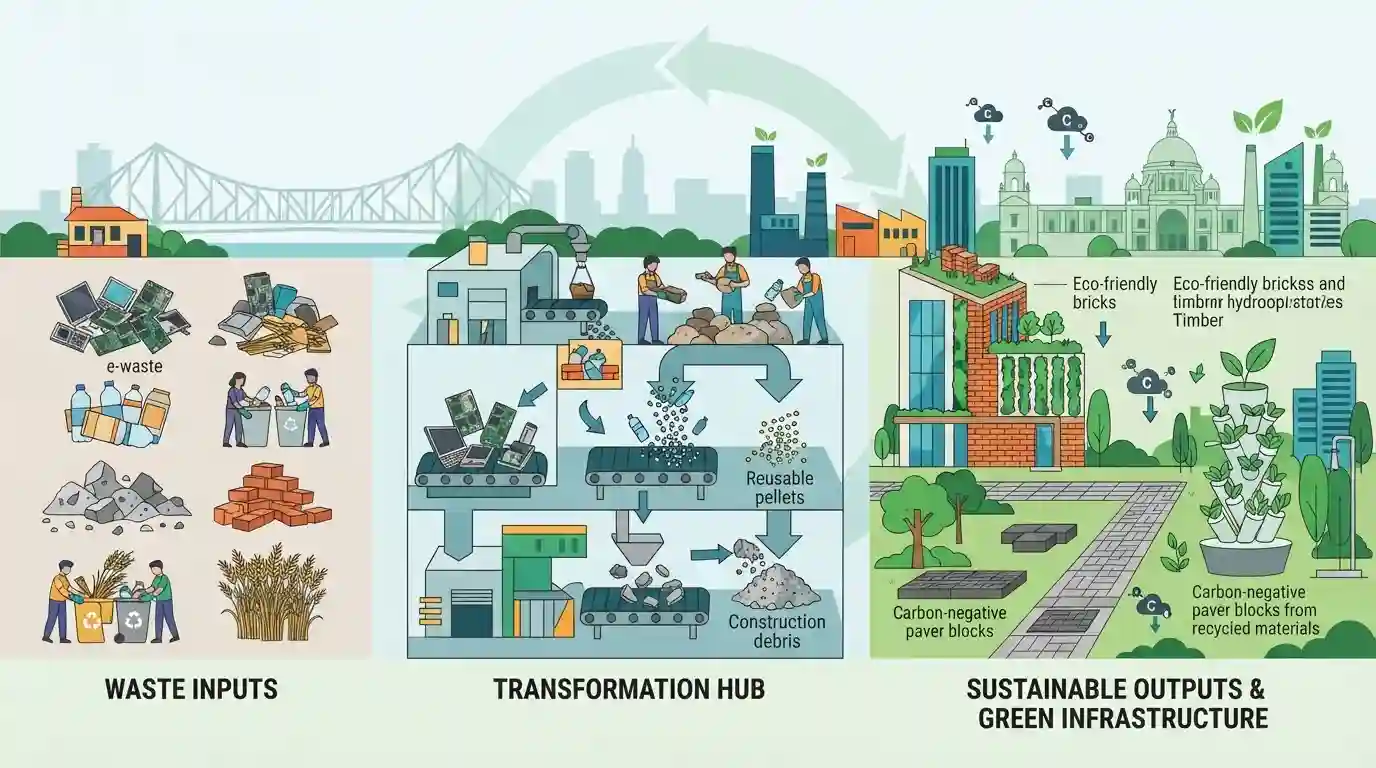
Kolkata's 'circular economy changemakers' are turning waste—ranging from e-waste and plastic to construction debris and agricultural residue—into sustainable living spaces and green infrastructure. Entrepreneurs are leading initiatives in sustainable architecture, eco-friendly building materials, carbon-negative paver blocks, and formalized e-waste recycling. These efforts reduce landfill burden, lower carbon footprints, and promote environmental sustainability in the construction and waste management sectors.
মূল বিষয়
- A group of entrepreneurs in Kolkata is championing the circular economy by repurposing waste into sustainable infrastructure and materials.
- Pradip Chopra (PS Group, iLEAD) utilizes discarded glass bottles, construction debris, and discarded fabrics in building walls and campuses, emphasizing sustainable architecture.
- Mukti Gupta's 'Adhigam Bhoomi' project builds a modern gurukul using eco-friendly materials like bamboo, cow dung, agricultural residue, and discarded bottles.
- Ranjan Kumar Gupta's Paver+ converts low-value plastic waste (which usually goes to landfills) into carbon-negative paver blocks and construction materials, incorporating multi-layer plastics.
- Sriyam and Nandan Mall's Huladek specializes in formalizing e-waste management, ensuring toxic metals are recovered and recycled safely rather than ending up in informal scrap yards.
গুরুত্বপূর্ণ শব্দ
Adhigam Bhoomi

A climate-responsive, free residential school for girls in West Bengal built with eco-friendly materials like bamboo and mud. Its curriculum integrates alternative learning, environmental sustainability, and traditional rural skills.
UPSC context
Relevant for GS-II (Education) and GS-III (Environment), showcasing an alternative, sustainable education model blending traditional knowledge with ecological awareness.
Paver+
A Kolkata-based circular economy initiative that transforms low-value municipal solid waste and plastic into durable, carbon-negative construction materials like paver blocks, eco-roads, and concrete wall panels.
UPSC context
Fits GS-III (Waste Management & Infrastructure). Demonstrates innovative, scalable solutions for plastic waste recycling and green infrastructure development.
Huladek
A certified e-waste management company providing formal, authorized channels for the responsible collection, safe disposal, and recycling of electronic devices from institutions and businesses in eastern India.
UPSC context
Crucial for GS-III (Environment & Ecology), highlighting the formalization of e-waste management and the promotion of a circular economy.
iLEAD
An educational institute in Kolkata that champions sustainable development by offering specialized courses in sustainable fashion and interior design, emphasizing economic growth through reduced waste and consumption.
UPSC context
Connects to GS-II (Skill Development) and GS-III (Environment), illustrating how circular economy principles can be integrated into higher education.
PS Group
A Kolkata-based real estate developer whose leadership advocates for sustainable architecture by utilizing discarded glass, salvaged fittings, reclaimed wood, and other scrap materials to minimize construction waste.
UPSC context
Maps to GS-III (Infrastructure & Sustainable Development). Exemplifies the private sector's role in adopting circular economy models for urban housing.
প্রিলিমস ফাঁদ
Extended Producer Responsibility (EPR) in India is strictly limited to plastic, e-waste, packaging, and battery management.
The updated Construction & Demolition Waste Management Rules explicitly introduce a legally binding EPR framework for building rubble in large infrastructure projects.
সংযুক্ত স্থির ধারণা
What are the three foundational pillars of a Circular Economy?
- Design out waste: Eliminating waste and pollution at the product design stage rather than relying entirely on post-consumption management.
- Maintain high value: Keeping products and materials in use at their highest utility and value through closed-loop recycling and reuse systems.
- Regenerate systems: Moving beyond extraction to actively rebuilding natural capital, such as safely returning biological nutrients to the soil.
What are the key mandates of India's updated C&D Waste Management Rules?
- EPR for C&D: Introduces mandatory Extended Producer Responsibility (EPR) for building and infrastructure projects with a built-up area exceeding 20,000 square meters.
- Demand-side targets: Requires new construction projects to incorporate minimum percentages of recycled materials, starting at 5% and scaling to 25% by 2030.
আন্তঃবিষয় প্যাটার্ন
EPR Certificates as Tradable Assets
India's updated waste rules rely on tradable EPR certificates for compliance. This links GS3 Environment directly to financial market mechanisms, similar to Carbon Credit trading.
Urbanization meets Circularity
The shift from linear waste dumping to using carbon-negative materials and recycled construction debris bridges GS1 Urbanization challenges with GS3 sustainable infrastructure themes.

A 2026 Prelims question will likely test the expansion of EPR mandates into non-traditional sectors like Construction & Demolition waste.
সংযুক্ত PYQ · 2
সংযুক্ত PYQ · 2
- 2023WBCS_PRELIMSGS1
Financial instruments that generate proceeds for investment in environmentally sustainable projects are called
- 2024WBCS_PRELIMSGS1
East Kolkata Wetland has been declared as
