Climate Change Adaptation and Infrastructure Resilience in Europe
Source:Indian Express ↗
Why It Matters
This editorial reframes the climate change debate from a singular focus on mitigation to the immediate necessity of adaptation and infrastructure resilience. It provides a crucial comparative perspective between developed and developing nations, making it highly relevant for Mains answers on climate justice, urban planning, and disaster management.
Summary
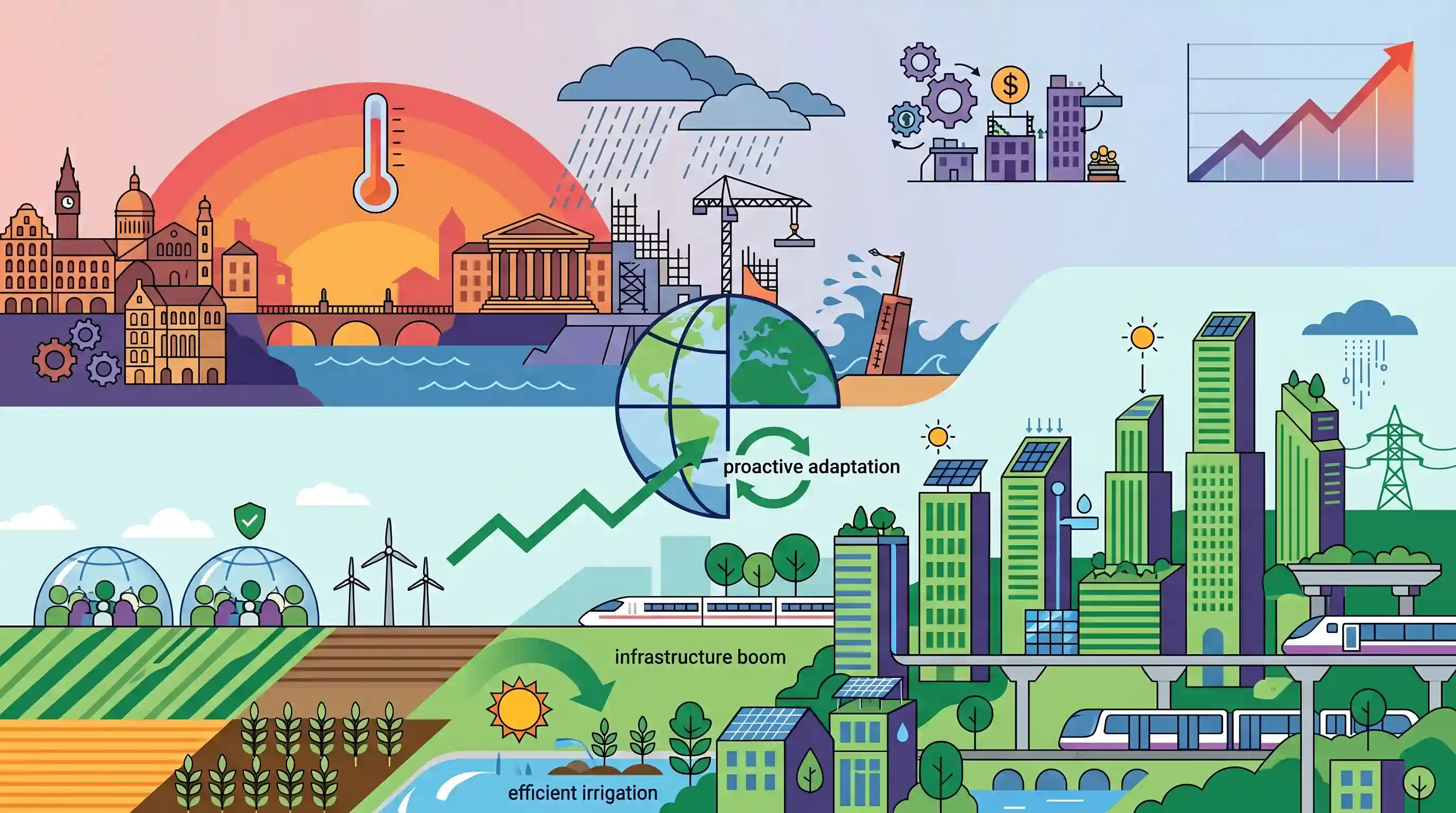
A recent warning from the European Scientific Advisory Board on Climate Change advising EU members to prepare for a 2.8°C temperature rise by 2100 highlights the shifting realities of global climate action. The article contrasts the climate challenges faced by the Global North and the Global South. While Europe benefits from robust social safety nets, its existing infrastructure is ill-equipped for severe climate extremes and will require costly retrofitting. In contrast, India remains highly vulnerable due to its large agricultural base and developmental status. However, India's ongoing infrastructure boom presents a unique opportunity: by shifting the focus from mere disaster response to proactive climate adaptation, India can build climate resilience directly into its emerging urban and rural infrastructure, avoiding the retrofitting trap faced by developed nations.
Key Points
- The European Scientific Advisory Board on Climate Change has warned EU nations to prepare for a 2.8°C rise in global temperatures by 2100, acknowledging that current mitigation efforts are falling short of the 1.5°C target.
- A significant challenge for developed nations like those in Europe is that their infrastructure was built for stable climate conditions, necessitating expensive retrofitting for future climate resilience.
- Developing countries such as India face acute vulnerabilities due to lower socioeconomic safety nets and high reliance on climate-sensitive sectors like agriculture.
- India has a strategic advantage as its infrastructure is largely still under construction, allowing policymakers to integrate climate resilience natively rather than bearing massive retrofitting costs later.
- The focus of climate action must broaden from solely mitigation (emissions reduction) to include proactive adaptation and building resilience against inevitable extreme weather events.
Important Terms
European Scientific Advisory Board on Climate Change (ESABCC)

An independent scientific body established under the European Climate Law (2021) to provide the EU with scientific expertise and advice on climate targets and policy consistency.
UPSC context
GS Paper II (International Institutions) & GS III (Environment); relevant for studying global climate governance frameworks and EU's climate leadership.
UNFCCC
The primary international environmental treaty (1992) aimed at stabilizing greenhouse gas concentrations to prevent dangerous human interference with the climate system.
UPSC context
GS Paper III (Environment); core of global climate negotiations, COPs, and agreements like the Paris Accord.
Climate Resilience
The ability of a system, community, or infrastructure to anticipate, absorb, accommodate, or recover from the effects of a hazardous climate event in a timely manner.
UPSC context
GS Paper III (Infrastructure & Disaster Management); tests understanding of building sustainable infrastructure and mitigating economic losses from extreme weather.
Climate Change Adaptation
Adjustments in ecological, social, or economic systems in response to actual or expected climatic stimuli and their effects to moderate harm or exploit beneficial opportunities.
UPSC context
GS Paper III (Environment/Agriculture); essential for discussing India's vulnerability in the agrarian sector and water management.
Infrastructure Retrofitting
The process of modifying existing buildings or infrastructure with new technology or features to improve energy efficiency, reduce carbon footprint, or increase resilience to climate impacts.
UPSC context
GS Paper III (Infrastructure/Urban Development); focuses on the 'retrofitting trap' for developed nations versus India's opportunity for 'climate-proof' new construction.
Global South
A term used to describe developing, less developed, or under-developed nations, primarily in the Southern Hemisphere, often characterized by high climate vulnerability and lower historical emissions.
UPSC context
GS Paper II (International Relations) & GS III (Environment); central to debates on climate justice, equity, and the principle of CBDR.
Prelims Trap
"The UNFCCC has officially revised its global temperature target to 2.8°C to account for realistic adaptation needs."
The 2.8°C figure is a preparation baseline advised by a European advisory board, not an official revision of the Paris Agreement's 1.5°C/2.0°C mitigation goals.
Static Concepts Connected
What is the Coalition for Disaster Resilient Infrastructure (CDRI)?
- Origin: Launched by India at the 2019 UN Climate Action Summit to promote resilience of infrastructure systems.
- Mandate: Promotes resilience of new and existing infrastructure systems to climate and disaster risks, supporting sustainable development.
- Key Mechanism: Functions as a partnership of national governments, UN agencies, and multilateral banks focusing on technical support rather than direct financing.
How do Climate Mitigation and Adaptation differ?
- Mitigation: Interventions aimed at reducing or preventing greenhouse gas emissions, such as transitioning to renewable energy or enhancing carbon sinks.
- Adaptation: Adjustments in ecological, social, or economic systems in response to actual or expected climatic stimuli, like building flood-resilient infrastructure.
Cross-Topic Patterns
Urbanization and Climate Adaptation
India's urban schemes (Smart Cities, AMRUT) must pivot to incorporate heat-action plans and flood-resilient drainage, directly linking GS1 Urbanization with GS3 Environment and Disaster Management.
Retrofitting vs. Global Climate Finance
Europe's massive domestic retrofitting costs may further strain its international climate finance commitments, impacting adaptation support and the newly operationalized Loss and Damage fund for developing nations.

Expect a GS-3 Mains question contrasting the Global North's 'retrofitting trap' with India's infrastructure 'latecomer advantage' via CDRI.
Linked PYQs · 4
Linked PYQs · 4
- 2024MainsGS3
What is disaster resilience? How is it determined? Describe various elements of a resilience framework. Also mention the global targets of Sendai Framework for Disaster Risk Reduction (2015–2030).
- 2022MainsGS3
Discuss global warming and mention its effects on the global climate. Explain the control measures to bring down the level of greenhouse gases which cause global warming, in the light of the Kyoto Protocol, 1997.
- 2017MainsGS3
'Climate change' is a global problem. How India will be affected by climate change? How Himalayan and coastal states of India will be affected by climate change?
- 2024MainsGS3
Flooding in urban areas is an emerging climate-induced disaster. Discuss the causes of this disaster. Mention the features of two such major floods in the last two decades in India. Describe the policies and frameworks in India that aim at tackling such floods.
