IMF assessment highlights global economic resilience amid uncertainty
Source:Indian Express ↗
Why It Matters
Provides crucial insights into the current global macroeconomic landscape, the impact of protectionist trade policies, and the role of international institutions like the IMF. It is highly relevant for GS3 Economy (macroeconomic stability, growth) and GS2 (international institutions).
Summary
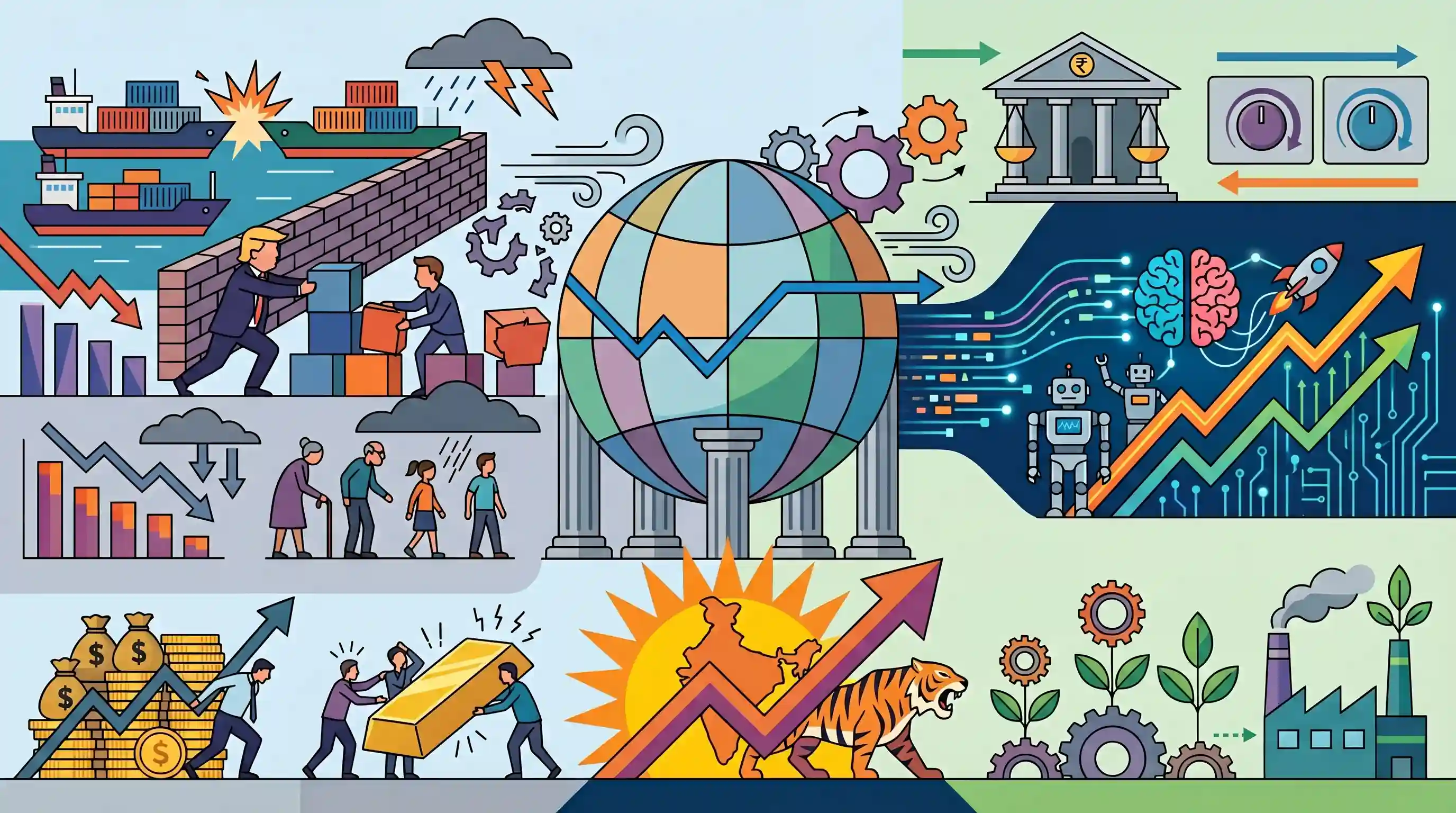
The article discusses the IMF's latest assessment of the global economy, emphasizing its resilience amid an era where "uncertainty is the new normal." Despite slowing growth, demographic shifts, and rising protectionism driven by leaders like Donald Trump, a global recession has been averted. This stability is credited to astute fiscal and monetary policies, private sector adaptation, and an AI-driven market boom. However, rising sovereign debt-to-GDP ratios and surging gold demand signal underlying market nervousness. Amidst these global challenges, the IMF highlights India as a vital engine of economic growth.
Key Points
- The global economic growth rate is projected to slow marginally from 3.3% in 2024 to 3.2% in 2025, according to the IMF.
- The IMF characterizes the current era as one where 'uncertainty is the new normal', citing geopolitical, technological, and demographic transformations.
- Despite punitive tariffs and protectionist rhetoric from leaders like Donald Trump, the global economy has avoided recession due to measured responses by governments and central banks.
- The private sector has adapted to protectionism by front-loading imports, while an AI-led boom has buoyed global markets (though it carries risks reminiscent of the Dotcom bubble).
- Underlying economic nervousness is evident in surging government debt-to-GDP ratios and rising global demand for gold as a safe-haven asset.
- The IMF specifically identifies India as a resilient and key engine of global economic growth amidst worldwide uncertainties.
Important Terms
International Monetary Fund (IMF)

An international organization of 190 countries fostering global monetary cooperation, securing financial stability, facilitating international trade, and reducing poverty through surveillance, lending, and capacity development.
UPSC context
GS Paper II (International Institutions) and GS III (Indian Economy); tests global governance and financial stability knowledge.
World Economic Outlook (WEO)
A flagship biannual report by the IMF providing analysis and projections of global economic developments, growth forecasts, and emerging market risks.
UPSC context
GS Paper III (Economy); high-yield for Prelims reports/indices and Mains analysis of global growth trends.
Protectionism
Economic policies, such as tariffs, quotas, and subsidies, designed to restrict imports and shield domestic industries from foreign competition.
UPSC context
GS Paper II (Trade Policies) and GS III (Globalization); relevant for trade wars and de-globalization debates.
Sovereign Debt
The total amount of money a country's central government owes to creditors, including domestic lenders and foreign investors, through bonds and loans.
UPSC context
GS Paper III (Fiscal Policy); critical for understanding fiscal deficits and macroeconomic sustainability.
Debt-to-GDP Ratio
A metric comparing a nation's public debt to its annual economic output (GDP), indicating its capacity to service and repay its total debt.
UPSC context
GS Paper III (Indian Economy); key indicator for fiscal health and the FRBM Act targets.
Fiscal Policy
The use of government spending and tax policy to influence macroeconomic conditions, such as aggregate demand, employment, and inflation.
UPSC context
GS Paper III (Indian Economy); tested via the Union Budget, fiscal deficit, and public finance management.
Monetary Policy
Actions by a central bank (e.g., RBI) to manage the money supply, interest rates, and credit availability to maintain price stability and support growth.
UPSC context
GS Paper III (Banking/Economy); fundamental for Prelims (MPC, policy rates) and Mains (inflation targeting).
Prelims Trap
"The World Economic Outlook report, highlighting global macroeconomic stability and debt risks, is published by the World Bank."
The World Economic Outlook (WEO) is a flagship report published by the International Monetary Fund (IMF), not the World Bank.
Static Concepts Connected
What does the Sovereign Debt-to-GDP ratio signify?
- Definition: It compares a country's total public debt to its economic output (GDP), measuring its capacity to repay creditors.
- Risk Indicator: A persistently high ratio signals elevated default risk, leading to higher sovereign borrowing costs and potential capital flight.
- Indian Target: The NK Singh Committee on FRBM recommended a combined debt-to-GDP ratio of 60% (40% Centre, 20% States).
Why is Gold considered a 'safe-haven' macroeconomic asset?
- Inflation hedge: Unlike fiat currencies, gold cannot be printed arbitrarily by central banks, allowing it to preserve purchasing power.
- Inverse yield relationship: Gold yields no interest. Its demand typically surges when real interest rates drop or equity markets face geopolitical uncertainties.
Cross-Topic Patterns
Protectionism and RBI's forex management
Rising western tariffs pressure emerging market exports, forcing central banks like the RBI to actively manage currency depreciation and build forex reserves to ensure trade competitiveness.
Global Debt vs. FRBM Act targets
Surging global sovereign debt provides crucial context for India's ongoing fiscal consolidation path and its deviation from the original 60% debt-to-GDP FRBM target post-pandemic.

Expect a multi-statement question linking IMF reports, rising global debt-to-GDP metrics, and safe-haven gold demand amidst trade wars.
Linked PYQs · 5
Linked PYQs · 5
- 2025MainsGS3
What are the challenges before the Indian economy when the world is moving away from free trade and multilateralism to protectionism and bilateralism? How can these challenges be met?
- 2018MainsGS3
How would the recent phenomena of protectionism and currency manipulations in world trade affect macroeconomic stability of India?
- 2014PrelimsGS1
Which of the following organizations brings out the publication known as 'World Economic Outlook'?
- 2016PrelimsGS1
'Global Financial Stability Report' is prepared by the
- 2019MainsGS3
Do you agree with the view that steady GDP growth and low inflation have left the Indian economy in good shape? Give reasons in support of your arguments.
