ICCI Report Warns of Rapid Global Ice Loss and Sea Level Rise
Source:The Hindu ↗
Why It Matters
Provides crucial recent data (State of the Cryosphere 2025) and conceptual keywords ('hydrological whiplash', permafrost as a net carbon source, black carbon impact) for Mains answers on climate change, geography, and disaster management. Directly addresses recurring PYQ themes on the cryosphere and Himalayan water resources.
Summary
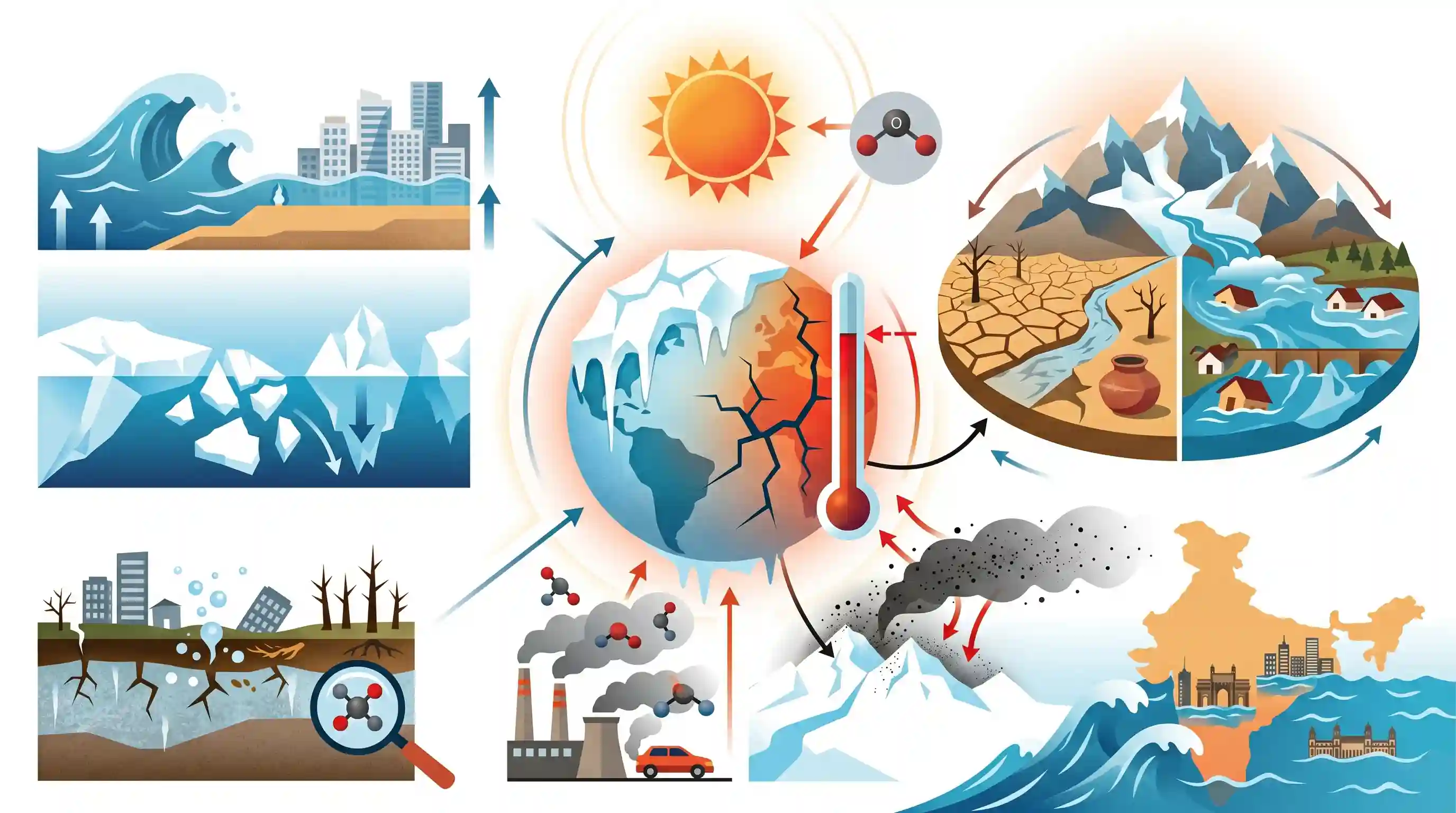
The 'State of the Cryosphere 2025' report by the International Cryosphere Climate Initiative (ICCI) issues a dire warning about the rapid loss of global ice due to climate change. With current climate pledges tracking well above the 2°C threshold, the world faces irreversible consequences, including the collapse of major ice sheets, catastrophic sea-level rise, and permafrost thawing that releases more carbon than it absorbs. For India, the impacts are two-fold: rising seas threaten coastal cities like Mumbai and Kolkata, while the melting of Himalayan glaciers induces 'hydrological whiplash'—triggering both severe water stress and glacial floods in the Ganga-Brahmaputra-Indus basin. The report highlights the urgent need to curb black carbon emissions to slow near-term Himalayan melt.
Key Points
- The ICCI's 'State of the Cryosphere 2025' report warns that global warming is nearing thresholds for irreversible Greenland and Antarctic ice sheet collapse, leading to catastrophic sea-level rise.
- Permafrost regions have crossed a tipping point, becoming net sources of greenhouse gas emissions rather than carbon sinks.
- Melting ice and warming seas are slowing major ocean currents and exacerbating ocean acidification.
- India's coastal cities (Mumbai, Kochi, Kolkata) and the Sundarbans face severe threats from accelerating sea-level rise.
- Himalayan glaciers are experiencing 'hydrological whiplash,' shifting from stable water reserves to rapid rain runoff, worsening both dry-season water stress and the risk of Glacial Lake Outburst Floods (GLOFs).
- Mitigating black carbon soot from local sources (stoves, kilns, crop residue) is critical for slowing near-term Himalayan ice melt.
Important Terms
Cryosphere

The frozen water part of the Earth system, including glaciers, ice sheets, sea ice, snow cover, and permafrost, which regulates global temperature and sea levels.
UPSC context
GS Paper 1: Physical Geography (Water bodies/ice caps); GS Paper 3: Environment (Climate change impacts).
Ambition on Melting Ice (AMI) High-level Group
A high-level group of 20+ governments, founded at COP27, focused on ensuring that the global impacts of cryosphere loss are understood by political leaders and the public.
UPSC context
GS Paper 3: International Environmental Initiatives and Climate Diplomacy (COP outcomes).
State of the Cryosphere 2025 Report
A major scientific assessment released at COP30 highlighting that global ice loss is accelerating at record rates, with current pledges leading to irreversible sea-level rise.
UPSC context
GS Paper 3: Important Reports/Indices; Environment. Tests knowledge of the 1.5°C threshold vs. 2°C impacts.
Hydrological Whiplash
The phenomenon of rapid transitions between hydrological extremes—such as sudden shifts from extreme drought to severe flooding—exacerbated by melting glaciers and climate change.
UPSC context
GS Paper 3: Disaster Management and Water Security (Flood-drought cycles in the Himalayas).
Black Carbon
A short-lived climate pollutant from incomplete combustion (soot) that accelerates ice melt by darkening snow surfaces and reducing their albedo (reflectivity).
UPSC context
GS Paper 3: Environmental Pollution and Degradation (Air pollution impacts on Himalayan glaciers).
International Cryosphere Climate Initiative (ICCI)
A network of senior policy experts and researchers that coordinates the annual State of the Cryosphere reports to inform global climate negotiations.
UPSC context
GS Paper 3: International NGOs and scientific bodies influencing climate policy.
Prelims Trap
Permafrost regions act as massive carbon sinks and will continually absorb excess anthropogenic greenhouse gases.
Recent reports confirm permafrost has crossed a tipping point, becoming a net source (emitter) of greenhouse gases like methane and CO2 due to rapid thawing, rather than a sink.
Static Concepts Connected
How does Black Carbon accelerate glacier melt and what are its sources?
- Albedo effect: Black carbon (soot) settles on ice, darkening it and drastically reducing its albedo (reflectivity), which increases solar heat absorption.
- Primary sources: Incomplete combustion of fossil fuels, biomass (wood stoves, brick kilns), and crop residue burning.
- Short-lived pollutant: It is a Short-Lived Climate Pollutant (SLCP). Unlike CO2, its atmospheric lifespan is brief, meaning immediate reduction yields fast climate benefits.
How does polar ice melt affect the Atlantic Meridional Overturning Circulation (AMOC)?
- Thermohaline circulation: AMOC is part of the global thermohaline circulation, driven by differences in ocean water temperature and salinity (density).
- Freshwater influx: Rapid melting of the Greenland ice sheet dumps massive amounts of freshwater into the North Atlantic, diluting its salinity.
- Density disruption: The diluted, fresher water is less dense and fails to sink, which slows down or potentially halts the global ocean conveyor belt.
Cross-Topic Patterns
AMOC slowdown + Indian Monsoon dynamics
The slowing of AMOC due to polar ice melt disrupts global weather, which historically and climatologically correlates with a weakened southwest monsoon over the Indian subcontinent.
Himalayan melt + NDMA GLOF guidelines
'Hydrological whiplash' ties directly into GS3 Disaster Management. Expect questions linking climate-induced Glacial Lake Outburst Floods (GLOFs) in Sikkim/Uttarakhand to specific NDMA mitigation guidelines.

Expect a 2026 Prelims question linking permafrost as a net carbon emitter, black carbon albedo effects, and AMOC slowdown.
Linked PYQs · 5
Linked PYQs · 5
- 2020MainsGS1
How will the melting of Himalayan glaciers have a far-reaching impact on the water resources of India?
- 2014MainsGS1
Bring out the relationship between the shrinking Himalayan glaciers and the symptoms of climate change in the Indian sub-continent.
- 2017MainsGS1
How does the cryosphere affect global climate?
- 2021MainsGS1
How do the melting of the Arctic ice and glaciers of the Antarctic differently affect the weather patterns and human activities on the Earth? Explain.
- 2019PrelimsGS1
Which of the following statements are correct about the deposits of 'methane hydrate'? 1. Global warming might trigger the release of methane gas from these deposits. 2. Large deposits of 'methane hydrate' are found in Arctic Tundra and under the seafloor. 3. Methane in atmosphere oxidizes to carbon dioxide after a decade or two. Select the correct answer using the code given below.
