Lucknow Division Tourism Circuit Plan and Heritage Development
Source:uni-india ↗
Why It Matters
UPPSC frequently tests candidates on the exact geographic locations of bird sanctuaries, national parks, and religious sites within Uttar Pradesh. The renaming of Nawabganj Bird Sanctuary to Shaheed Chandrashekhar Azad Bird Sanctuary and the infrastructural boost to Naimisharanya and Dudhwa are critical facts for Prelims geography and state-specific current affairs.
Summary
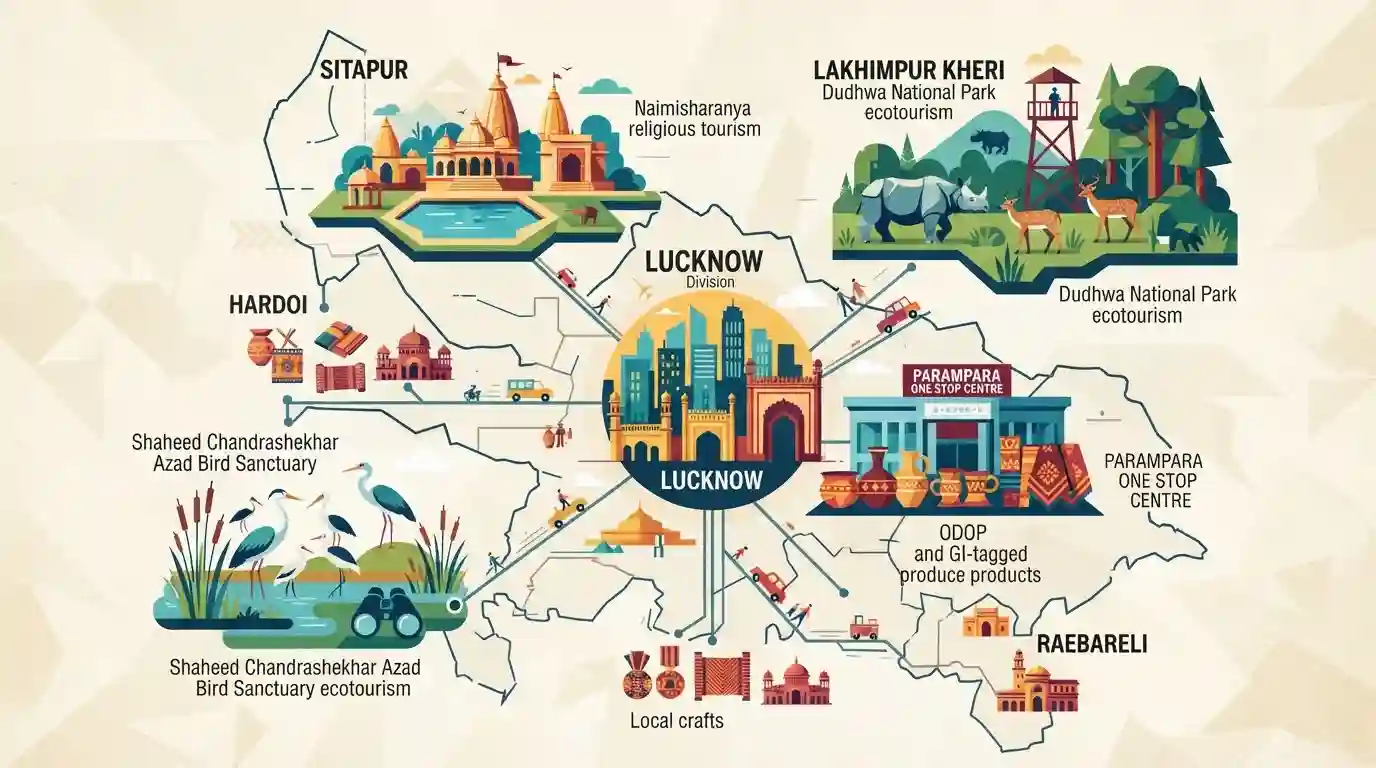
The Uttar Pradesh government has approved a multifaceted tourism plan for the Lucknow Division, strategically linking the state capital with a wider circuit of regional attractions. The initiative seeks to develop Lucknow as a gateway to prominent destinations such as Naimisharanya (Sitapur) for religious tourism, and Dudhwa National Park (Lakhimpur Kheri) and Shaheed Chandrashekhar Azad Bird Sanctuary (Unnao) for ecotourism. A notable project includes the creation of the 'Parampara One Stop Centre' in Lucknow to exhibit ODOP and GI-tagged products. These infrastructure upgrades span multiple districts including Hardoi and Raebareli, aimed at boosting local economies and preserving cultural heritage.
Key Points
- The UP Government has launched a comprehensive tourism circuit plan to establish Lucknow as a central hub linking religious, ecological, and cultural destinations in its division.
- The 'Parampara One Stop Centre for Tourism and Culture' will be developed in Lucknow to promote ODOP crafts, GI-tagged goods, and local cuisine.
- Naimisharanya in Sitapur is slated for major religious tourism upgrades, including Vedic knowledge centers, heritage pathways, and modernized pilgrim amenities.
- Ecotourism projects will upgrade facilities at Dudhwa National Park (Lakhimpur Kheri) and the Shaheed Chandrashekhar Azad Bird Sanctuary (Unnao, formerly Nawabganj Bird Sanctuary).
Important Terms
Parampara One Stop Centre

A proposed multi-facility tourism and culture gateway in Uttar Pradesh designed to showcase regional destinations, ODOP products, traditions, and heritage under one unified regional identity.
UPSC context
Relevant for UPPSC/UPSC GS1 (Culture) & GS3 (Tourism); highlights state infrastructural pushes for integrated eco-tourism.
One District One Product (ODOP)
A government initiative launched by Uttar Pradesh in 2018—and later adopted nationally—aimed at fostering regional development by identifying, branding, and promoting one distinctive indigenous product from each district.
UPSC context
Crucial for GS2 & GS3. Tests MSME growth, decentralised economic planning, export hubs, and rural livelihoods.
Dudhwa National Park
A national park in UP's Lakhimpur Kheri district established in 1977. Part of the Terai Arc Landscape, it is renowned for its swamps, Royal Bengal Tigers, Barasingha, and one-horned rhinoceros.
UPSC context
Highly tested in GS3 (Environment). Evaluates knowledge of Terai ecosystems, Project Tiger, and transboundary conservation.
Naimisharanya
An ancient Hindu pilgrimage centre along the Gomti River in Sitapur, UP. Prominently mentioned in the Mahabharata, the site is undergoing major redevelopment as a "Vedic City" for religious tourism.
UPSC context
Important for GS1 (Art & Culture). Tests geographical mapping of heritage sites and cultural tourism initiatives.
Shaheed Chandrashekhar Azad Bird Sanctuary
Formerly Nawabganj Bird Sanctuary, this Ramsar site in Unnao, UP provides crucial habitat for migratory birds. It is being upgraded with eco-tourism facilities, including a state-of-the-art AR-VR forest dome.
UPSC context
Key for Prelims & GS3 (Environment). Covers Ramsar wetlands, avian biodiversity, and protected area infrastructure.
Prelims Trap
Naimisharanya, the ancient Puranic tapobhoomi where the Mahabharata was compiled, is situated on the banks of the Ganga River.
Naimisharanya is actually located on the banks of the Gomti River (a tributary of the Ganga) in Sitapur district, not directly on the Ganga River.
Static Concepts Connected
What are the ecological features of the Dudhwa Tiger Reserve?
- Terai Arc Landscape: Represents the clay-rich swampy grasslands and moist deciduous sal forests along the Indo-Nepal transboundary ecological corridor.
- Key Wildlife: Serves as a prime habitat for the endangered swamp deer (Barasingha), Bengal florican, and reintroduced Indian one-horned rhinoceros.
- Composition: Comprises three distinct protected areas: Dudhwa National Park, Kishanpur Wildlife Sanctuary, and Katarniaghat Wildlife Sanctuary.
What is the cultural and literary significance of Naimisharanya?
- Puranic Tapobhoomi: Celebrated in Hindu tradition as the forest where 88,000 sages performed penance and where the Mahabharata and Puranas were compiled.
- Geographical Location: Situated along the Gomti River in Sitapur, UP, and mentioned in ancient texts as well as Abul Fazl's Ain-i-Akbari.
Cross-Topic Patterns
Ecotourism vs. Ramsar Conservation
Upgrading tourist facilities at Ramsar sites like Nawabganj requires navigating strict ecological regulations under the Wetland Conservation Rules, balancing infrastructure with avian habitat preservation.
GI Tags & Tourism Economics
Linking geographical indications and ODOP crafts to major tourist transit hubs like Lucknow demonstrates how intellectual property rights can drive regional economic growth.

UP's protected areas (Dudhwa, Katarniaghat) and their river systems (Gomti, Ghaghara) are highly probable matches in map-based Prelims MCQs.
Linked PYQs · 3
Linked PYQs · 3
- 2022UPPSC_PRELIMSGS1
Dudhwa National Park is located in which of the following districts of Uttar Pradesh?
- 2005UPPSC_PRELIMSGS1
In Uttar Pradesh Nawabganj Bird Sanctuary is located in the district:
- 2025UPPSC_PRELIMSGS1
Which of the following Ramsar wetland site is/are NOT situated in Uttar Pradesh? 1. Sarsai Nawar Jheel 2. Samaspur Bird Sanctuary 3. Rudrasagar Lake 4. Sultanpur National Park Select the correct answer from the code given below:
