Uttarakhand transitions toward industrial and manufacturing hub
Source:businesstoday ↗
Why It Matters
Highly relevant for UKPSC aspirants studying the economic geography, industrial development, and policy framework of Uttarakhand.
Summary
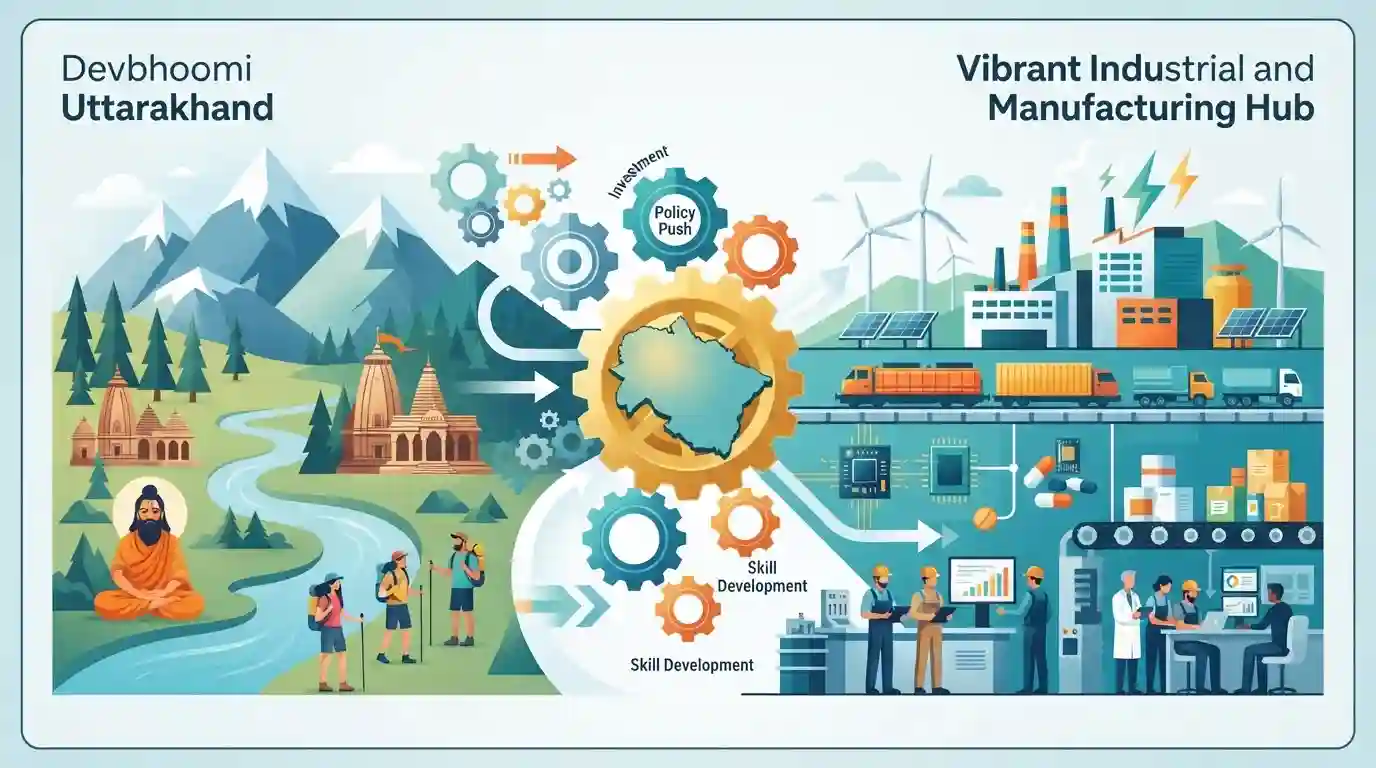
The article discusses Uttarakhand's evolution from a purely tourism and spirituality-focused state ('Devbhoomi') into a vibrant industrial and manufacturing hub, highlighting the government's push for economic development, industrial policies, and regional investments.
Key Points
- Uttarakhand is transitioning from its identity primarily as Devbhoomi (Land of Gods) to an emerging industrial and manufacturing destination.
- The state is focusing on boosting manufacturing, infrastructure, and investments to accelerate economic development across its hill and plain regions.
- Policy initiatives are being targeted to balance ecological preservation with sustainable industrial growth and employment generation.
Important Terms
Uttarakhand Government

The state government of Uttarakhand, responsible for formulating administrative, economic, and industrial policies such as the MSME Policy and Mega Industrial Policy to drive economic growth and job creation.
UPSC context
UKPSC Paper 5 (Economy of Uttarakhand): Important for questions on state-level planning, industrial growth strategies, and governance initiatives.
Uttarakhand Mega Industrial and Investment Policy 2025
A state policy introduced to position Uttarakhand as a premier national and international destination for capital investment, offering structured capital subsidies and tax incentives for large manufacturing enterprises.
UPSC context
UKPSC Paper 5 / Mains: Tests knowledge of state industrial policies, investment promotion, and economic diversification.
Devbhoomi
A popular epithet for Uttarakhand denoting its spiritual significance as the 'Land of the Gods', historically associated with pilgrimage and tourism rather than heavy industry.
UPSC context
UKPSC Paper 5 (Geography and Culture of Uttarakhand): Frequently tested in questions regarding the cultural identity and economic transformation of the hill state.
Prelims Trap
Uttarakhand's industrial policy offers identical capital subsidies and manufacturing incentives across all its hill and plain districts without ecological zoning.
Aspirants often assume state industrial policies apply uniformly across all districts, missing the distinction between eco-sensitive hill districts and plain manufacturing hubs.
Static Concepts Connected
What are the key pillars of Uttarakhand's Industrial and Service Sector Policy?
- Sectoral Focus: Focuses on MSMEs, auto-ancillaries, pharmaceuticals, and IT sectors across designated zones.
- Fiscal Incentives: Provides capital subsidies, stamp duty exemptions, and power tariff concessions to attract private investment.
- Zonal Strategy: Promotes green industries in hill districts (Category A & B) while encouraging heavy manufacturing in plain districts like Udham Singh Nagar and Haridwar.
Cross-Topic Patterns
Industrial Policy vs. Eco-Fragility in Hill States
Industrial development in hill states must navigate fragile mountain ecosystems, connecting economic policy with environmental impact assessments and disaster management frameworks.

Uttarakhand's industrial transition will likely feature in Mains questions on hill-state economic models balancing eco-preservation and growth.
Linked PYQs · 2
Linked PYQs · 2
- 2021UKPSC_PRELIMSGS1
In how many hill districts of Uttarakhand, Tea Development Programme was carried out during the year 2020-2021?
- 2024UKPSC_PRELIMSGS1
UTDB is established in Uttarakhand to promote:
