Mumbai Fire Stations lead Municipal Net Zero Energy Transition
Source:Indian Express ↗
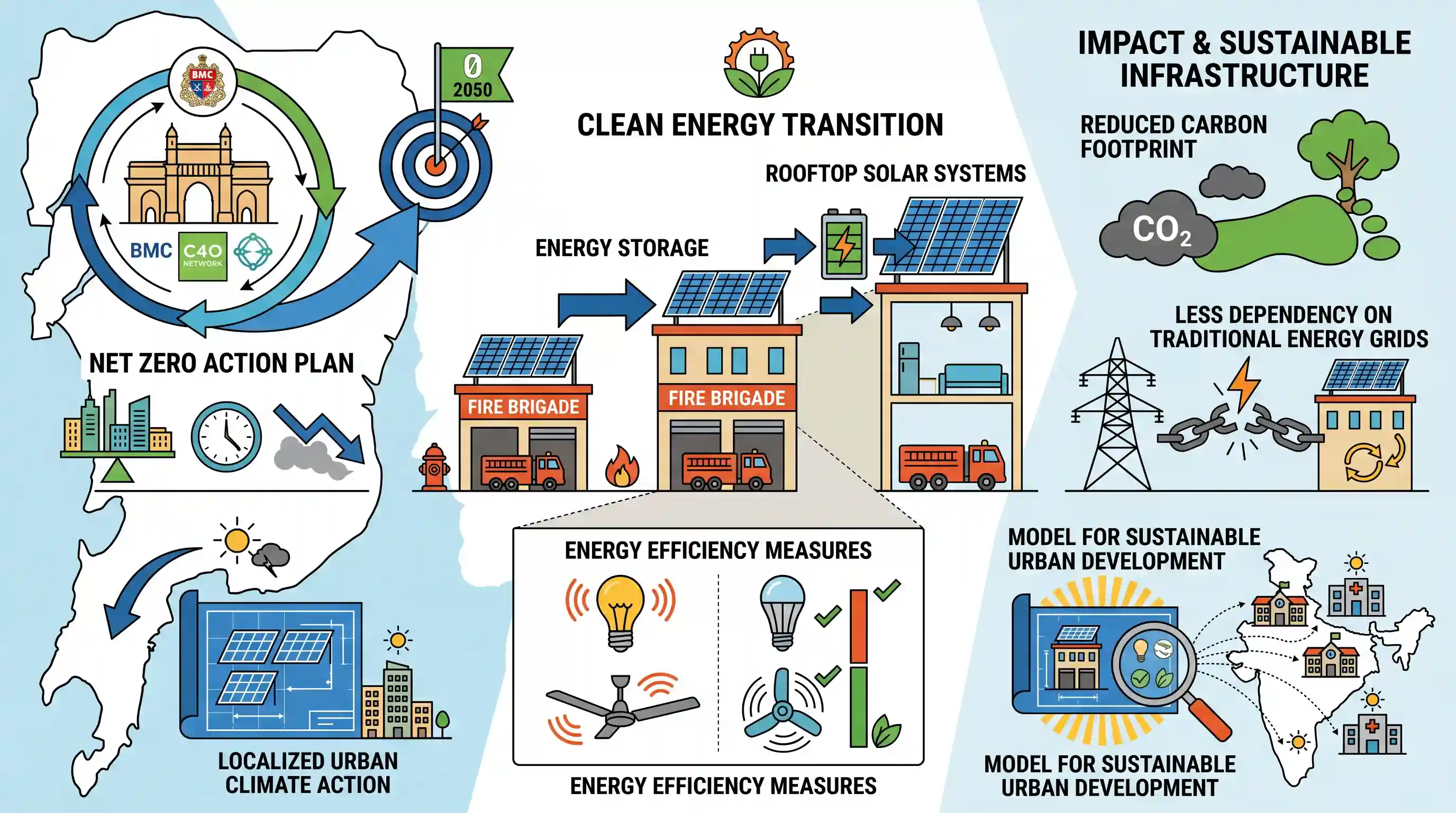
Why It Matters
The article provides a localized, actionable case study of urban municipal governance tackling climate change. It is highly relevant for GS3 questions on renewable energy adoption, sustainable infrastructure, and India's net-zero targets, as well as for GS2 on urban local bodies taking proactive governance measures.
Summary
The Brihanmumbai Municipal Corporation (BMC) is spearheading a clean energy transition by installing rooftop solar systems on Mumbai's fire brigades. Guided by a "Net Zero Action Plan" formulated by the C40 network, the initiative aims for municipal buildings to achieve net-zero energy by 2050. The project integrates solar power generation with energy efficiency measures, such as the use of LEDs and BLDC fans, reducing the city's carbon footprint and dependency on traditional energy grids. This serves as a leading model for localized urban climate action and sustainable infrastructure in India.
Key Points
- The Brihanmumbai Municipal Corporation (BMC) is installing rooftop solar systems on Mumbai's fire brigade stations to transition towards net-zero energy.
- The first phase of the project targets 18 fire brigade locations, complementing the 11 stations that already have solar panels.
- C40 cities developed a 'Net Zero Action Plan' for municipal buildings in Mumbai and Panvel, aiming for net-zero energy in existing buildings and net-zero carbon in new buildings by 2050.
- Alongside solar generation, BMC is enhancing energy efficiency by replacing conventional fixtures with LEDs and BLDC fans.
- This localized urban initiative contributes to reducing the carbon footprint of municipal operations and exemplifies practical climate action at the city level.
Important Terms
Mumbai Climate Action Plan (MCAP)

A 30-year roadmap (2022-2050) launched by the BMC to tackle climate change. It aims for net-zero emissions by 2050 through six key areas, including energy and transport.
UPSC context
GS III (Environment); India’s first city-level climate plan, testing sub-national action towards global climate goals.
Net Zero Emissions
A state where an entity's greenhouse gas emissions are balanced by equivalent removals from the atmosphere. While India’s national target is 2070, Mumbai aims for 2050.
UPSC context
GS III (Environment); central to the Paris Agreement and India’s 'Panchamrit' commitments to limit global warming.
C40 Cities
A global network of nearly 100 megacity mayors (including Mumbai) committed to halving emissions by 2030 and reaching net-zero through performance-based climate standards.
UPSC context
GS II (International Relations); represents 'city diplomacy' and the role of local governments in global environmental governance.
Brihanmumbai Municipal Corporation (BMC)
The civic body governing Mumbai, responsible for urban infrastructure and public health. It is the lead implementing agency for the city's climate and energy transitions.
UPSC context
GS II (Local Governance); relates to the 74th Amendment and the functional capacity of Urban Local Bodies (ULBs).
Rooftop Solar
Photovoltaic systems installed on building roofs to generate decentralized electricity, reducing carbon footprints and dependency on the centralized fossil-fuel power grid.
UPSC context
GS III (Energy/Infrastructure); tests knowledge of renewable energy targets and decentralized power generation.
BEST (Brihanmumbai Electric Supply and Transport)
Mumbai's public utility providing electricity and bus services. It is a key player in the city's decarbonization through the adoption of electric vehicle (EV) fleets.
UPSC context
GS III (Infrastructure/Transport); relevant for sustainable urban mobility and national schemes like FAME-II.
Prelims Trap
Mumbai aligns its municipal net-zero target with India's national deadline of 2070.
Mumbai's Climate Action Plan (MCAP) aims for net-zero by 2050, which is two full decades ahead of India's national 2070 target declared at COP26.
Static Concepts Connected
What is the C40 Cities Climate Leadership Group?
- Global network: A global network of nearly 100 mayors collaborating to drive urgent, science-based climate action.
- Primary objective: To halve collective fossil fuel use within a decade and limit global heating to 1.5°C, aligned with the Paris Agreement.
- Indian participation: Multiple Indian cities are active participants, including Mumbai, Delhi (NCT), Chennai, Bengaluru, Ahmedabad, and Kolkata.
How do BLDC motors and Net Metering drive urban energy transitions?
- BLDC technology: Brushless Direct Current (BLDC) motors use electronic commutation instead of physical carbon brushes, drastically reducing energy loss, heat dissipation, and maintenance needs.
- Net Metering: A billing mechanism that credits localized renewable energy producers (like rooftop solar owners) for any surplus electricity they export back to the central grid.
Cross-Topic Patterns
Paradiplomacy in Climate Action
Cities directly engaging in global networks (like C40) without central mediation reflects "paradiplomacy", a growing trend where sub-national actors lead global environmental governance.
NZEB vs Standard Green Building Ratings
While GRIHA and LEED certify broader environmental parameters (water, materials), Net Zero Energy Buildings (NZEB) strictly focus on ensuring annual renewable generation matches or exceeds operational energy consumption.

Expect a comparative Prelims statement contrasting India’s 2070 Panchamrit goal with aggressive 2050 sub-national targets like Mumbai's.
Linked PYQs · 4
Linked PYQs · 4
- 2020MainsGS3
Describe the benefits of deriving electric energy from sunlight in contrast to the conventional energy generation. What are the initiatives offered by our Government for this purpose?
- 2022MainsGS3
Do you think India will meet 50 percent of its energy needs from renewable energy by 2030 ? Justify your answer. How will the shift of subsidies from fossil fuels to renewables help achieve the above objective ? Explain.
- 2016PrelimsGS1
'Net metering' is sometimes seen in the news in the context of promoting the
- 2024PrelimsGS1
Consider the following statements: Statement-I : The European Parliament approved The Net-Zero Industry Act recently. Statement-II: The European Union intends to achieve carbon neutrality by 2040 and therefore aims to develop all of its own clean technology by that time. Which one of the following is correct in respect of the above statements?
