US Iran Conflict Impact on Strait of Hormuz Energy Security
Source:The Hindu ↗
Why It Matters
The geopolitics of the Middle East and the stability of the Strait of Hormuz are critical to India's energy security and diaspora interests. Understanding the US-Iran dynamic, particularly around the JCPOA and maritime chokepoints, is essential for answering questions on international relations and global economic impacts.
Summary
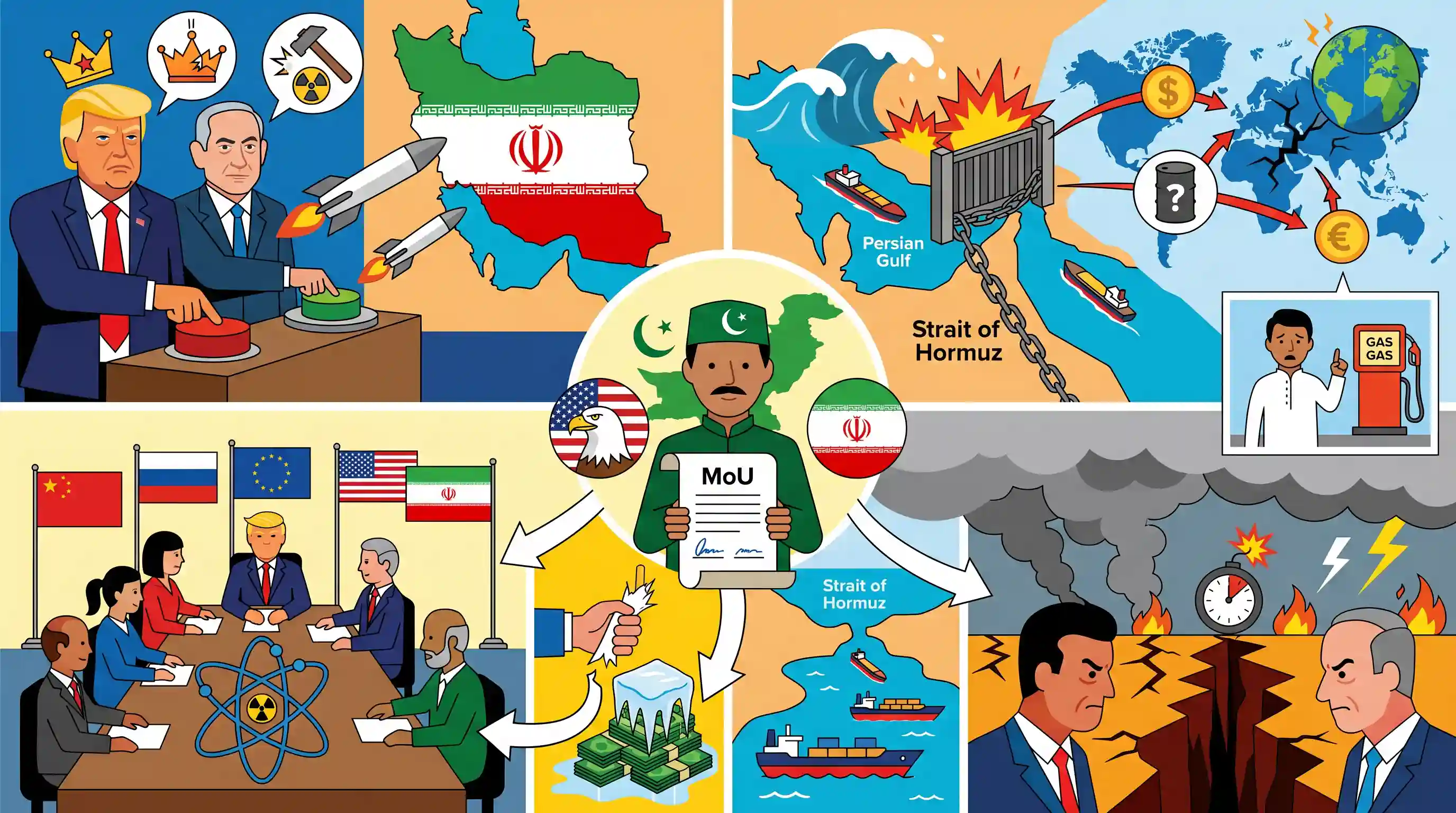
The editorial critically examines the recent US-Iran conflict initiated by Donald Trump and Benjamin Netanyahu. Intended to force regime change and dismantle Iran's nuclear infrastructure, the war backfired as Iran launched retaliatory strikes and choked off the Strait of Hormuz. The ensuing global economic pressure forced the US to agree to a temporary ceasefire brokered through Pakistan. Under the MoU, blockades and frozen funds are to be lifted in exchange for restoring maritime traffic. The crisis has forced negotiations back to the nuclear issue, echoing the 2015 JCPOA. The editorial warns that unless the deep-seated trust deficit is addressed, the region remains highly volatile.
Key Points
- The US and Israel launched a war against Iran on February 28, aiming for regime change, dismantling nuclear capabilities, and weakening Iran's regional allies.
- Iran retaliated forcefully by striking US bases in the Persian Gulf and taking control of the strategic Strait of Hormuz, causing massive global economic disruption.
- A temporary ceasefire was brokered via an MoU drafted by Pakistan, wherein Iran agreed to reopen the Strait of Hormuz in exchange for the US lifting port blockades and unfreezing Iranian funds.
- The conflict\'s focus has narrowed back to Iran\'s nuclear program, resembling the 2015 JCPOA framework that Donald Trump abandoned in 2018.
- A severe trust deficit remains between the US and Iran, leaving the broader Middle Eastern crisis unresolved despite the temporary truce.
Important Terms
Joint Comprehensive Plan of Action (JCPOA)

A 2015 deal between Iran and P5+1 powers to restrict Iran's nuclear enrichment in exchange for relief from international economic sanctions.
UPSC context
GS-II International Relations; crucial for analyzing India’s energy security and regional connectivity projects like Chabahar.
Strait of Hormuz
A vital maritime chokepoint between Iran and Oman connecting the Persian Gulf to the Arabian Sea, through which 20% of global oil passes.
UPSC context
GS-I Geography and GS-III Energy Security; its closure directly impacts India's crude oil prices and current account deficit.
Maritime Chokepoint
A strategic maritime passage that can be easily blocked, often used as leverage in geopolitical conflicts to disrupt global trade or energy supplies.
UPSC context
GS-I World Geography; tests knowledge of strategic waterways like Hormuz, Malacca, and Bab-el-Mandeb.
Regime Change
The forced replacement of a sovereign government by an external power through military, economic, or covert political intervention.
UPSC context
GS-II International Relations; involves critical analysis of US foreign policy in West Asia and its regional stability implications.
Memorandum of Understanding (MoU)
A formal diplomatic document outlining an agreement between parties, often used in international law as a precursor to a binding treaty.
UPSC context
GS-II Bilateral Agreements; tests understanding of diplomatic instruments used in India's foreign relations.
Diplomatic Mediation
Intervention by a third party (e.g., Pakistan) to help conflicting states reach a peaceful settlement or a temporary ceasefire.
UPSC context
GS-II International Relations; focuses on the role of regional powers in resolving conflicts affecting global stability.
Prelims Trap
"The Strait of Hormuz is a strategic chokepoint connecting the Persian Gulf to the Red Sea."
Aspirants often confuse Middle East chokepoints. Hormuz links the Persian Gulf to the Gulf of Oman, while Bab-el-Mandeb links the Red Sea to the Gulf of Aden.
Static Concepts Connected
What are the key strategic maritime chokepoints in the Middle East?
- Strait of Hormuz: Connects the Persian Gulf to the Gulf of Oman and the Arabian Sea; critical for global oil transit.
- Bab-el-Mandeb: Connects the Red Sea to the Gulf of Aden and the Arabian Sea, serving as the gateway to the Suez Canal.
- Suez Canal: An artificial sea-level waterway connecting the Mediterranean Sea to the Red Sea, enabling direct Europe-Asia shipping.
What was the framework of the 2015 Joint Comprehensive Plan of Action (JCPOA)?
- P5+1 Membership: Negotiated between Iran and the P5 (US, UK, France, Russia, China) plus Germany and the European Union.
- The Core Bargain: Iran agreed to severely limit uranium enrichment and allow IAEA inspections in exchange for relief from international economic sanctions.
Cross-Topic Patterns
Energy Security + CAD + Remittance Economics
Middle East volatility directly impacts India's macroeconomic stability by inflating the Current Account Deficit (CAD) via high crude prices and threatening vital NRI remittances.
Pakistan's evolving strategic utility
Brokering the US-Iran ceasefire provides Pakistan renewed strategic leverage with Washington, shifting its relevance from the Afghan theater to Gulf geopolitics and complicating India's isolation strategy.

Map locations (Hormuz) + India's Strategic Petroleum Reserves and CAD vulnerabilities are prime targets for a linked 2026 Prelims Q.
Linked PYQs · 3
Linked PYQs · 3
- 2018MainsGS2
In what ways would the ongoing US-Iran Nuclear Pact Controversy affect the national interest of India? How should India respond to this situation?
- 2012MainsGS2
How have the US sanctions against Iran affected India's bilateral relations with Iran?
- 2024PrelimsGS1
Consider the following statements : Statement-I : Sumed pipeline is a strategic route for Persian Gulf oil and natural gas shipments to Europe. Statement-II : Sumed pipeline connects the Red Sea with the Mediterranean Sea. Which one of the following is correct in respect of the above statements?
