Assam Pygmy Hog Conservation Programme and Habitat Restoration
Source:Indian Express ↗
ఇది ఎందుకు ముఖ్యం
The article provides a textbook case study of successful species recovery and rewilding in India, offering crucial insights into wildlife conservation strategies, captive breeding, and grassland habitat restoration relevant to GS3 Environment.
సారాంశం
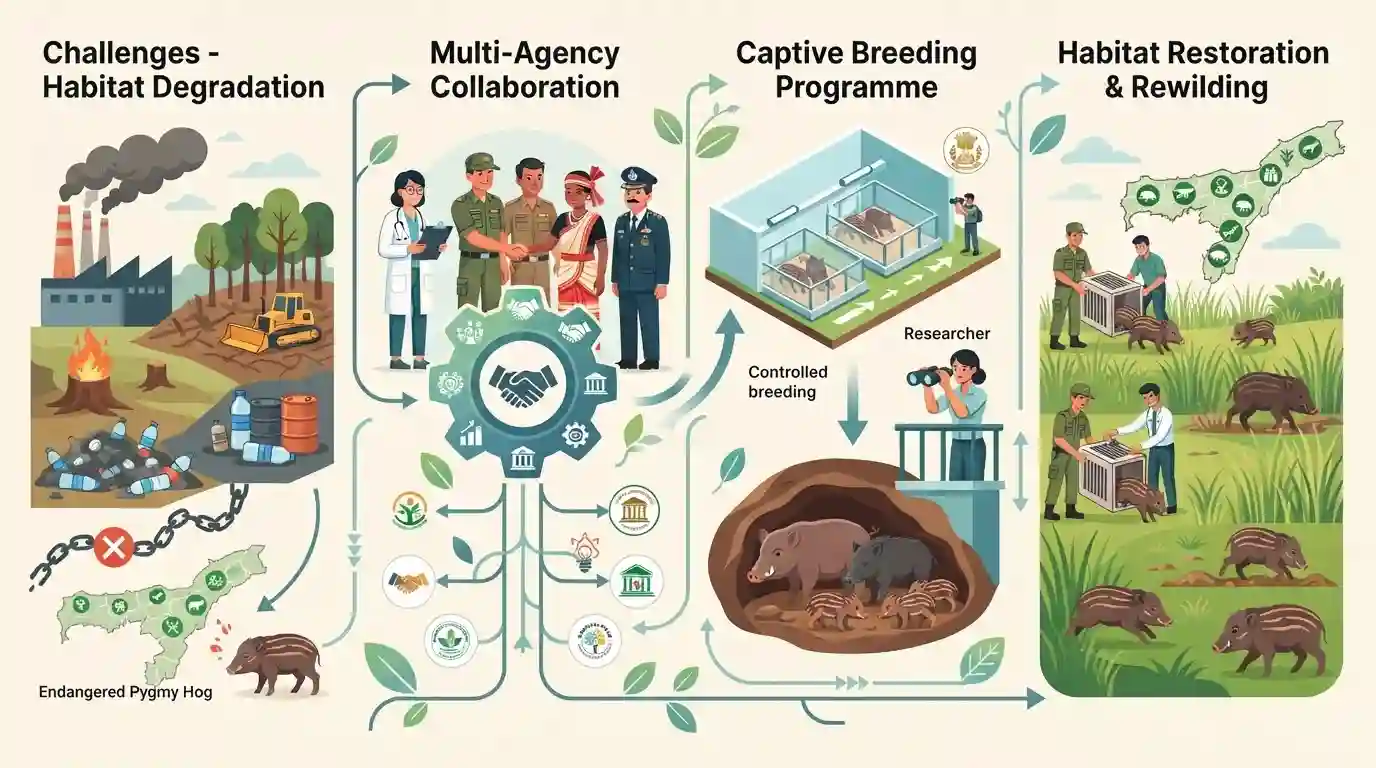
An overview of the successful conservation and rewilding journey of the Pygmy Hog in Assam through the Pygmy Hog Conservation Programme (PHCP), highlighting habitat restoration, captive breeding, and collaborative multi-agency efforts.
ముఖ్య అంశాలు
- The Pygmy Hog (Porcula salvania), the world's smallest wild pig, has seen its population rise from just 6 individuals to 194 rewilded hogs through concerted conservation efforts in Assam.
- The Pygmy Hog Conservation Programme (PHCP) was initiated in 1996 by the Durrell Wildlife Conservation Trust in collaboration with the Assam Forest Department, MoEFCC, and partners like Aranyak.
- Conservation success highlights the effectiveness of captive breeding coupled with systematic rewilding and grassland habitat restoration in protected areas like Manas National Park, Barnadi Wildlife Sanctuary, and Orang National Park.
- Pygmy hogs are indicator species for tall, wet grassland ecosystems, which are often overlooked compared to major forest or wetland conservation projects.
ముఖ్యమైన పదాలు
Pygmy Hog Conservation Programme (PHCP)

A collaborative species recovery initiative launched in 1996 in Assam to save the world's rarest wild pig through captive breeding, habitat restoration, and successful rewilding.
UPSC context
UPSC Prelims/Mains (GS Paper III): Important for biodiversity conservation, species recovery programs, and endangered fauna in Northeast India.
Durrell Wildlife Conservation Trust
An international conservation organization founded by Gerald Durrell that co-initiates and supports grassroots species recovery and rewilding initiatives globally, including the PHCP.
UPSC context
UPSC Prelims/Mains (GS Paper III): Relevant for international conservation partnerships and NGOs involved in Indian wildlife preservation.
Aaranyak
A premier biodiversity conservation research organization based in Assam that actively partners in implementing science-backed wildlife conservation and community outreach programs.
UPSC context
UPSC Prelims/Mains (GS Paper III): Key regional NGO example for environment and biodiversity protection questions.
IUCN (International Union for Conservation of Nature)
The international body that assesses species extinction risk and maintains the Red List of Threatened Species, which reclassified the pygmy hog from 'critically endangered' to 'endangered'.
UPSC context
UPSC Prelims: Essential for understanding global conservation statuses, Red List categories, and international environmental frameworks.
Wildlife (Protection) Act, 1972
India's apex legislation for the protection of wild animals, birds, and plants, providing legal backing and sanctuary frameworks for endangered species conservation.
UPSC context
UPSC Prelims/Mains (GS Paper III): Core statutory framework tested frequently regarding protected areas, schedules, and environmental governance.
ప్రిలిమ్స్ ఉచ్చు
All wild pigs in India share the same legal protection status under the Wildlife Protection Act, 1972.
Aspirants often assume all wild pigs or boars are common vermin under Schedule V. The Pygmy Hog is strictly protected under Schedule I of the WPA, 1972.
అనుసంధానమైన స్థిర భావనలు
What are the key legal provisions and conservation categories under India's Wildlife (Protection) Act, 1972?
- Statutory Schedules: Six distinct schedules offering varying degrees of legal protection, with Schedule I providing absolute protection and highest penalties.
- Protected Areas: Empowers state governments to notify wildlife sanctuaries, national parks, and community reserves for in-situ conservation.
- Advisory Bodies: Provides statutory backing to bodies like the National Board for Wildlife (NBWL) chaired by the Prime Minister.
అంతర-అంశ నమూనాలు
Grassland Restoration vs. Forest Rights Act
Grassland conservation like the Pygmy Hog project intersects with Schedule I wildlife protection and tribal rights over forest produce in protected areas under FRA 2006.
Collaborative Conservation & Schedule I Species
The PHCP model demonstrates how international NGOs, state forest departments, and local groups like Aaranyak can co-manage endangered endemic species under WPA 1972.

Endemic indicator species + Schedule I status under WPA 1972 makes pygmy hog rewilding a prime candidate for a multi-statement prelims question.
అనుసంధాన PYQలు · 3
అనుసంధాన PYQలు · 3
- 2022PrelimsGS1
With reference to Indian laws about wildlife protection, consider the following statements : 1. Wild animals are the sole property of the government. 2. When a wild animal is declared protected, such animal is entitled for equal protection whether it is found in protected areas or outside. 3. Apprehension of a protected wild animal becoming a danger to human life is sufficient ground for its capture or killing. Which of the statements given above is/are correct?
- 2017PrelimsGS1
In India, if a species of tortoise is declared protected under Schedule I of the Wildlife (Protection) Act, 1972, what does it imply?
- 2025PrelimsGS1
Regarding Peacock tarantula (Gooty tarantula), consider the following statements : I. It is an omnivorous crustacean. II. Its natural habitat in India is only limited to some forest areas. III. In its natural habitat, it is an arboreal species. Which of the statements given above is/are correct?
