Assam conservation program successfully reintroduces pygmy hogs
Source:Indian Express ↗
આ શા માટે મહત્વનું છે
Provides a concrete case study of successful species reintroduction and grassland ecosystem conservation in India, directly aligning with UPSC syllabus requirements on biodiversity, wildlife protection, and environmental management.
સારાંશ
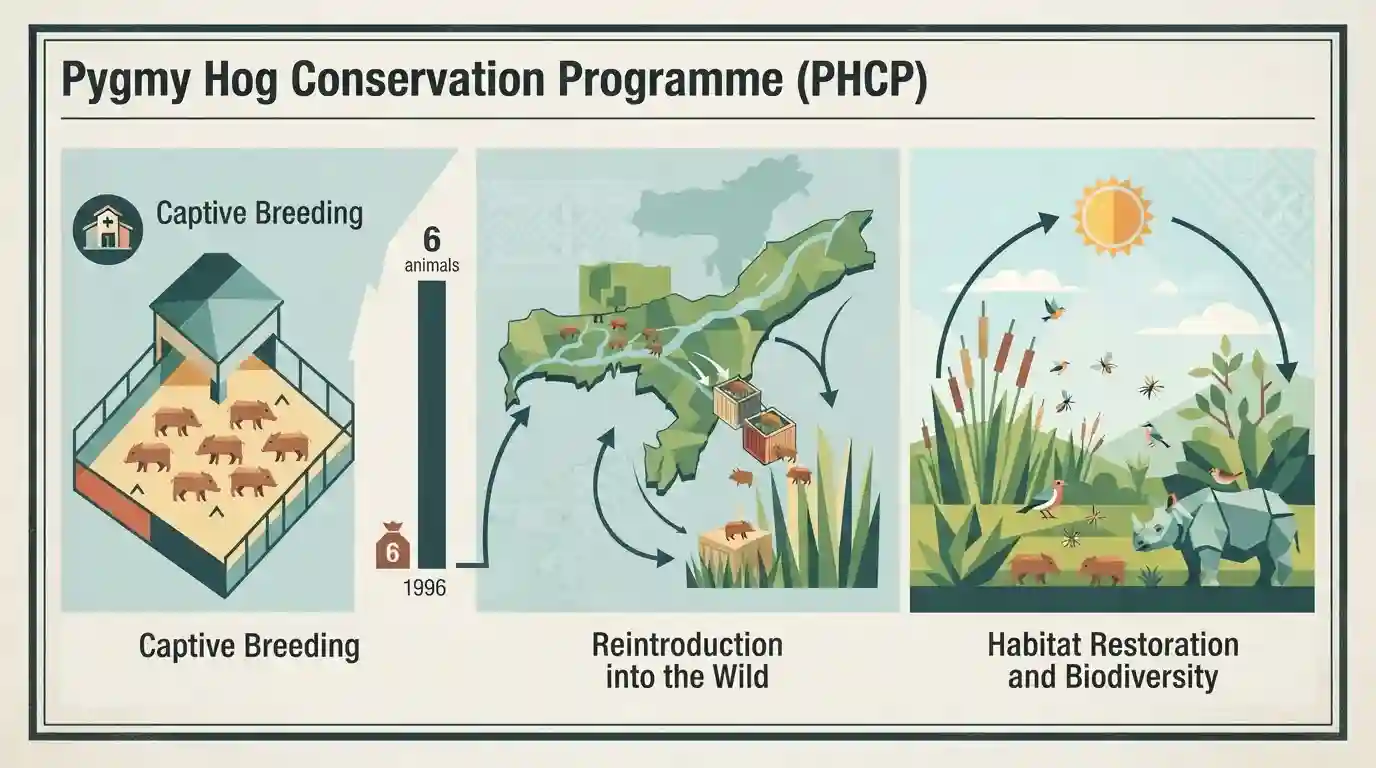
Assam's conservation success with the endangered pygmy hog (Porcula salvania)—growing from a captive base of 6 animals in 1996 to 194 reintroduced members in the wild via the Pygmy Hog Conservation Programme (PHCP)—highlights the role of captive breeding, flagship species management, and habitat restoration in biodiversity conservation.
મુખ્ય મુદ્દા
- The pygmy hog (Porcula salvania), India's only endemic wild pig and one of the world's rarest mammals, has grown in number from 6 captured in 1996 to 194 bred and reintroduced into the wild through the Pygmy Hog Conservation Programme (PHCP).
- In June 2026, 15 captive-bred pygmy hogs were released into the Kuribeel grasslands of Manas National Park, marking a return to an area where they had been absent for nine years.
- Pygmy hogs are indicator or flagship species for tall, wet grasslands of the Himalayan foothills; protecting them helps preserve the wider grassland ecosystem.
- The Ministry of Environment, Forest and Climate Change has included the pygmy hog under its Species Recovery Programme, with plans to expand reintroductions to Jaldapara (West Bengal) and Uttar Pradesh.
મહત્વપૂર્ણ શબ્દો
Pygmy Hog Conservation Programme (PHCP)

A collaborative conservation initiative launched in 1996 in Assam to save the endangered pygmy hog from extinction via captive breeding, habitat restoration, and successful reintroduction into the wild.
UPSC context
GS Paper III (Environment & Biodiversity). Tests knowledge of species recovery programmes, endangered fauna conservation, and wildlife management in India.
Species Recovery Programme
Structured institutional efforts combining captive breeding, habitat protection, and managed reintroductions to restore critically endangered wild species to their native ecosystems.
UPSC context
GS Paper III (Biodiversity Conservation). Evaluates understanding of in-situ and ex-situ conservation strategies and policy frameworks for endangered species.
Wildlife Institute of India
An autonomous national institution under the Ministry of Environment, Forest and Climate Change, located in Dehradun, specializing in wildlife research, training, and conservation advisory.
UPSC context
GS Paper III (Environment). Tests awareness of key environmental institutions, scientific advisory bodies, and wildlife research frameworks in India.
Ministry of Environment, Forest and Climate Change
The nodal Union ministry responsible for planning, promoting, and coordinating environmental, forestry, and wildlife policies and programs across India.
UPSC context
GS Paper II (Governance) & GS Paper III (Environment). Tests governance structures, environmental administration, and policy implementation in India.
સંલગ્ન સ્થિર ખ્યાલો
What are the key criteria and categories under the IUCN Red List and WPA 1972?
- IUCN Definition: Critically Endangered status applies when a species faces an extremely high risk of extinction in the wild.
- WPA Schedule I: Schedule I of the Wildlife Protection Act 1972 affords the highest level of legal protection and absolute prohibition on hunting.
- Endemic Vulnerability: Endemic species are restricted to a specific geographical region, making them exceptionally vulnerable to habitat fragmentation and local eradication.
આંતર-વિષય પેટર્ન
Grassland Conservation vs. Forest Rights Act
Grassland ecosystem conservation is tied to state-level tribal displacement issues, grazing rights conflicts, and the 2006 Forest Rights Act implementation.
Manas UNESCO Heritage & Insurgency Recovery
Manas National Park's restoration trajectory reflects how transboundary security, insurgency decline, and UNESCO World Heritage status recovery intersect.

Pygmy hog conservation + grassland ecology + Wildlife Protection Act schedules is a high-yield prelims matching triplet.
સંલગ્ન PYQ · 3
સંલગ્ન PYQ · 3
- 2020PrelimsGS1
Which one of the following protected areas is well-known for the conservation of a sub-species of the Indian swamp deer (Barasingha) that thrives well on hard ground and is exclusively graminivorous?
- 2026PrelimsGS1
With reference to Madhav National Park, which of the following statements is/are correct ? 1. It was declared a Tiger Reserve in India in 2025. 2. Sakhya Sagar, which is designated as a Ramsar Site, is situated within this National Park. 3. Its area is shared between Madhya Pradesh and Rajasthan. Select the answer using the code given below :
- 2019PrelimsGS1
Which one of the following National Parks lies completely in the temperate alpine zone?
