Legislative disruptions and challenges to democratic bodies
Source:The Hindu ↗
Why It Matters
The persistent issue of parliamentary disruptions directly affects the legislative output and accountability of the executive, forming a core area of the GS-2 Polity syllabus. The article provides the Presiding Officer's perspective on restoring the quality of debates, the importance of cooperative federalism, and public participation in lawmaking, all of which are highly relevant for Mains answers.
Summary
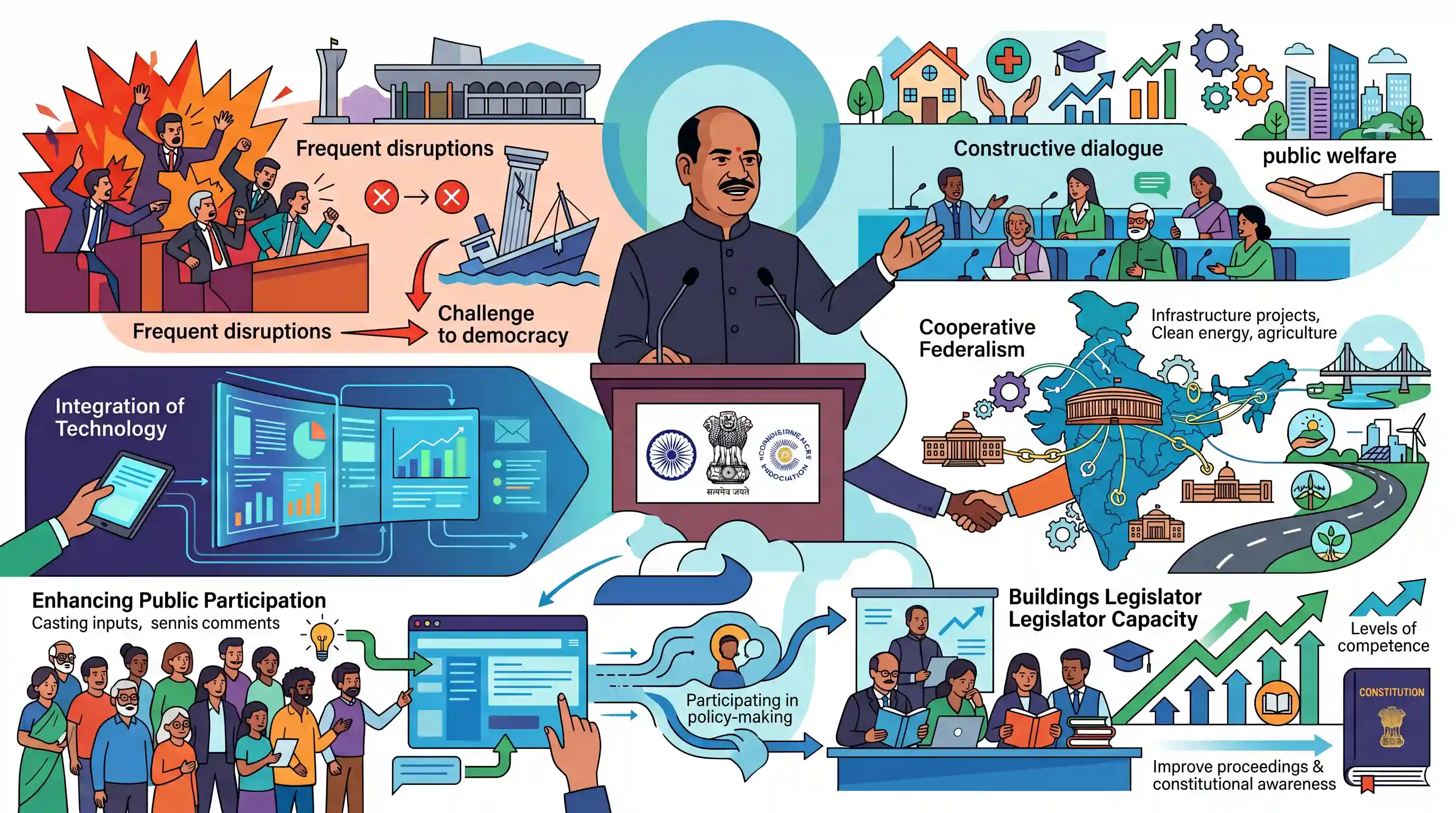
Speaking at the 10th Commonwealth Parliamentary Association (CPA) India Region Zone-II conference in Chandigarh, Lok Sabha Speaker Om Birla raised serious concerns over frequent disruptions in legislative bodies, terming them a major challenge to democracy. He stressed that Parliament and State Assemblies should be forums for constructive dialogue and public welfare, not deadlock. Emphasizing the principles of cooperative federalism, he urged the Centre and States to align their efforts for national development. Birla also called for integrating technology, enhancing public participation in policy-making, and building the capacity of legislators to improve the overall quality of parliamentary proceedings and constitutional awareness.
Key Points
- Lok Sabha Speaker Om Birla highlighted that frequent disruptions in Parliament and State Assemblies are a significant threat to democratic institutions.
- Legislatures must function as centers of meaningful dialogue and discussion to fulfill public expectations, rather than sites of deadlock.
- Elected representatives should prioritize the welfare of the most marginalized individuals in society when framing policies and laws.
- The Speaker emphasized cooperative federalism, urging the Centre and States to work together to meet the aspirations of a developed India by 2047.
- Key reform areas identified included capacity building of legislators, increased use of technology, public participation in lawmaking, and fostering constitutional awareness among citizens.
Important Terms
Speaker of the Lok Sabha

The constitutional head of the Lok Sabha who ensures orderly conduct, protects members' privileges, and determines the legislative agenda while maintaining neutrality during house proceedings.
UPSC context
GS Paper II: Functions and responsibilities of constitutional bodies; role in legislative discipline and anti-defection law.
Commonwealth Parliamentary Association (CPA)
An international organization of around 180 parliaments promoting democratic governance, the rule of law, and cooperation among legislatures within Commonwealth nations through conferences and workshops.
UPSC context
GS Paper II: International forums and their role in strengthening parliamentary democracy and legislative best practices.
Cooperative Federalism
A constitutional concept where central and state governments work as partners, sharing responsibilities and resources to solve common national challenges and achieve developmental goals.
UPSC context
GS Paper II: Federal structure, Centre-State relations, and mechanisms like NITI Aayog that foster collaboration.
Legislative Disruptions
The intentional obstruction of parliamentary proceedings through shouting, entering the well, or placards, which reduces legislative productivity and hinders executive accountability.
UPSC context
GS Paper II: Functioning of Parliament and State Legislatures; impact on the quality of law-making and democratic ethics.
Vidhan Sabha
The directly elected lower (or only) house of a State Legislature, acting as the primary forum for law-making and executive accountability at the state level.
UPSC context
GS Paper II: Structure and functioning of the State Legislature; federal relations and regional representation.
Prelims Trap
Both the Lok Sabha Speaker and Rajya Sabha Chairman can automatically suspend disrupting members.
Only the Lok Sabha Speaker holds the power of 'automatic suspension' (Rule 374A). The Rajya Sabha Chairman can direct withdrawal, but suspension requires a formal motion (Rule 256).
Static Concepts Connected
What are the mechanisms for suspending disrupting MPs in Parliament?
- Direction to withdraw: Rule 373 (LS) / 255 (RS) allows the presiding officer to direct a member to immediately withdraw for the remainder of the day's sitting.
- Formal suspension motion: Under Rule 374 (LS) / 256 (RS), the presiding officer 'names' a member, followed by a House motion to suspend them for the session.
- Automatic suspension (LS): Rule 374A, exclusive to Lok Sabha, allows automatic suspension for 5 consecutive sittings or remainder of the session for grave disorder.
What is the Pre-Legislative Consultation Policy (PLCP) of 2014?
- Public domain mandate: Ministries must place draft legislative proposals in the public domain for at least 30 days to invite feedback before Cabinet approval.
- Required disclosures: Drafts must include a brief justification, estimated financial implications, and potential impact of the proposed legislation.
- Non-statutory nature: It is an executive guideline rather than a legally binding statute, which often results in ministries bypassing the public consultation process.
Cross-Topic Patterns
Parliament Productivity + Executive Accountability
Frequent disruptions lead to bypassing Departmentally Related Standing Committees (DRSCs) and passing bills without debate, severely undermining the legislature's ability to hold the executive accountable.
Role of Speaker + Anti-Defection
Debates around the Speaker's neutrality in managing legislative disruptions often link back to their quasi-judicial powers under the Tenth Schedule, a recurring GS2 Mains theme.

Expect a comparative Prelims question on the disciplinary powers of the LS Speaker vs RS Chairman regarding the suspension of members.
Linked PYQs · 4
Linked PYQs · 4
- 2019MainsGS2
Individual Parliamentarian's role as the national law maker is on a decline, which in turn, has adversely impacted the quality of debates and their outcome. Discuss.
- 2020MainsGS2
Once a Speaker, Always a Speaker' ! Do you think this practice should be adopted to impart objectivity to the office of the Speaker of Lok Sabha ? What could be its implications for the robust functioning of parliamentary business in India?
- 2024MainsGS2
What changes has the Union Government recently introduced in the domain of Centre-State relations ? Suggest measures to be adopted to build the trust between the Centre and the States and for strengthening federalism.
- 2015MainsGS2
The concept of cooperative federalism has been increasingly emphasized in recent years. Highlight the drawbacks in the existing structure and the extent to which cooperative federalism would answer the shortcomings.
