French Prime Minister Ousted in Confidence Vote Defeat
Source:The Hindu ↗
Why It Matters
The political crisis in France serves as a crucial case study for UPSC aspirants studying comparative constitutions, particularly the differences between India's parliamentary system and France's semi-presidential system. It also highlights the macroeconomic and political challenges of implementing fiscal austerity measures to manage sovereign debt.
Summary
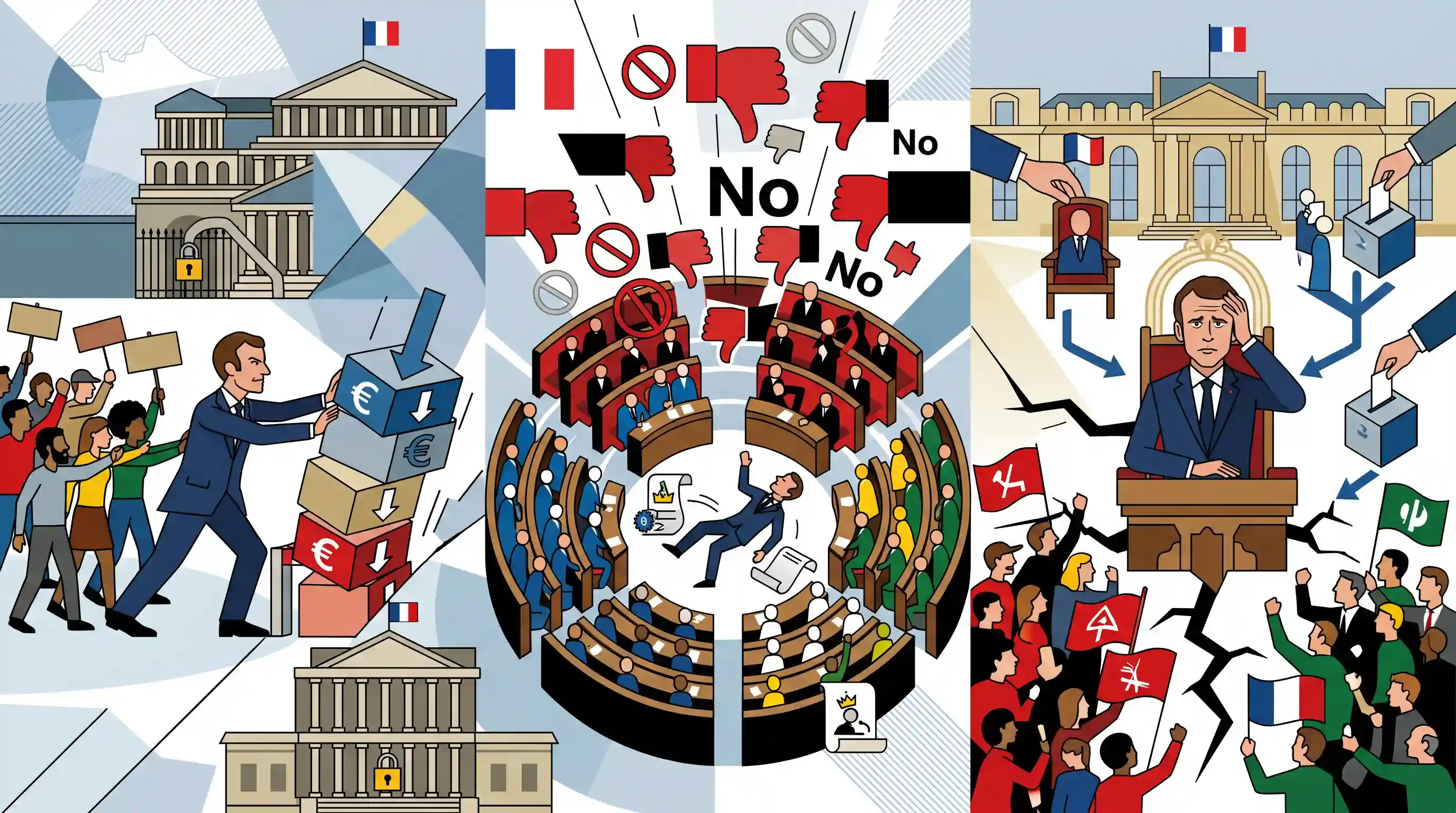
French Prime Minister Francois Bayrou was ousted following a defeat in a parliamentary confidence vote, a move that has plunged President Emmanuel Macron's government into a severe political crisis. The confidence vote was triggered after Bayrou attempted to bypass parliament to implement an unpopular austerity budget designed to address the country's mounting sovereign debt. Under Article 50 of the French Constitution, Bayrou must resign, leaving Macron to either appoint a new Prime Minister or call for snap elections against a backdrop of intense social unrest and pressure from both far-left and far-right political factions.
Key Points
- French Prime Minister Francois Bayrou's government was ousted after losing a confidence vote triggered by a contentious austerity budget, causing a significant political crisis.
- The government bypassed a parliamentary vote to push through a €44 billion austerity budget aimed at reducing sovereign debt, which prompted the confidence motion.
- In accordance with Article 50 of the French Constitution, the defeat requires the Prime Minister to tender the government's resignation to President Emmanuel Macron.
- Macron now faces a stark choice of appointing a seventh Prime Minister or calling for snap parliamentary elections amid widespread social unrest and strikes.
Important Terms
Semi-Presidential System

The 1958 Fifth Republic model combining a powerful, directly elected President with a Prime Minister accountable to parliament. It contrasts with India’s parliamentary system where the President is a ceremonial head.
UPSC context
GS Paper 2 (Comparative Constitutions). Tests understanding of executive structures and power distribution in global democratic models.
National Assembly
The directly elected lower house of the French Parliament. It has the primary power to legislate and dismiss the government through censure motions, serving as a parallel to India’s Lok Sabha.
UPSC context
GS Paper 2. Important for comparative analysis of bicameral legislatures and parliamentary oversight mechanisms.
Article 50 of the French Constitution
A provision of the French Constitution requiring the Prime Minister to submit the government’s resignation to the President if the National Assembly adopts a motion of censure or rejects its policy.
UPSC context
GS Paper 2. Relevant for studying constitutional provisions governing government stability and legislative-executive relations.
National Rally
A prominent far-right, nationalist party in France. Its rise reflects global trends of right-wing populism and Euroscepticism, significantly influencing French domestic policy and European Union stability.
UPSC context
GS Paper 2 (International Relations). Useful for discussing global political ideologies and their impact on international alliances.
Fiscal Consolidation
Economic strategies, often involving austerity (spending cuts), used to reduce government budget deficits and debt. These measures often trigger parliamentary no-confidence votes due to high social unpopularity.
UPSC context
GS Paper 3 (Economy). Tests knowledge of deficit management strategies and their socio-political impacts.
Prelims Trap
Like the French President, the Indian President can unilaterally dissolve the lower house during a political crisis.
The Indian President exercises dissolution powers strictly on the aid and advice of the Council of Ministers, whereas the French President holds unilateral constitutional authority.
Static Concepts Connected
What distinguishes a Semi-Presidential system from a Parliamentary one?
- Dual Executive: Features both a directly elected President (Head of State) with real executive powers and a Prime Minister (Head of Government).
- Survival: The PM depends on legislative confidence (like India), but the President operates independently of the legislature's confidence.
- Cohabitation: Occurs when the President and PM belong to opposing political parties, a feature unique to this hybrid system.
How do austerity measures attempt to resolve a sovereign debt crisis?
- Fiscal Consolidation: Governments drastically cut public spending and increase taxes to reduce fiscal deficits and stabilize debt-to-GDP ratios.
- Market Confidence: Aimed at reassuring bond markets and international lenders, thereby lowering the nation's sovereign borrowing costs.
- Contractionary Risk: These measures often suppress aggregate demand, risking economic recession and severe social unrest if implemented abruptly.
Cross-Topic Patterns
Comparative Polity: Indian vs French Budgeting
UPSC frequently tests constitutional comparisons. France's Article 49.3, which allows the executive to bypass legislative budget votes, contrasts sharply with India's strict legislative control over the budget under Article 112.
Austerity economics & democratic stability
The link between harsh fiscal consolidation and political instability is a recurring macro-economic theme, echoing the European debt crisis and Sri Lanka's recent economic collapse.

Comparative constitution questions in 2026 may contrast the Indian PM's budgetary accountability with the French Executive's bypass powers.
Linked PYQs · 2
Linked PYQs · 2
- 2022MainsGS2
Critically examine the procedures through which the Presidents of India and France are elected.
- 2025MainsGS3
Explain how the Fiscal Health Index (FHI) can be used as a tool for assessing the fiscal performance of states in India. In what way would it encourage the states to adopt prudent and sustainable fiscal policies?
