संसदीय विश्वास मत संकट में फ्रांसीसी प्रधानमंत्री को पद से हटाया गया
स्रोत:द हिंदू ↗
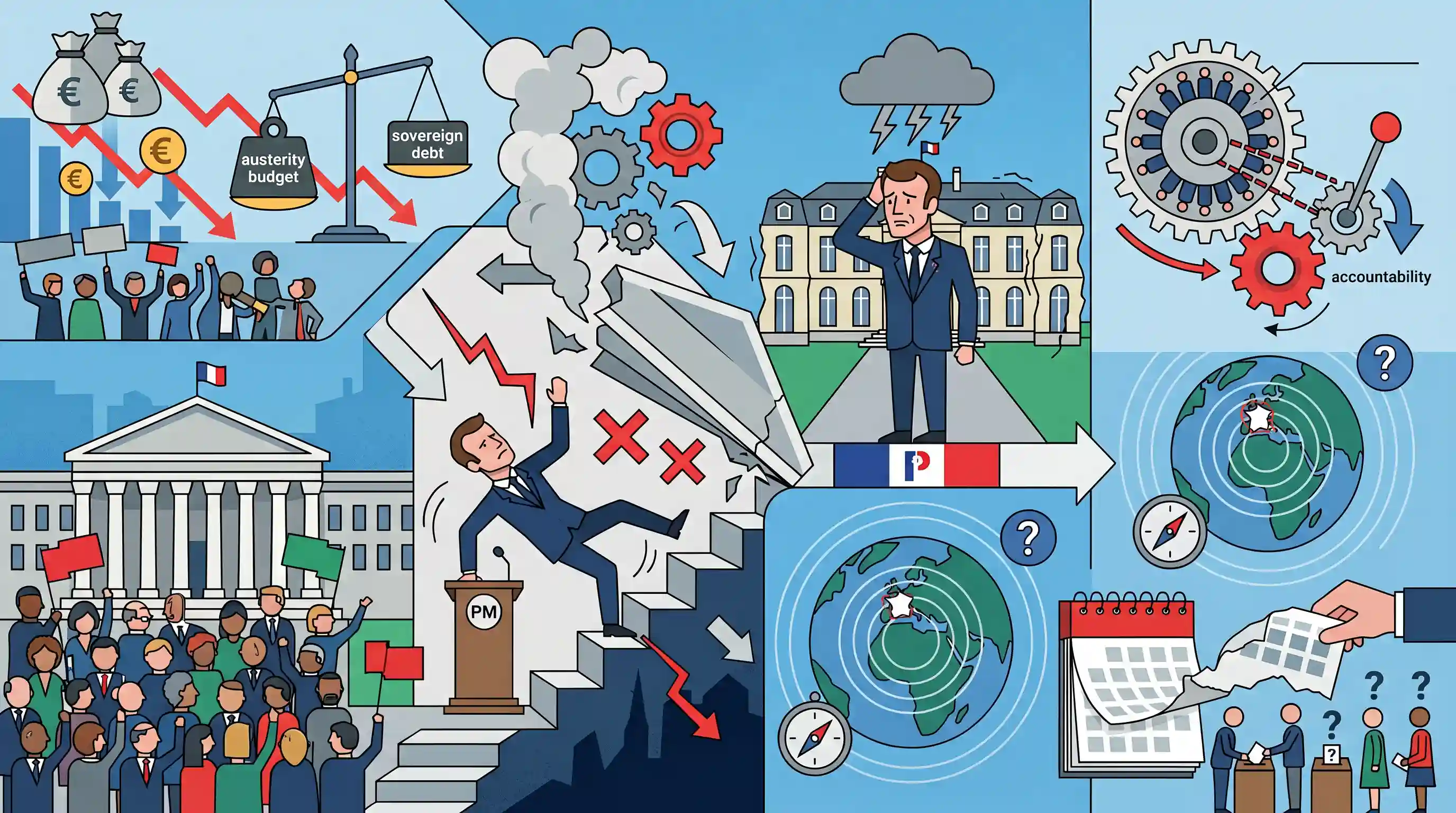
क्यों मायने रखता है
This political crisis in a major Western democracy offers a real-world comparative case study on parliamentary systems, specifically how the executive is held accountable by the legislature via no-confidence motions. It also touches on the economic constraints (sovereign debt and austerity) that often drive political instability.
सारांश
The French Prime Minister was ousted in a parliamentary vote of no-confidence following severe opposition to a controversial austerity budget aimed at addressing France's sovereign debt. This historic legislative defeat plunges President Emmanuel Macron’s government into a profound political crisis, destabilizing the current administration and raising the prospect of snap elections. For UPSC aspirants, the crisis illustrates core principles of parliamentary democracy, specifically the mechanism of executive accountability to the legislature and the deployment of no-confidence motions.
मुख्य बिंदु
- French Prime Minister Francois Bayrou was ousted following a no-confidence vote in the National Assembly, triggering a constitutional crisis.
- फ्रांस के बढ़ते संप्रभु ऋण (sovereign debt) को नियंत्रित करने के लिए लाए गए एक प्रस्तावित ऑस्टेरिटी बजट पर तीव्र विरोध के कारण सरकार गिर गई।
- The political instability severely impacts President Emmanuel Macron's administration, potentially necessitating snap elections or the formation of a new coalition.
- The event serves as a practical example of the parliamentary mechanism where the executive remains strictly accountable to the legislature and can be removed upon losing its confidence.
महत्वपूर्ण शब्द
Austerity Budget

A fiscal policy aimed at reducing government budget deficits through spending cuts, tax increases, or both, typically implemented during debt crises to reassure creditors.
UPSC context
Relevant for GS3 (Fiscal Policy) and GS2; tests understanding of state responses to sovereign debt crises and public welfare trade-offs.
National Assembly (France)
The lower house of France's bicameral Parliament, consisting of 577 directly elected deputies; it holds the power to dismiss the government through a motion of censure.
UPSC context
GS2 (तुलनात्मक संविधान); यह इस बात का परीक्षण करता है कि विभिन्न लोकतंत्रों में निचले सदन कार्यपालिका को किस प्रकार जवाबदेह ठहराते हैं।
अनुच्छेद 49.3 (फ्रांसीसी संविधान)
A controversial provision in the French Constitution allowing the Prime Minister to bypass a parliamentary vote on a bill, provided the government survives a subsequent no-confidence motion.
UPSC context
GS2 (Comparative Constitution); a unique executive power often compared to India’s Ordinance-making powers or guillotine motions.
No-Confidence Motion
एक संसदीय तंत्र (जिसे फ्रांस में 'Motion of Censure' कहा जाता है) जिसका उपयोग विधायिका द्वारा सरकार से समर्थन वापस लेने के लिए किया जाता है, जिससे प्रधानमंत्री को इस्तीफा देने के लिए बाध्य होना पड़ता है।
UPSC context
GS2 (संसदीय प्रक्रियाएं); भारत के अनुच्छेद 75(3) की आवश्यकताओं और विदेशी विधायी निरीक्षण मॉडलों के बीच तुलना का परीक्षण करता है।
Executive Accountability
The principle that the executive branch is answerable to the legislature for its actions and must maintain its confidence to remain in power.
UPSC context
GS2 (Polity); foundational concept for understanding the checks and balances in a parliamentary or semi-presidential democracy.
प्रारंभिक ट्रैप
फ्रांसीसी संसद में एक सफल अविश्वास प्रस्ताव प्रधानमंत्री और राष्ट्रपति दोनों को इस्तीफा देने के लिए मजबूर करता है।
फ्रांस में अर्ध-राष्ट्रपतीय प्रणाली (semi-presidential system) अपनाई जाती है। नेशनल असेंबली (National Assembly) में अविश्वास प्रस्ताव के माध्यम से प्रधानमंत्री और मंत्रिमंडल को पद से हटा दिया जाता है, लेकिन प्रत्यक्ष रूप से निर्वाचित राष्ट्रपति अपने पद पर बना रहता है।
संबंधित अवधारणाएँ
फ्रांस की अर्ध-अध्यक्षीय प्रणाली की क्या विशेषताएं हैं?
- Dual Executive: It features both a directly elected President with substantial executive powers and a Prime Minister.
- विभाजित जवाबदेही: प्रधानमंत्री विधायिका के प्रति उत्तरदायी होते हैं, लेकिन राष्ट्रपति इससे पूरी तरह स्वतंत्र होते हैं और उन्हें अविश्वास प्रस्ताव के माध्यम से हटाया नहीं जा सकता है।
- Cohabitation: राष्ट्रपति और प्रधानमंत्री विरोधी राजनीतिक दलों से संबंधित हो सकते हैं यदि विधायिका का बहुमत राष्ट्रपति की पार्टी से भिन्न हो।
संसदीय लोकतंत्र में बजट की हार कार्यपालिका की जवाबदेही से किस प्रकार संबंधित है?
- Collective Responsibility: Under parliamentary models (like India's Article 75), the executive must constantly command a majority in the lower house.
- निहित विश्वास: बजट या धन विधेयक पारित करने में विफल होना स्वाभाविक रूप से यह सिद्ध करता है कि सरकार ने विधायी बहुमत का समर्थन खो दिया है, जो पारंपरिक रूप से इसके इस्तीफे को अनिवार्य बनाता है।
अंतर-विषय पैटर्न
Austerity vs. Sovereign Debt (GS3)
France's crisis links GS2 Polity with GS3 Economy, illustrating how strict macroeconomic consolidation (austerity) to manage sovereign debt can trigger fatal legislative backlash.
तुलनात्मक संवैधानिक व्यवस्थाएँ
The UPSC frequently tests comparisons of constitutional frameworks; France's semi-presidential model is a classic contrast to both the US presidential and UK/Indian parliamentary systems.

Expect a comparative constitution question contrasting executive accountability in France's semi-presidential system with India's model.
संबद्ध PYQ · 3
संबद्ध PYQ · 3
- 2020PrelimsGS1
A Parliamentary System of Government is one in which
- 2022PrelimsGS1
Which of the following is/are the exclusive power(s) of Lok Sabha ? 1. To ratify the declaration of Emergency 2. To pass a motion of no-confidence against the Council of Ministers 3. To impeach the President of India Select the correct answer using the code given below:
- 2021MainsGS2
To what extent, in your view, the Parliament is able to ensure accountability of the executive in India?
