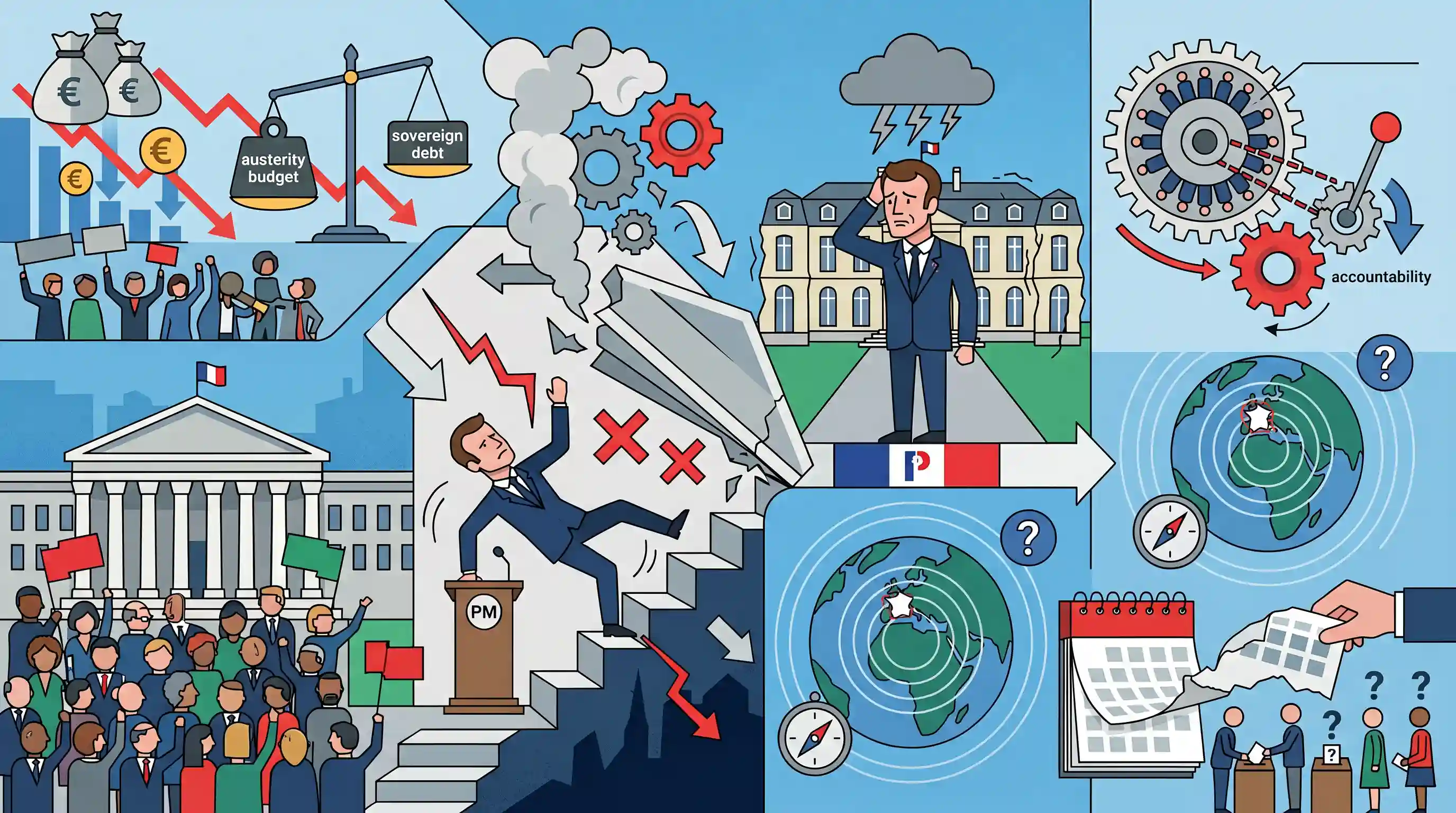
French Prime Minister ousted in parliamentary confidence vote crisis
Source:The Hindu ↗
Why It Matters
This political crisis in a major Western democracy offers a real-world comparative case study on parliamentary systems, specifically how the executive is held accountable by the legislature via no-confidence motions. It also touches on the economic constraints (sovereign debt and austerity) that often drive political instability.
Summary
The French Prime Minister was ousted in a parliamentary vote of no-confidence following severe opposition to a controversial austerity budget aimed at addressing France's sovereign debt. This historic legislative defeat plunges President Emmanuel Macron’s government into a profound political crisis, destabilizing the current administration and raising the prospect of snap elections. For UPSC aspirants, the crisis illustrates core principles of parliamentary democracy, specifically the mechanism of executive accountability to the legislature and the deployment of no-confidence motions.
Key Points
- French Prime Minister Francois Bayrou was ousted following a no-confidence vote in the National Assembly, triggering a constitutional crisis.
- The government collapsed due to intense opposition over a proposed austerity budget designed to rein in France's growing sovereign debt pile.
- The political instability severely impacts President Emmanuel Macron's administration, potentially necessitating snap elections or the formation of a new coalition.
- The event serves as a practical example of the parliamentary mechanism where the executive remains strictly accountable to the legislature and can be removed upon losing its confidence.
Important Terms
Austerity Budget

A fiscal policy aimed at reducing government budget deficits through spending cuts, tax increases, or both, typically implemented during debt crises to reassure creditors.
UPSC context
Relevant for GS3 (Fiscal Policy) and GS2; tests understanding of state responses to sovereign debt crises and public welfare trade-offs.
National Assembly (France)
The lower house of France's bicameral Parliament, consisting of 577 directly elected deputies; it holds the power to dismiss the government through a motion of censure.
UPSC context
GS2 (Comparative Constitution); tests knowledge of how lower houses in different democracies hold the executive accountable.
Article 49.3 (French Constitution)
A controversial provision in the French Constitution allowing the Prime Minister to bypass a parliamentary vote on a bill, provided the government survives a subsequent no-confidence motion.
UPSC context
GS2 (Comparative Constitution); a unique executive power often compared to India’s Ordinance-making powers or guillotine motions.
No-Confidence Motion
A parliamentary mechanism (called a 'Motion of Censure' in France) used by the legislature to withdraw support from the government, forcing the Prime Minister's resignation.
UPSC context
GS2 (Parliamentary Devices); tests comparison between India’s Article 75(3) requirements and foreign legislative oversight models.
Executive Accountability
The principle that the executive branch is answerable to the legislature for its actions and must maintain its confidence to remain in power.
UPSC context
GS2 (Polity); foundational concept for understanding the checks and balances in a parliamentary or semi-presidential democracy.
Prelims Trap
"A successful no-confidence motion in the French parliament forces both the Prime Minister and the President to resign."
France follows a semi-presidential system. A no-confidence motion in the National Assembly ousts the Prime Minister and cabinet, but the directly elected President remains in office.
Static Concepts Connected
What defines France's semi-presidential system?
- Dual Executive: It features both a directly elected President with substantial executive powers and a Prime Minister.
- Split Accountability: The Prime Minister is accountable to the legislature, but the President is entirely independent of it and cannot be removed via no-confidence.
- Cohabitation: The President and PM can belong to opposing political parties if the legislature's majority differs from the President's party.
How does a budget defeat relate to executive accountability in a parliamentary democracy?
- Collective Responsibility: Under parliamentary models (like India's Article 75), the executive must constantly command a majority in the lower house.
- Implied Confidence: Failing to pass a budget or money bill inherently proves the government has lost legislative majority support, conventionally mandating its resignation.
Cross-Topic Patterns
Austerity vs. Sovereign Debt (GS3)
France's crisis links GS2 Polity with GS3 Economy, illustrating how strict macroeconomic consolidation (austerity) to manage sovereign debt can trigger fatal legislative backlash.
Comparative Constitutional Schemes
The UPSC frequently tests comparisons of constitutional frameworks; France's semi-presidential model is a classic contrast to both the US presidential and UK/Indian parliamentary systems.

Expect a comparative constitution question contrasting executive accountability in France's semi-presidential system with India's model.
Linked PYQs · 3
Linked PYQs · 3
- 2020PrelimsGS1
A Parliamentary System of Government is one in which
- 2022PrelimsGS1
Which of the following is/are the exclusive power(s) of Lok Sabha ? 1. To ratify the declaration of Emergency 2. To pass a motion of no-confidence against the Council of Ministers 3. To impeach the President of India Select the correct answer using the code given below:
- 2021MainsGS2
To what extent, in your view, the Parliament is able to ensure accountability of the executive in India?
