Legislative Agenda and Federal Issues Face Parliamentary Debate
Source:The Hindu ↗
Why It Matters
The article highlights critical current legislative proposals (like the Higher Education Commission of India Bill and One Nation, One Election) and underscores systemic challenges in parliamentary functioning. Understanding these dynamics is essential for addressing questions on executive accountability, federalism, and legislative reforms in GS Paper 2.
Summary
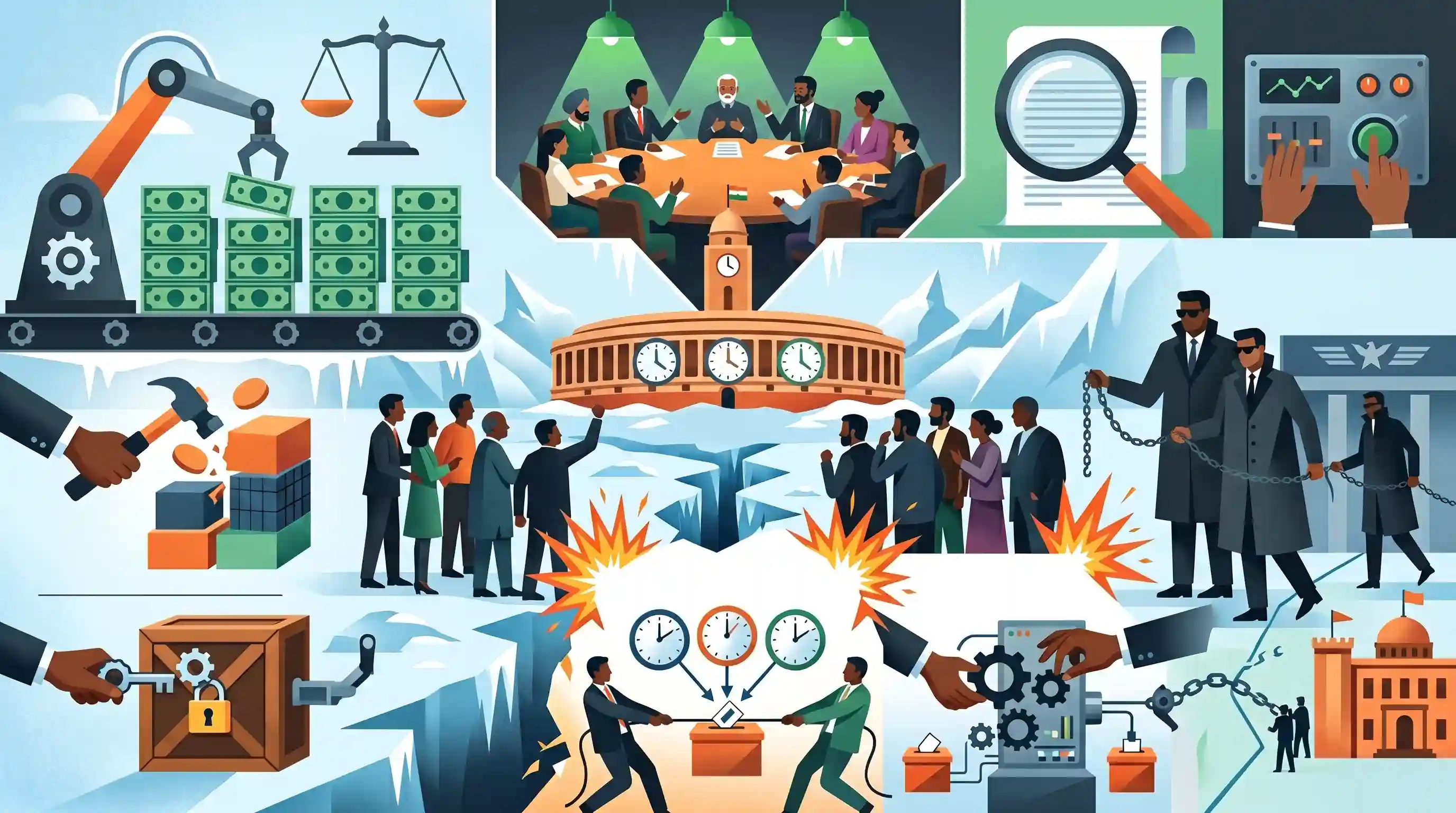
The upcoming 19-day winter session of Parliament is set to be highly contentious, given the deep freeze in relations between the ruling government and the Opposition. The government’s heavy legislative agenda includes 14 bills, with the Higher Education Commission of India Bill—designed to centralize higher education regulation by replacing the UGC, AICTE, and NCTE—and the Jan Vishwas Bill being particularly significant. Furthermore, explosive debates are expected over the 'One Nation, One Election' synchronised poll proposal, electoral reforms, and the alleged misuse of federal investigative agencies. The editorial emphasizes that instead of rushing through bills amid chaos, Parliament must function as a space for constructive debate to ensure robust legislative scrutiny and executive accountability.
Key Points
- The winter session of Parliament, featuring 15 sittings over 19 days, begins against a backdrop of severe government-opposition hostility.
- The legislative agenda features 14 bills, notably the Higher Education Commission of India Bill, which seeks to merge key regulators like the UGC and AICTE into a single body, raising potential federalism concerns.
- Other major bills include the Jan Vishwas Bill aimed at simplifying the criminal justice system and improving ease of doing business.
- Hot-button issues demanding parliamentary debate include the 'One Nation, One Election' proposal, electoral roll reforms, farmers' negotiations, and the alleged political weaponization of federal agencies.
- The editorial underscores the necessity for constructive debate and thorough legislative scrutiny to uphold parliamentary accountability and democratic integrity.
Important Terms
Higher Education Commission of India Bill, 2025

A proposed law to establish a single higher education regulator, replacing UGC, AICTE, and NCTE to streamline standards and accreditation as envisioned in the National Education Policy 2020.
UPSC context
GS Paper 2: Social Sector/Education. Tests knowledge of major regulatory overhauls in higher education and NEP 2020 implementation.
Jan Vishwas (Amendment of Provisions) Bill, 2025
A legislative reform aimed at decriminalizing minor procedural and technical offences across multiple central laws to promote trust-based governance and improve the ease of doing business.
UPSC context
GS Paper 2: Governance/Legal Reforms. Focuses on administrative efficiency, decriminalization of business laws, and Ease of Doing Business.
Health Security se National Security Cess Bill, 2025
A fiscal bill proposing a capacity-based cess on demerit goods like pan masala to fund dedicated expenditures for public health programs and national security needs.
UPSC context
GS Paper 3: Economy/Budgeting. Tests understanding of targeted taxation (cess) and resource mobilization for strategic sectors.
Atomic Energy Bill, 2025
Legislation designed to open India's civil nuclear sector to private players and joint ventures, facilitating the goal of 100 GW nuclear capacity by 2047.
UPSC context
GS Paper 3: Energy/Infrastructure. Relevant for energy transition, nuclear policy, and private participation in strategic sectors.
Arbitration and Conciliation (Amendment) Bill
Proposed changes to the 1996 Act to introduce emergency arbitration, recognize virtual proceedings, and expedite commercial dispute resolution to strengthen India’s arbitration ecosystem.
UPSC context
GS Paper 2: Judiciary/Governance. Tests knowledge of Alternative Dispute Resolution (ADR) and legal reforms for commercial efficiency.
University Grants Commission (UGC)
A statutory body established in 1956 to coordinate, determine, and maintain standards of university education in India; set to be merged into the HECI.
UPSC context
GS Paper 2: Statutory Bodies. Key for understanding the current higher education structure and its upcoming transformation.
All India Council for Technical Education (AICTE)
The apex statutory body for planning and coordinating technical education in India, overseeing quality and accreditation for engineering and management institutions.
UPSC context
GS Paper 2: Statutory Bodies. Relevant for sectoral regulation and the shift toward unified educational governance.
National Highways (Amendment) Bill
Proposed legislation to facilitate faster and more transparent land acquisition processes for highway projects to accelerate national infrastructure development.
UPSC context
GS Paper 3: Infrastructure. Addresses land acquisition challenges—a critical hurdle in Indian infrastructure and developmental projects.
Prelims Trap
"The Constitution mandates holding a Winter Session of Parliament every year."
The Constitution only mandates that the gap between two sessions cannot exceed six months (Article 85). It does not explicitly mandate a Winter, Budget, or Monsoon session.
Static Concepts Connected
What is the constitutional framework governing Parliamentary Sessions in India?
- Article 85 limit: Mandates that the maximum gap between two parliamentary sessions must not exceed six months.
- Summoning authority: The President summons each House, acting strictly on the binding advice of the Cabinet Committee on Parliamentary Affairs.
What constitutional changes are fundamentally required for 'One Nation, One Election'?
- Article amendments: Requires amending Articles 83 and 172 (duration of Houses), and Articles 85 and 174 (dissolution of legislatures).
- State ratification: Since it alters the federal structure, ratification by at least half the State Legislatures under Article 368 is mandatory.
Cross-Topic Patterns
HECI + Concurrent List Federalism
Replacing UGC/AICTE with a centralized HECI mirrors recent debates where Union laws heavily dominate the Concurrent List, sparking Centre-State friction over educational autonomy.
Jan Vishwas + Judicial Pendency
Decriminalizing minor corporate offences directly links economic 'Ease of Doing Business' reforms with critical governance solutions aimed at reducing massive backlogs in the lower judiciary.

A 2026 multi-statement question will likely test the specific constitutional articles (83, 172, 356) needing amendment for simultaneous polls.
Linked PYQs · 4
Linked PYQs · 4
- 2019MainsGS2
Individual Parliamentarian's role as the national law maker is on a decline, which in turn, has adversely impacted the quality of debates and their outcome. Discuss.
- 2021MainsGS2
To what extent, in your view, the Parliament is able to ensure accountability of the executive in India?
- 2024MainsGS2
Examine the need for electoral reforms as suggested by various committees with particular reference to "one nation one election" principle.
- 2020MainsGS2
National Education Policy 2020 is in conformity with the Sustainable Development Goal-4 (2030). It intends to restructure and reorient education system in India. Critically examine the statement.
