Maritime Blockades and Humanitarian Access in the Middle East
Source:The Hindu ↗
Why It Matters
This event is crucial for UPSC aspirants as it intersects World Geography (Middle East/Mediterranean region), International Relations (the geopolitical dynamics of the Israel-Palestine conflict), and International Law (freedom of navigation, naval blockades, and humanitarian access). It also illustrates the evolving role of international non-governmental coalitions in attempting public service delivery and humanitarian intervention during global crises.
Summary
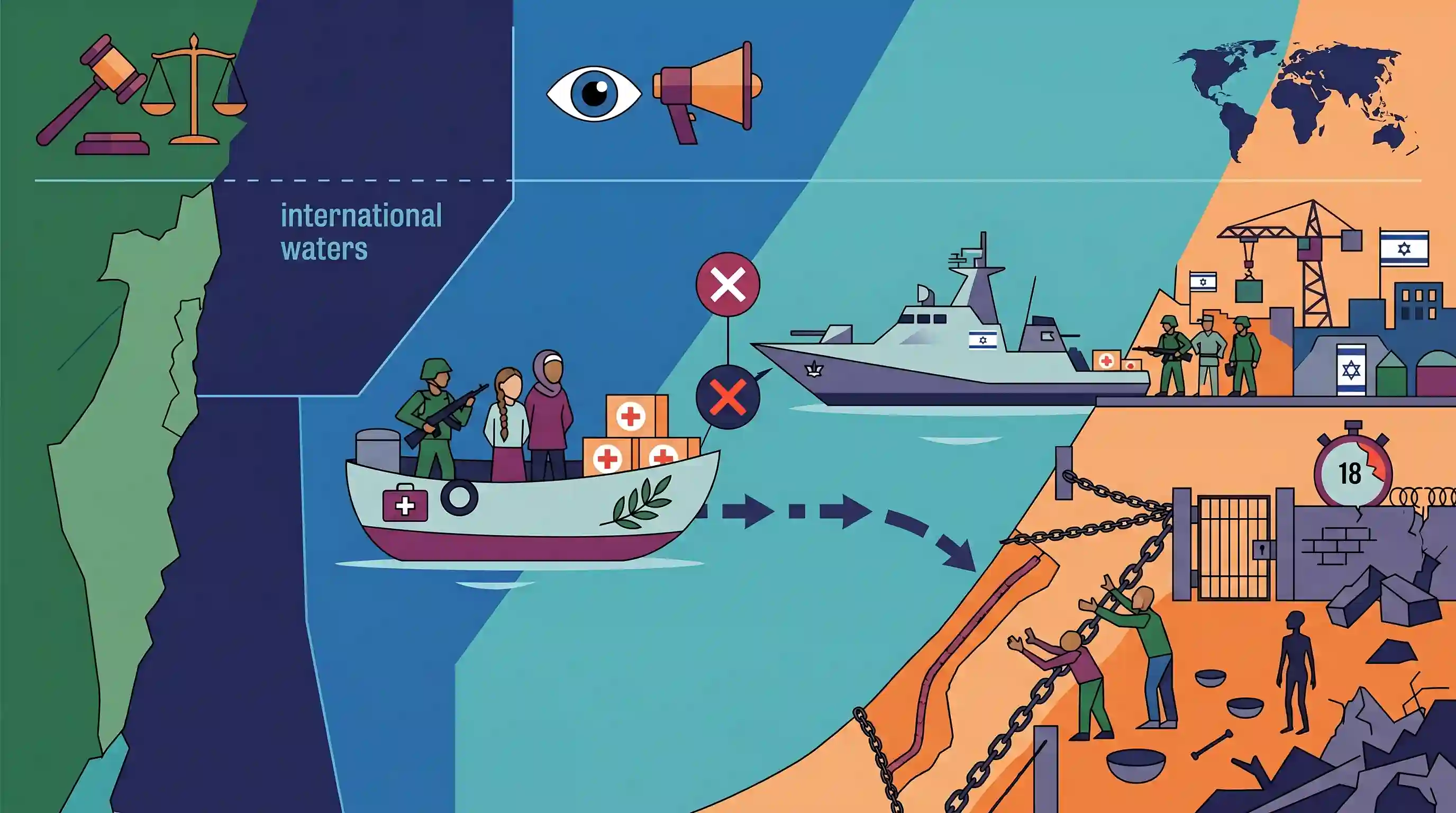
Israeli naval forces intercepted the aid vessel 'Madleen', organized by the Freedom Flotilla Coalition, in international waters about 200 km from the Gaza Strip. Activists aboard, including climate campaigner Greta Thunberg and French-Palestinian politician Rima Hassan, were detained and taken to the Israeli port of Ashdod. The boat was attempting to deliver medical supplies and break Israel's 18-year naval blockade of Gaza, which rights groups condemn as collective punishment. The interception highlights the catastrophic humanitarian situation and famine risk in Gaza amid the protracted Israel-Hamas war, while also bringing attention to maritime law issues regarding intercepts in international waters.
Key Points
- Israeli naval forces intercepted the Gaza-bound aid yacht 'Madleen' in international waters, detaining activists including Greta Thunberg.
- Organised by the Freedom Flotilla Coalition, the voyage aimed to deliver medical aid and challenge the 18-year Israeli naval blockade on the Gaza Strip.
- The seizure underscores the severe humanitarian crisis and famine risk in Gaza stemming from the ongoing Israel-Hamas conflict.
- The incident raises complex international law questions concerning maritime blockades, freedom of navigation in international waters, and the role of global civil society in conflict zones.
Important Terms
UN Convention on the Law of the Sea (UNCLOS)

A 1982 treaty establishing a comprehensive legal framework for maritime activities, including navigation rights, maritime boundaries, and resource management across zones like territorial waters, EEZ, and high seas.
UPSC context
GS-2 (International Relations); GS-3 (Security). Tests understanding of maritime sovereignty and freedom of navigation in global hotspots.
Geneva Conventions
Four international treaties and three protocols establishing legal standards for humanitarian treatment during armed conflict, protecting civilians, prisoners of war, and medical personnel not participating in hostilities.
UPSC context
GS-2 (International Law). Essential for discussing humanitarian protection of civilians and India's stance on global conflict ethics.
Collective Punishment
A prohibited act under the Fourth Geneva Convention (Article 33) where a population is penalized for actions committed by individuals; central to legal debates over the Gaza blockade's humanitarian impact.
UPSC context
GS-2 (Human Rights); GS-4 (Ethics). Key for analyzing the legality of warfare and the ethics of civilian suffering.
Freedom Flotilla Coalition
An international grassroots movement of civil society groups formed in 2010 that organizes non-violent maritime missions to challenge the Israeli naval blockade of Gaza and deliver humanitarian aid.
UPSC context
GS-2 (Role of Civil Society). Illustrates how non-state actors and NGOs attempt to influence international policy and humanitarian outcomes.
Naval Blockade
A military operation preventing vessels from entering or leaving a specific coastal area; legally subject to the San Remo Manual and requiring that civilians not be deprived of essential supplies.
UPSC context
GS-2 (International Relations). Relevant for maritime security and the legalities of using naval force in regional conflicts.
High Seas
Maritime areas beyond national jurisdiction (usually 200 nautical miles from shore) where UNCLOS guarantees freedom of navigation, with interceptions permitted only for piracy or with flag-state consent.
UPSC context
GS-2 (International Law). Tests knowledge of maritime jurisdictions and the challenges of enforcement actions in international waters.
Prelims Trap
UNCLOS guarantees absolute freedom of navigation in international waters, strictly prohibiting state-imposed naval blockades.
While UNCLOS applies in peacetime, customary laws of naval warfare (e.g., San Remo Manual) permit belligerents to enforce blockades during armed conflict, subject to humanitarian conditions.
Static Concepts Connected
Which West Asian countries share a coastline with the Mediterranean Sea?
- Bordering Nations: Israel, Lebanon, and Syria open directly into the eastern Mediterranean basin.
- Notable Exceptions: Jordan and Iraq are frequent distractors in UPSC Prelims; neither shares a Mediterranean coastline (Jordan only touches the Red Sea via the Gulf of Aqaba).
- Gaza Strip Borders: Enclosed by Israel to the north and east, Egypt to the southwest, and the Mediterranean Sea to the west.
How does international law regulate naval blockades and civilian protection?
- San Remo Manual: A recognized body of customary international law that permits belligerent states to enforce maritime blockades during armed conflict, provided they are effectively enforced and impartial.
- Humanitarian Exemptions: Blockading powers are legally obligated to allow the free passage of essential humanitarian and medical supplies for the civilian population.
- Collective Punishment: Strictly prohibited under Article 33 of the Fourth Geneva Convention; rights groups frequently cite this to declare prolonged, indiscriminate blockades illegal.
Cross-Topic Patterns
UNCLOS vs. Laws of War
The intersection of peacetime maritime rights (UNCLOS) and wartime exceptions (San Remo Manual) links the Gaza blockade to broader maritime security themes, such as the Red Sea shipping attacks.
Non-State Actors in Geopolitics
Global civil society groups actively challenging state-enforced blockades highlights the evolving, direct-interventionist role of NGOs in traditional hard-security domains and geopolitical conflicts.

Expect a multi-statement Prelims question in 2026 mixing Mediterranean map locations (Gaza, Israel) with UNCLOS peacetime exceptions.
Linked PYQs · 4
Linked PYQs · 4
- 2003PrelimsGS1
Israel has common borders with
- 2017PrelimsGS1
Mediterranean Sea is a border of which of the following countries? 1. Jordan 2. Iraq 3. Lebanon 4. Syria Select the correct answer using the code given below:
- 2018MainsGS2
“India’s relations with Israel have, of late, acquired a depth and diversity, which cannot be rolled back.” Discuss.
- 2021MainsGS2
Can Civil Society and Non-Governmental Organizations present an alternative model of public service delivery to benefit the common citizen? Discuss the challenges of this alternative model.
