Uttarakhand Expands Free Travel and Loan Schemes for Women
Source:livemint ↗
Why It Matters
The initiatives represent a comprehensive, multi-pronged approach (credit, mobility, sanitation, and safety) by the Uttarakhand government to transition women from job seekers to job providers. These state-level schemes, alongside systemic interventions like 30% horizontal reservation for women, are highly critical topics for Uttarakhand state exams (UKPSC PCS Prelims & Mains).
Summary
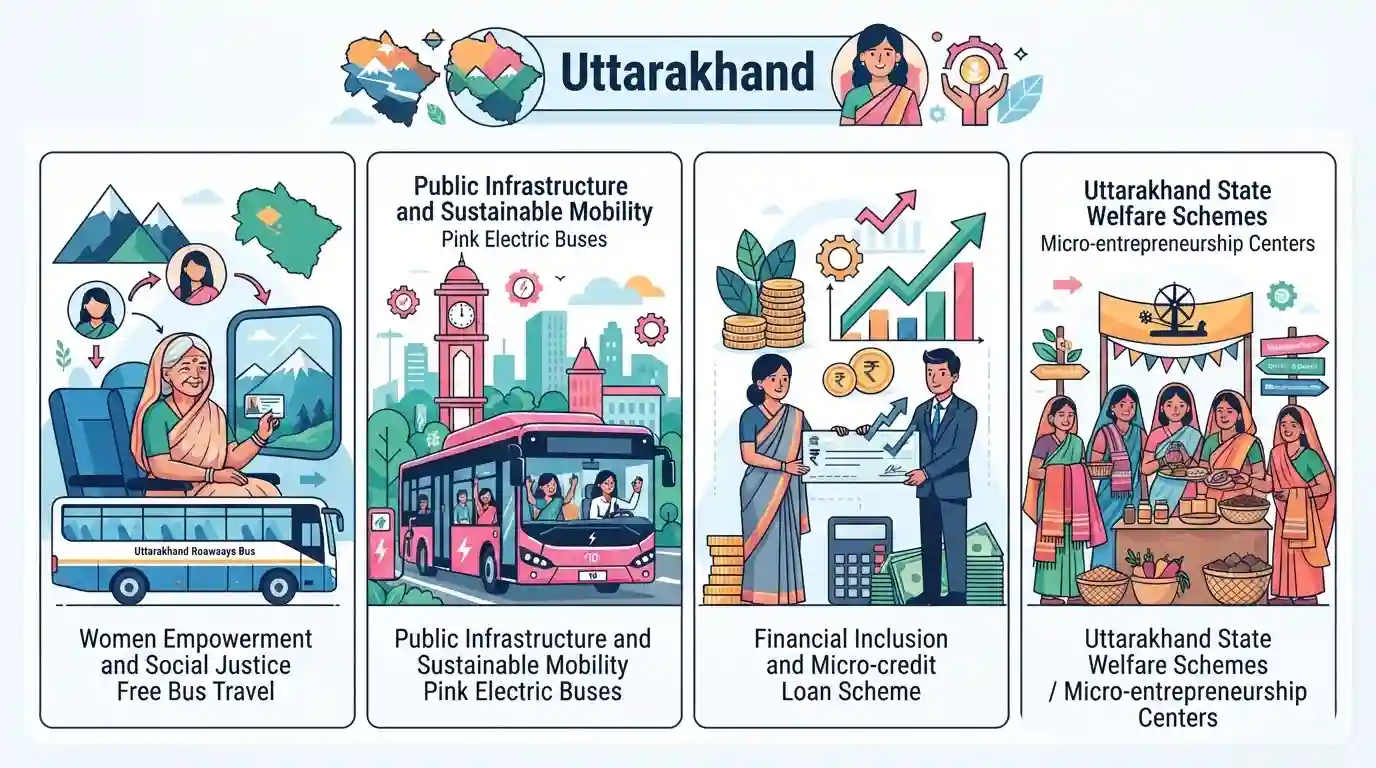
Uttarakhand Chief Minister Pushkar Singh Dhami has launched a series of new public transport, safe mobility, and economic empowerment initiatives specifically tailored for women. Key measures include lowering the free state bus travel eligibility age for women to 60 years, designating 10 pink electric buses in Dehradun under the central PM e-Bus Sewa scheme, raising the loan ceiling under the Women’s Self-Employment Scheme to ₹2.50 lakh, and establishing district-specific product centers under the Mukhyamantri Sashakt Bahna Utsav Yojana to boost SHG-led micro-entrepreneurship.
Key Points
- Free Travel for Older Women: The minimum eligibility age for women to travel free of cost in state Roadways buses has been lowered from 65 to 60 years.
- Introduction of Pink E-Buses: Dehradun will run 10 dedicated women-only pink electric buses. These are part of 137 electric buses allocated to Uttarakhand under the central PM e-Bus Sewa scheme (with 100 proposed for Dehradun).
- Expanded Financial Credit: The maximum limit of concessional loans under the Women's Self-Employment Scheme has been hiked from ₹2 lakh to ₹2.50 lakh. This is in addition to the existing interest-free loans of up to ₹5 lakh available for self-help groups (SHGs).
- Market Access under Sashakt Bahna Scheme: Under the Mukhyamantri Sashakt Bahna Utsav Yojana, dedicated marketing centres will be set up in development blocks. Dehradun will host 13 block-level centers, showcasing and selling local products from each of Uttarakhand's 13 districts.
- Lakhpati Didi Milestone: Around 3.09 lakh women in Uttarakhand have attained 'Lakhpati Didi' status through various micro-entrepreneurship and SHG initiatives.
- Broader Welfare Schemes: The state highlighted ongoing efforts like the Nanda Gaura Yojana (for girls), Chief Minister Mahalakshmi Kit Yojana (maternal & child health kit), 181 Women Helpline, and the statutory 30% horizontal reservation for women in state government services.
Important Terms
PM e-Bus Sewa

A central scheme launched to boost green mobility by deploying 10,000 electric buses. In Uttarakhand, it funds Dehradun and Haridwar's electric fleets, including 10 dedicated "pink e-buses" for women's safe transit.
UPSC context
GS Paper III (Infrastructure & Sustainable Mobility); tests central-state welfare, green public transit, and urban development.
Women's Self-Employment Scheme
Also known as Mahila Swarojgar Yojana, this Uttarakhand initiative offers concessional loans—now raised up to ₹2.50 lakh—to encourage local women entrepreneurs, supporting their shift from job seekers to employment providers.
UPSC context
Paper VI (Uttarakhand Geography & Society); tests state schemes for economic empowerment and micro-credit access.
Mukhyamantri Sashakt Bahna Utsav Yojana
An Uttarakhand state scheme launched to provide better marketing opportunities and display platforms for indigenous products made by local women's self-help groups (SHGs) at block and district levels.
UPSC context
Paper VI (Uttarakhand-specific schemes); tests economic empowerment, local crafts, and rural enterprise-led livelihoods.
Lakhpati Didi Scheme
A flagship initiative launched under the Uttarakhand State Rural Livelihood Mission to economically empower rural SHG women, enabling them to achieve an annual household income of at least ₹1 lakh.
UPSC context
Paper III (Social Justice) & Paper VI; tests poverty alleviation, rural development, and women's financial inclusion.
Nanda Gaura Yojana
A flagship social security scheme in Uttarakhand offering conditional financial aid (₹11,000 at birth and ₹51,000 post Class 12) to promote female education, prevent child marriage, and improve the child sex ratio.
UPSC context
Paper VI (Uttarakhand Administration and Welfare Schemes); tests female literacy, maternal-child health, and gender equity incentives.
Chief Minister Mahalakshmi Kit Yojana
An Uttarakhand scheme providing a maternal and newborn care kit after institutional delivery of the first two girl children, ensuring proper initial hygiene, health, and nutrition for both mother and child.
UPSC context
Paper VI (Uttarakhand-specific Welfare Schemes); tests institutional delivery incentives, infant mortality reduction, and child-maternal care.
30% Horizontal Reservation for Women in Government Services
Legally enacted under the Uttarakhand Public Services Act, 2023, this policy guarantees 30% horizontal reservation in state government jobs to women permanently domiciled in Uttarakhand, promoting local female representation.
UPSC context
Paper III (Indian Polity & Constitution) & Paper VI; tests affirmative action, reservation mechanics, and domicile-based benefits.
Prelims Trap
The Nanda Gaura Yojana provides a lumpsum financial assistance of ₹62,000 to native girl children at the time of birth.
The scheme does not pay ₹62,000 at once. It is split into two phases: ₹11,000 upon institutional birth, and ₹51,000 only after passing Class 12 while remaining unmarried.
Static Concepts Connected
What is the legal status of the 30% horizontal reservation for women in Uttarakhand?
- Constitutional Basis: Originating from Article 15(3), the state enacted the Uttarakhand Public Services (Horizontal Reservation for Women) Act, 2022.
- Domicile Criteria: It provides a 30% horizontal reservation in state government jobs specifically for women candidates with Uttarakhand domicile.
- Judicial Validation: The Supreme Court stayed high court restrictions, validating the state's legislative competence to offer domicile-based horizontal gender quotas.
What is the concept of Gender-Responsive Budgeting (GRB)?
- Core Objective: It is a fiscal tool that analyzes budget allocations through a gender lens to address gender-specific vulnerabilities and inequalities.
- Two-Part Structure: Divided into Part A (100% women-specific schemes like Nanda Gaura) and Part B (minimum 30% allocation for women, like pink e-buses).
Cross-Topic Patterns
Gender Budgeting + Green Mobility
Merging PM e-Bus Sewa's climate mandates with safety-focused transit exemplifies gender-responsive budgeting, ensuring green infrastructure directly addresses gender-based mobility constraints.
SHG Micro-Credit + Hill Economy
Scaling self-employment credit and block-level marketing targets the "money-order economy" structural weakness by creating localized, women-led micro-enterprises in remote hill terrains.

Uttarakhand's specific welfare thresholds (Nanda Gaura steps, loan hikes) are prime targets for multi-statement State GS questions.
Linked PYQs · 3
Linked PYQs · 3
- 2024UKPSC_PRELIMSGS1
As per census 2011, which of the following district of Uttarakhand had lowest female literacy rate ?
- 2024UKPSC_PRELIMSGS1
How many of the following women M.L.A.s were there in the first Legislative Assembly of Uttarakhand ?
- 2025UKPSC_PRELIMSGS1
Which of the following groups of districts of Uttarakhand is correct in descending order of sex-ratio according to the Census of India 2011?
