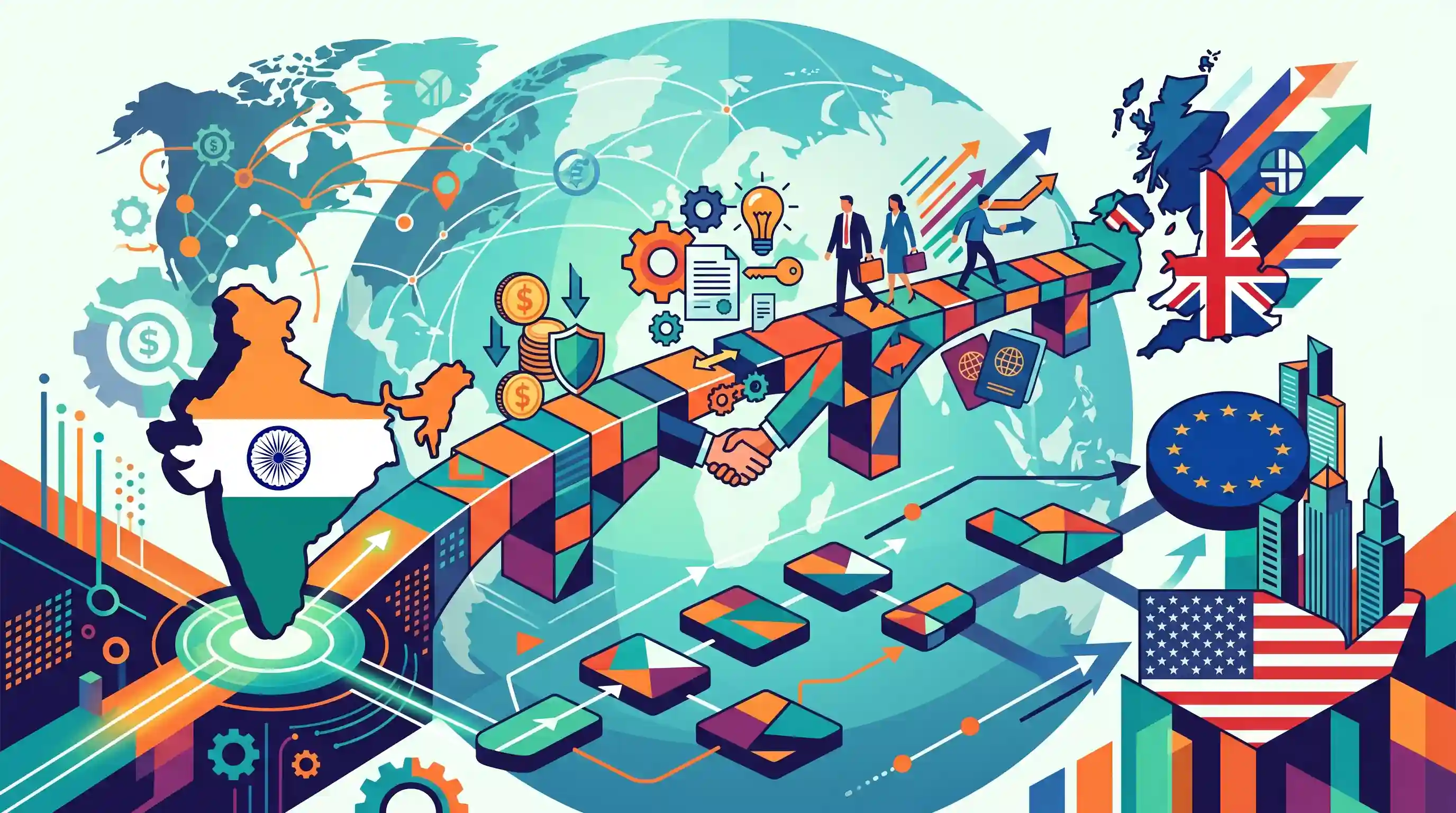
Bilateral Free Trade Agreements and Western Economic Integration
Source:Indian Express ↗
Why It Matters
Understanding the interconnected nature of modern trade agreements helps aspirants analyze how a single bilateral pact (like the India-UK FTA) can influence India's broader economic diplomacy and integration with the West.
Summary
The article emphasizes that signing a Free Trade Agreement (FTA) with the United Kingdom is a strategic milestone that extends beyond bilateral benefits, acting as a stepping stone for India to secure similar agreements with the US and the EU. By establishing precedents on contentious issues such as tariffs, intellectual property, and labor mobility, an India-UK deal builds a workable framework and demonstrates India's readiness to integrate deeper with major developed economies, paving the way for pacts like the India-EU BTIA.
Key Points
- Successfully concluding an FTA with the UK could serve as a critical template for India's future trade negotiations with developed Western economies like the US and the EU.
- Finalizing a UK deal signals India's capacity to navigate complex trade issues such as intellectual property rights, tariff reductions, cross-border data flows, and professional mobility.
- An India-UK trade pact enhances India's strategic leverage and positions it favorably for reviving and completing the long-pending Broad-based Trade and Investment Agreement (BTIA) with the EU.
- Deeper economic integration with Western markets is essential for India's export-led growth ambitions and countering regional economic imbalances.
Important Terms
Free Trade Agreement (FTA)

A treaty between two or more countries to reduce or eliminate customs duties (tariffs) and non-tariff barriers on goods and services, facilitating easier cross-border commerce and economic integration.
UPSC context
GS Paper II (International Relations) & III (Economy); tests knowledge of trade liberalization, market access, and strategic bilateral partnerships.
Broad-based Trade and Investment Agreement (BTIA)
The comprehensive trade and investment agreement currently being negotiated between India and the European Union, covering goods, services, and investment protection, originally launched in 2007.
UPSC context
GS Paper II (International Relations); focus on India-EU bilateral ties and roadblocks like agricultural tariffs and professional mobility.
European Union (EU)
A political and economic union of 27 European countries operating as a single market. It is one of India's largest trading partners and a key source of foreign investment.
UPSC context
GS Paper II (International Relations); relevant for studying global groupings, major trade partners, and the impact of regional blocs on India.
Intellectual Property Rights (IPR)
Legal rights protecting creations of the mind (patents, trademarks, copyrights). In trade deals, developed nations often seek stricter standards than India’s domestic laws, such as those preventing patent 'evergreening.'
UPSC context
GS Paper III (Economy/Science); crucial for understanding innovation, pharma industry interests, and 'TRIPS-plus' provisions in modern FTAs.
Labor Mobility
The movement of professionals across borders to provide services (Mode 4 trade). For India, this typically involves seeking easier visa regimes and social security exemptions for IT and healthcare workers.
UPSC context
GS Paper III (Economy); focuses on services-led growth, remittances, and the global movement of skilled Indian manpower.
Tariffs
Taxes or duties imposed by a government on imported goods. Reducing these is the primary goal of trade deals to make domestic exports more competitive in foreign markets.
UPSC context
GS Paper III (Economy); relates to trade protectionism, domestic industry safeguards (e.g., dairy, automobiles), and export competitiveness.
Prelims Trap
"Data Exclusivity is a mandatory compliance requirement for all WTO members under the TRIPS agreement."
Data exclusivity is a "TRIPS-Plus" provision pushed by developed nations in FTAs. The WTO's TRIPS agreement only requires protection against "unfair commercial use," not strict exclusivity.
Static Concepts Connected
What are the four modes of services trade under WTO's GATS?
- Mode 1 (Cross-border): Services flow across borders without physical movement of the provider or consumer (e.g., telemedicine, BPO).
- Mode 2 (Consumption abroad): The consumer travels to the service provider's country to consume the service (e.g., tourism, higher education).
- Mode 3 (Commercial presence): A service provider establishes a physical subsidiary or branch in another country (e.g., foreign banks).
- Mode 4 (Natural persons): Individuals travel temporarily to a foreign country to provide professional services (e.g., Indian IT professionals on UK visas).
How does Data Exclusivity differ from standard patent protection in FTAs?
- Patent Protection: Grants exclusive rights to manufacture or sell a novel, inventive, and industrially applicable invention for a set period (20 years).
- Data Exclusivity: Protects clinical trial data submitted to regulators. Generic makers cannot rely on this data for their own drug approvals, delaying cheaper generic entry regardless of patent status.
Cross-Topic Patterns
FTAs vs. India's generic pharma sector
UK/EU demands for "Data Exclusivity" directly threaten India's status as the "Pharmacy of the World" by preventing generic manufacturers from using original clinical trial data for early generic approvals.
New-age FTAs bypassing WTO deadlocks
With WTO multilateralism stalled, developed nations are increasingly embedding non-trade issues like labor, carbon border taxes, and TRIPS-Plus IPR rules directly into "New-Age" bilateral FTAs.

2026 prelims may feature a multi-statement question on "New-Age FTAs" combining GATS Mode 4, data exclusivity, and carbon border taxes.
Linked PYQs · 4
Linked PYQs · 4
- 2017PrelimsGS1
'Broad-based Trade and Investment Agreement (BTIA)' is sometimes seen in the news in the context of negotiations held between India and
- 2023PrelimsGS1
Consider the following statements: Statement-I: Recently, the United States of America (USA) and the European Union (EU) have launched the 'Trade and Technology Council'. Statement-II: The USA and the EU claim that through this they are trying to bring technological progress and physical productivity under their control. Which one of the following is correct in respect of the above statements?
- 2016PrelimsGS1
The term 'Regional Comprehensive Economic Partnership' often appears in the news in the context of the affairs of a group of countries known as
- 2014MainsGS2
The aim of Information Technology Agreements (ITAs) is to lower all taxes and tariffs on information technology products by signatories to zero. What impact would such agreements have on India's interests?
