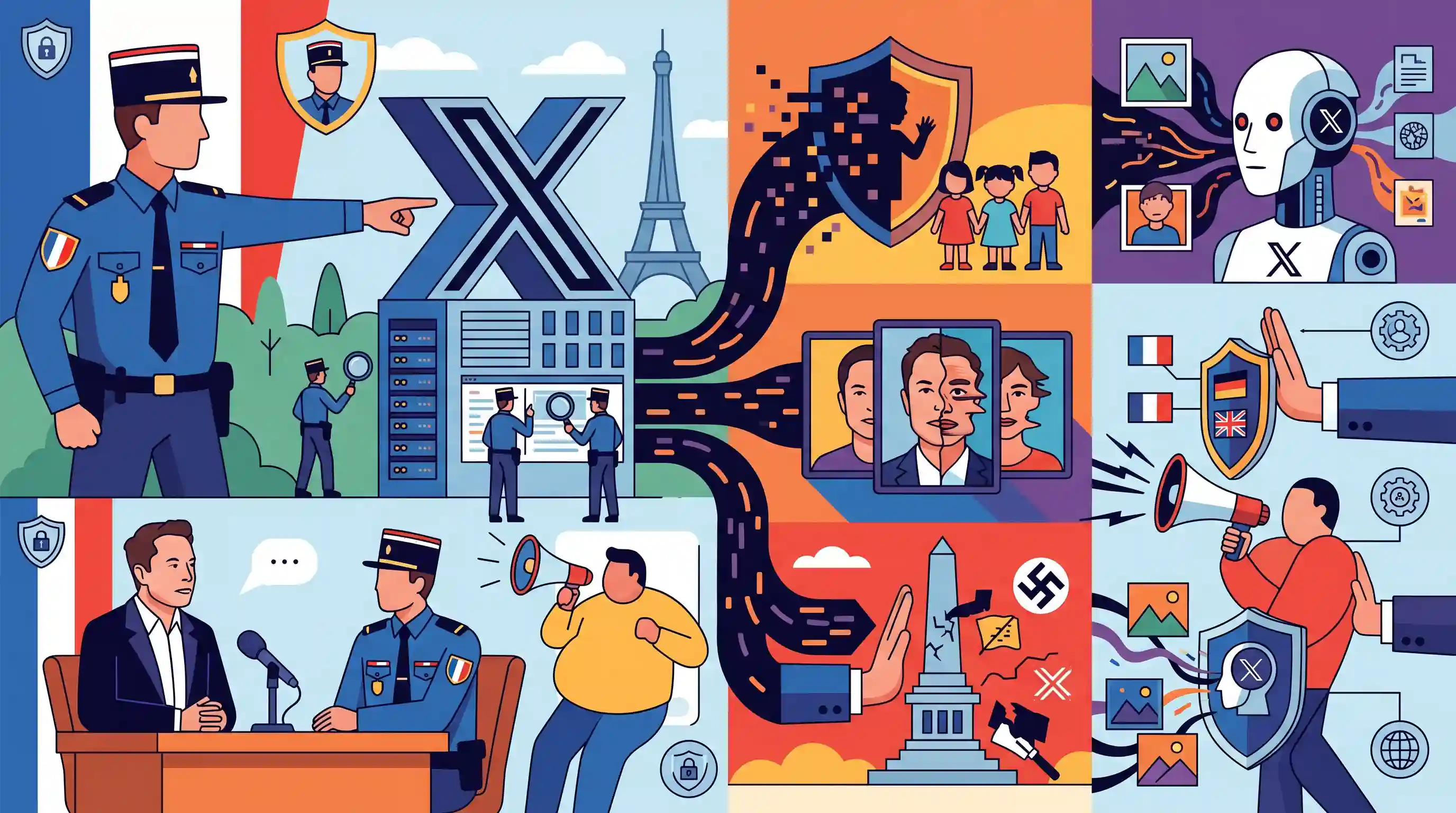
France raids X offices and summons Elon Musk over content rules
Source:The Hindu ↗
Why It Matters
The escalating conflict between sovereign governments and global tech giants highlights critical questions for India regarding intermediary liability, regulation of AI tools like deepfakes, and striking a balance between freedom of expression and national/societal security.
Summary
French authorities have summoned Elon Musk for a voluntary interview and raided the Paris offices of his social media platform, X. The platform is under investigation for a slew of serious allegations, including the dissemination of child pornography, deepfakes, and Holocaust denial. X's AI chatbot, Grok, has specifically drawn scrutiny for spreading sexually explicit deepfakes and biased narratives. The crackdown is part of a broader European effort to hold tech giants accountable for content hosted on their platforms, challenging the 'free speech absolutist' stance maintained by Musk. This move follows similar actions taken against Telegram's CEO by France, and X's regulatory conflicts in Brazil and the UK.
Key Points
- French authorities raided the Paris offices of X (formerly Twitter) and summoned Elon Musk for a voluntary interview.
- The investigation targets severe offences including the spread of child pornography, non-consensual deepfakes, and the denial of crimes against humanity (such as the Holocaust).
- X's AI chatbot, Grok, is also under scrutiny for allegedly possessing biased algorithms, denying the Holocaust, and spreading sexually explicit deepfakes.
- The development signifies growing global regulatory pressure on Big Tech platforms, joining recent actions by France against Telegram's CEO, as well as clashes between X and governments in Brazil and the UK over disinformation.
- The incident highlights the ongoing debate over intermediary liability, the limits of 'free speech' absolutism, and the need for ethical guidelines for emerging AI technologies.
Important Terms
Digital Services Act (DSA)

A landmark EU regulation that mandates strict content moderation, transparency, and risk mitigation for 'Very Large Online Platforms' (VLOPs) to combat illegal content and disinformation.
UPSC context
GS II/III: Global standards in digital governance and their influence on India’s regulatory landscape for big tech.
IT Rules, 2021
Indian regulations requiring social media platforms to appoint grievance officers, remove unlawful content within specific timelines (e.g., 24-36 hours), and enable traceability for certain messages.
UPSC context
GS II/III: State control over social media, protection of digital rights, and intermediary accountability in India.
Deepfakes
Highly realistic AI-generated synthetic media (video, audio, or images) often used to spread misinformation, manipulate public opinion, or create non-consensual explicit content.
UPSC context
GS III: Internal security threats, information warfare, and ethical challenges in artificial intelligence.
Safe Harbour Provision
A legal principle (Section 79 of India's IT Act) that protects platforms from liability for third-party content, provided they follow government-mandated 'due diligence' and takedown orders.
UPSC context
GS III: Legal frameworks governing cyber sovereignty and the limits of platform immunity in modern law.
Intermediary Liability
The legal accountability of digital platforms for content shared by users. Regulation seeks to balance platform freedom with the state's duty to prevent harm.
UPSC context
GS II: Governance and the role of the state in regulating powerful non-state actors in the digital era.
Generative AI
A type of AI capable of creating new text, images, or media. It powers tools like X’s Grok, which face scrutiny for biased or harmful output.
UPSC context
GS III: S&T developments and their socio-economic impact; GS IV: Ethics in emerging technologies.
Prelims Trap
Section 79 of the IT Act provides absolute immunity to intermediaries.
Safe harbour under Section 79 of the IT Act is conditional. Intermediaries lose this protection if they fail to act on lawful government takedown orders.
Static Concepts Connected
What is 'Safe Harbour' and Intermediary Liability?
- Section 79 IT Act: Grants social media and internet intermediaries conditional immunity from legal prosecution for third-party data or user-generated content they host.
- Conditional Immunity: Protection is stripped if the platform initiates the transmission, modifies the information, or fails to expeditiously remove unlawful content upon receiving a government order.
- IT Rules 2021: Mandates strict due diligence, appointing resident compliance officers, and rapid 24-hour takedowns of non-consensual explicit content to retain safe harbour.
How does the Indian Constitution restrict absolute free speech online?
- Article 19(1)(a): Guarantees freedom of speech and expression, but unlike the US First Amendment (often cited by free speech absolutists), it explicitly rejects unchecked speech.
- Article 19(2) Restrictions: Permits state regulation based on sovereignty, security, public order, decency, or morality—grounds heavily utilized to penalize online hate speech, deepfakes, and explicit material.
Cross-Topic Patterns
AI Bias & Corporate Ethics
Chatbots generating explicit deepfakes or historical denial makes AI bias a dual GS3/GS4 issue, focusing on algorithmic accountability and corporate ethical governance.
Extraterritorial Tech Policing
The raids on X and the arrest of Telegram's CEO highlight a global shift from mere financial penalties to direct criminal enforcement against tech executives to enforce digital sovereignty.

Mains 2026: Expect a question linking generative AI's deepfake capabilities to the erosion of safe harbour protections for intermediaries.
Linked PYQs · 5
Linked PYQs · 5
- 2024MainsGS3
Social media and encrypting messaging services pose a serious security challenge. What measures have been adopted at various levels to address the security implications of social media? Also suggest any other remedies to address the problem.
- 2016MainsGS3
Use of Internet and social media by non-state actors for subversive activities is a major security concern. How have these been misused in the recent past? Suggest effective guidelines to curb the above threat.
- 2025MainsGS4
In the present digital age, social media has revolutionised our way of communication and interaction. However, it has raised several ethical issues and challenges. Describe the key ethical dilemmas in this regard.
- 2024MainsGS4
The application of Artificial Intelligence as a dependable source of input for administrative rational decision-making is a debatable issue. Critically examine the statement from the ethical point of view.
- 2023MainsGS3
Introduce the concept of Artificial Intelligence (AI). How does Al help clinical diagnosis? Do you perceive any threat to privacy of the individual in the use of Al in healthcare?
