France Shift to Linux Highlights Global Digital Sovereignty Push
Source:Indian Express ↗
Why It Matters
This article underscores the growing intersection of technology, national security, and international relations. It provides contemporary global examples (France) and domestic equivalents (India) of countries pursuing self-reliance in digital infrastructure to counter tech monopolies and the weaponization of supply chains, directly relevant to Mains topics on IT, indigenization, and global supply chain resilience.
Summary
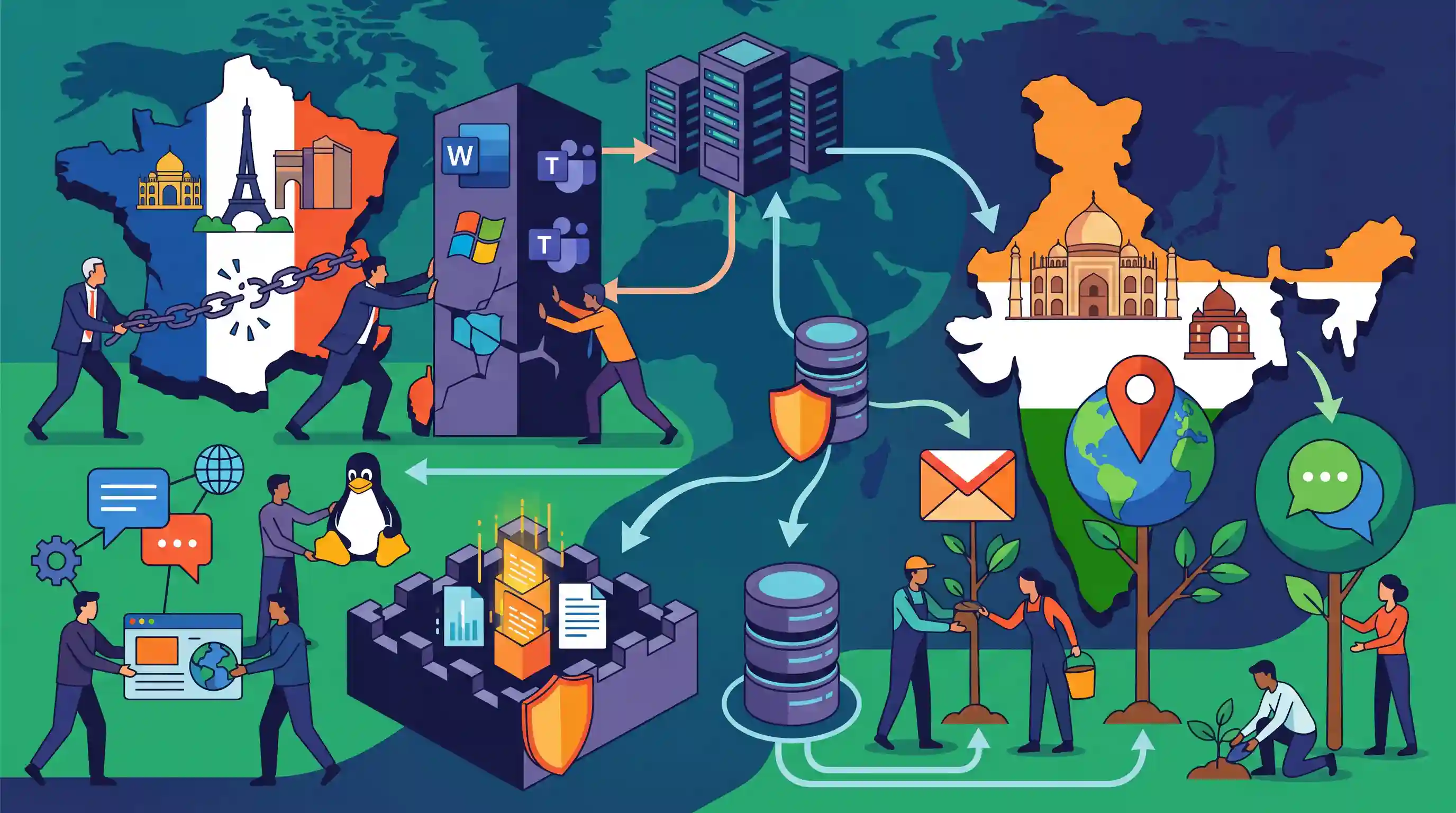
France is actively asserting its 'digital sovereignty' by shifting its government IT infrastructure from proprietary US software like Microsoft Windows and Teams to open-source alternatives like Linux and a domestically developed tool, Visio. This strategic decoupling aims to reduce reliance on foreign tech monopolies, safeguard national data, and mitigate geopolitical vulnerabilities—particularly the risk of foreign powers weaponizing software licenses through extraterritorial sanctions. The article highlights India's similar trajectory toward building an independent digital ecosystem by promoting 'Swadeshi' platforms such as Zoho Mail, MapmyIndia, and Arattai to ensure technological self-reliance and strategic autonomy.
Key Points
- France's digital agency (DINUM) is transitioning government computers from Microsoft Windows to the open-source Linux OS to establish 'digital sovereignty.'
- The French government has adopted 'Visio,' a domestic video conferencing tool based on open-source Jitsi, replacing Microsoft Teams.
- The shift is driven by geopolitical concerns regarding over-reliance on US big tech and the vulnerability of digital infrastructure to extraterritorial sanctions and foreign policy whims.
- The weaponization of tech licenses is evident in instances like Microsoft cutting off services to Indian refiner Nayara Energy over EU sanctions on Russia.
- India is making a parallel push toward 'Swadeshi' tech, adopting domestic alternatives like Zoho Mail for government use and promoting MapmyIndia (Mappls) and Arattai to reduce dependence on foreign monopolies.
Important Terms
Digital Sovereignty

A nation's ability to exercise independent control over its digital infrastructure, data, and technologies to safeguard national security and strategic interests.
UPSC context
GS II (International Relations) and GS III (Cybersecurity/Science & Tech). Tests understanding of strategic autonomy in the digital age.
Atmanirbhar Bharat
The flagship national mission to make India self-reliant by promoting domestic manufacturing and reducing import dependency in critical sectors, including technology.
UPSC context
GS III (Economy/Indigenization of Technology). Core pillar of India's current developmental and technological policy.
DINUM
(Direction interministérielle du numérique) The French government agency coordinating digital strategy and spearheading the transition from proprietary US software to open-source alternatives.
UPSC context
GS II (International Relations). Relevant for comparative studies of global digital sovereignty policies and European strategic autonomy.
Swadeshi Tech
The movement to develop and adopt indigenous hardware and software solutions to reduce reliance on foreign tech giants and ensure data security.
UPSC context
GS III (Indigenization of Technology). Tests knowledge of domestic alternatives and the "vocal for local" initiative in IT.
Zoho
An Indian multinational SaaS company often showcased as a prime example of domestic technological self-reliance and an alternative to foreign business suites.
UPSC context
GS III (Science & Tech/Economy). Key example of Indian enterprise contributing to the "Digital Atmanirbharta" vision.
MapmyIndia
An Indian technology firm providing domestic navigation and mapping solutions (Mappls), positioned as a secure, sovereign alternative to foreign services like Google Maps.
UPSC context
GS III (Science & Tech). Important for understanding the role of domestic GIS data in national security and autonomy.
Nayara Energy
An Indian energy company whose experience with foreign software disruptions served as a critical case study for India's push toward digital sovereignty.
UPSC context
GS III (Cybersecurity/Strategic Autonomy). Used as an illustrative example of the geopolitical risks of over-dependence on foreign tech platforms.
Prelims Trap
"Free and Open Source Software (FOSS) is legally prohibited from being monetized or sold commercially."
FOSS guarantees access to the source code for modification and redistribution, but developers can still charge for the software, premium features, or customized enterprise support.
Static Concepts Connected
What defines Free and Open Source Software (FOSS) versus Proprietary Software?
- Source Code Access: FOSS allows users to study, modify, and distribute the code freely, unlike proprietary software which legally restricts access to its source code.
- Vendor Independence: FOSS eliminates "vendor lock-in", ensuring governments aren't permanently reliant on a single foreign corporation for critical updates or operations.
- Commercialization: FOSS can still be sold for profit or bundled with paid support services; 'free' refers to liberty of use, not necessarily price.
How do Extraterritorial Sanctions threaten a nation's strategic autonomy?
- Secondary Sanctions: Domestic laws applied globally, penalizing third-party countries or companies for trading with a sanctioned nation (e.g., US sanctions on Russia impacting Indian firms).
- Tech Weaponization: Foreign tech monopolies can arbitrarily revoke software licenses or cloud access for domestic firms to comply with their home country's geopolitical directives.
- CAATSA Example: The US Countering America's Adversaries Through Sanctions Act (CAATSA) is a prominent example of utilizing extraterritorial reach to dictate global trade and defense ties.
Cross-Topic Patterns
India Stack and Digital Diplomacy
The push for indigenous GovTech complements India's foreign policy of exporting Digital Public Infrastructure (UPI, Aadhaar) to the Global South, offering a neutral alternative to US/Chinese digital hegemony.
NavIC, Space-Tech and Geospatial Autonomy
Domestic mapping alternatives like MapmyIndia rely heavily on ISRO's NavIC and Bhuvan portal. This connects space-tech self-reliance directly to internal digital sovereignty and civilian data security.

Expect a 2026 Prelims question linking FOSS definitions to Digital Public Infrastructure (DPI) and India's data localization policies.
Linked PYQs · 4
Linked PYQs · 4
- 2025MainsGS2
"With the waning of globalization, post-Cold War world is becoming a site of sovereign nationalism.” Elucidate.
- 2024MainsGS2
‘The West is fostering India as an alternative to reduce dependence on China's supply chain and as a strategic ally to counter China's political and economic dominance.’ Explain this statement with examples.
- 2023MainsGS3
What is the status of digitalization in the Indian economy? Examine the problems faced in this regard and suggest improvements.
- 2018MainsGS3
Data security has assumed significant importance in the digitized world due to rising cyber crimes. The Justice B. N. Srikrishna Committee Report addresses issues related to data security. What, in your view, are the strengths and weaknesses of the Report relating to protection of personal data in cyber space?
