France Endorses Make in India for Defense Co Development Partnerships
Source:The Hindu ↗
Why It Matters
Highlights the strategic evolution of the India-France defense partnership towards co-development and technology transfer, which is crucial for India's defense self-reliance and modernization efforts.
Summary
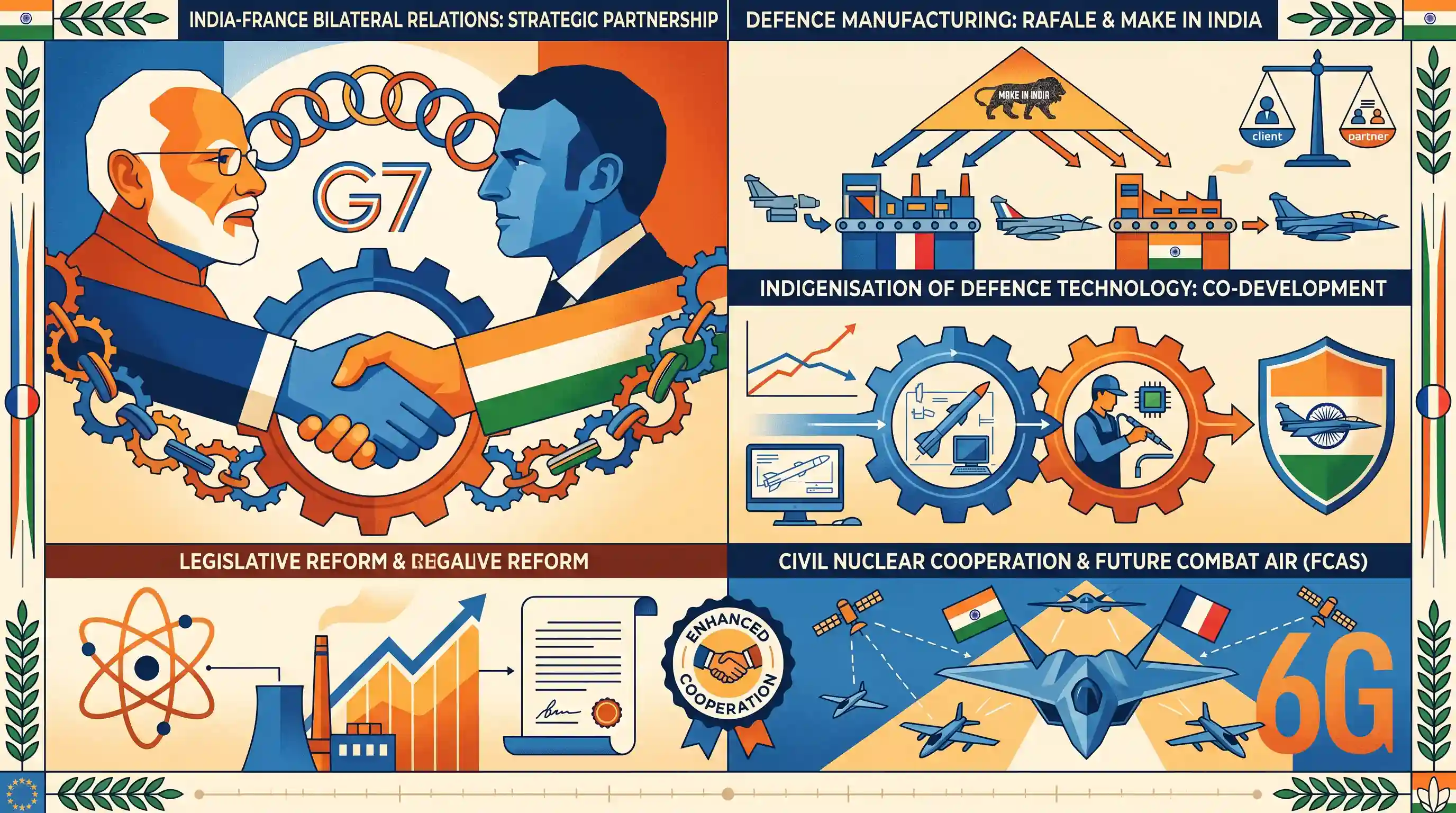
Ahead of Prime Minister Narendra Modi's visit to France for the G7 Summit, French diplomatic sources indicated that future defense agreements, including the proposed deal for 114 Rafale fighter jets, will align with India's 'Make in India' initiative. This signals a strategic shift from a traditional vendor-client relationship to an equal partnership focused on co-development, local manufacturing, and industrial cooperation. Furthermore, bilateral discussions are expected to cover enhanced civil nuclear energy cooperation, driven by recent Indian legislative reforms, and India's potential involvement in the Future Combat Air System (FCAS) sixth-generation fighter aircraft program.
Key Points
- France has committed to aligning future defense cooperation, including the procurement of 114 Rafale jets, with India's 'Make in India' initiative.
- The defense partnership is shifting from a traditional buyer-seller model to an 'equal partnership' emphasizing co-development, local manufacturing, and technology integration.
- India and France are exploring expanded civil nuclear energy cooperation, facilitated by recent legislative reforms in India.
- India has expressed formal interest in joining the Future Combat Air System (FCAS), a European sixth-generation fighter aircraft program, for co-development and co-manufacturing.
Important Terms
Make in India (Defence)

A flagship initiative launched in 2014 to transform India into a global manufacturing hub. In defense, it focuses on 'Aatmanirbharta' (self-reliance) through domestic production, co-development, and reducing import dependency.
UPSC context
GS Paper 3 (Economy/Security). Tests understanding of manufacturing, FDI limits (74%), and the shift to 'Co-developer' models.
Future Combat Air System (FCAS)
A 6th-generation 'system of systems' project (including next-gen fighters and drones) originally between France and Germany. India is exploring co-development to gain exposure to stealth, advanced propulsion, and combat clouds.
UPSC context
GS Paper 3 (Science/Tech/Security). Relevant for futuristic aerospace technology and long-term strategic co-production with France.
Rafale Deal (MRFA)
Refers to the procurement of 114 multi-role fighter jets (MRFA) for the IAF. The new model emphasizes indigenous manufacturing (Make in India) rather than simple off-the-shelf purchase.
UPSC context
GS Paper 3 (Security). Tests knowledge of defense procurement, technology transfer (ToT), and strengthening the Indian Air Force fleet.
Indigenisation of Defence
The process of developing and producing military equipment within India using local resources. It aims to reduce foreign exchange outflow and ensure operational continuity during global supply chain disruptions.
UPSC context
GS Paper 3 (Internal Security). Analyzes 'Positive Indigenisation Lists' and the role of the domestic military-industrial complex.
G7 Outreach Partner
India's status as a 'special invitee' to G7 summits, reflecting its role as a 'swing state' and bridge between the Global North and Global South.
UPSC context
GS Paper 2 (International Relations). Tests understanding of India's multilateral diplomacy and rising global stature in informal forums.
Strategic Autonomy
A core pillar of India's foreign policy, especially with France, emphasizing independent decision-making and resistance to rigid bloc politics while pursuing self-reliance in critical technologies.
UPSC context
GS Paper 2 (International Relations). Fundamental for explaining India's balanced relations with the US, Russia, and Europe.
Prelims Trap
"Under the Civil Liability for Nuclear Damage Act, 2010, absolute liability for nuclear accidents rests directly with foreign reactor suppliers."
CLNDA channels absolute liability to the operator (e.g., NPCIL), not the supplier. However, Section 17(b) gives the operator a "right of recourse" against suppliers for defective equipment.
Static Concepts Connected
What are the key features of the Civil Liability for Nuclear Damage Act (CLNDA), 2010?
- Operator Liability: Channels absolute, no-fault liability for nuclear damage exclusively to the operator of the nuclear installation (like NPCIL in India).
- Right of Recourse (Sec 17): Allows the operator to seek damages from the supplier if the nuclear incident resulted from supplying equipment with patent or latent defects.
- Financial Caps: Caps the operator's financial liability per incident, with the Central Government stepping in to cover damages exceeding this capped amount.
How does the Defence Acquisition Procedure (DAP) 2020 promote indigenisation?
- IDDM Priority: Prioritizes the 'Buy (Indian-IDDM)' category (Indigenously Designed, Developed and Manufactured) over outright global purchases.
- Enhanced FDI: Permits up to 74% Foreign Direct Investment in the defence sector under the automatic route to encourage co-production.
- Indigenous Content (IC): Mandates specific percentages of indigenous content in platforms, pushing foreign OEMs toward local manufacturing and tech-transfer joint ventures.
Cross-Topic Patterns
SMRs for clean energy transition
Bilateral nuclear focus has shifted from stalled mega-reactors like Jaitapur to Small Modular Reactors (SMRs), directly linking international diplomacy with India's Net Zero 2070 decarbonization goals.
FCAS & AI-networked warfare
India's interest in the European Future Combat Air System (FCAS) highlights a shift toward 6th-gen 'system of systems' warfare, tying defence procurement to emerging networked AI capabilities.

Expect a 2026 multi-statement question combining India-France Horizon 2047 pillars, SMR characteristics, and the CLNDA 2010 liability laws.
Linked PYQs · 2
Linked PYQs · 2
- 2014MainsGS3
Foreign Direct Investment (FDI) in the defence sector is now set to be liberalized. What influence this is expected to have on Indian defence and economy in the short and long run?
- 2017MainsGS3
Give an account of the growth and development of nuclear science and technology in India. What is the advantage of fast breeder reactor programme in India?
