Foreign portfolio investment outflows and capital market volatility
Source:The Hindu ↗
Why It Matters
FPI flows are a vital source of foreign capital but are highly volatile ('hot money'). Their sudden withdrawal impacts the rupee exchange rate, domestic liquidity, and forex reserves. Aspirants must understand how global factors like U.S. Fed rate hikes directly influence India's macroeconomic stability.
Summary
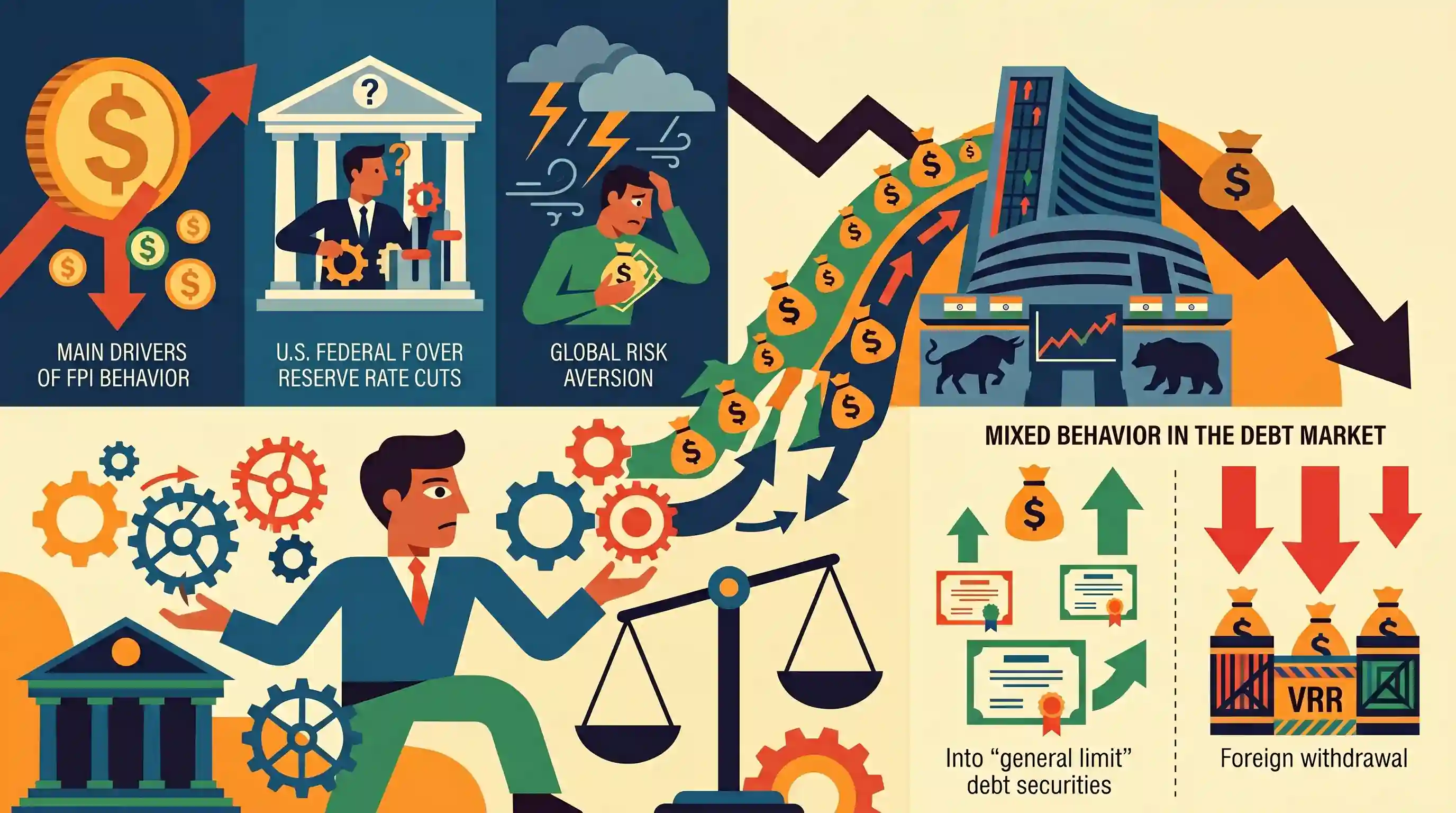
Foreign Portfolio Investors (FPIs) pulled out ₹3,765 crore from Indian equities in November 2025, driven by global risk aversion, a strong U.S. dollar, and uncertainty over U.S. Federal Reserve rate cuts. While pulling out of secondary equities, FPIs showed mixed behavior in the debt market, investing heavily in the general limit while withdrawing from the Voluntary Retention Route (VRR). This volatility highlights the sensitivity of emerging markets to global macroeconomic headwinds.
Key Points
- FPIs withdrew a net ₹3,765 crore from Indian equities in November 2025, continuing a selling trend.
- The equity sell-off was triggered by global risk-off sentiment, uncertainty regarding the U.S. Federal Reserve's interest rate trajectory, and a strong U.S. dollar.
- In the debt market, FPIs invested ₹8,114 crore under the general limit but simultaneously withdrew ₹5,053 crore through the Voluntary Retention Route (VRR).
- Geopolitical tensions and volatile crude oil prices have further depressed risk appetite for emerging markets.
Important Terms
Foreign Portfolio Investors (FPIs)

Foreign entities or individuals investing in financial assets like shares and bonds without management control. These are passive, short-term investments highly sensitive to global interest rates and risk sentiment.
UPSC context
GS Paper III (Indian Economy); tests knowledge of capital account volatility and market liquidity.
Voluntary Retention Route (VRR)
An RBI-launched channel allowing FPIs to invest in Indian debt markets with fewer regulatory hurdles, provided they commit to holding a minimum investment for a specific period (usually 3 years).
UPSC context
GS Paper III (Indian Economy); important Prelims topic regarding mechanisms to attract stable foreign capital.
U.S. Federal Reserve
The central bank of the United States. Its interest rate decisions dictate global liquidity, significantly influencing foreign capital flows into or out of emerging markets like India.
UPSC context
GS Paper III (Macroeconomics); covers external sector risks, currency valuation, and monetary policy interdependence.
Secondary Market
A financial market where previously issued securities, such as stocks and bonds, are traded among investors. It provides liquidity and aids in price discovery for existing assets.
UPSC context
GS Paper III (Capital Markets); distinguishes primary capital formation from ongoing trading liquidity.
Balance of Payments (BoP)
A systematic record of all economic transactions between a country's residents and the world. It consists of the Current Account (trade) and Capital Account (investments).
UPSC context
GS Paper III (External Sector); fundamental for understanding economic stability and forex reserve management.
Debt Market
The financial market where fixed-income securities, such as government bonds and corporate debentures, are traded. It allows governments and companies to raise capital via borrowing.
UPSC context
GS Paper III (Financial Markets); relevant for understanding government securities (G-Secs) and corporate funding.
Prelims Trap
"VRR (Voluntary Retention Route) is a specialized RBI channel to attract stable FPI investments into Indian equities."
VRR is exclusively designed for Indian debt markets (corporate and government bonds), not equities. It exempts investors from certain rules in exchange for a retention commitment.
Static Concepts Connected
What is the Voluntary Retention Route (VRR) for Foreign Portfolio Investors?
- Core Purpose: Introduced by the RBI to attract stable, long-term FPI investments specifically into Indian debt markets, curbing the volatility of 'hot money'.
- Retention Commitment: FPIs must voluntarily commit to retaining a minimum percentage (e.g., 75%) of their invested amount in India for a specified minimum period.
- Regulatory Exemption: Investments under VRR are largely exempt from standard macro-prudential regulations like short-term investment caps and concentration limits.
How do US Federal Reserve rate hikes impact Indian macroeconomic stability?
- Capital Flight: Higher US rates narrow the interest-rate differential, making safer US Treasury bonds more attractive and triggering FPI withdrawals from emerging markets.
- Currency Depreciation: Massive dollar outflows depreciate the Indian Rupee, which immediately fuels imported inflation (especially in crude oil and electronics).
- ECB Pressure: Firms that raised capital abroad face significantly higher repayment costs in Rupee terms, hurting corporate balance sheets.
Cross-Topic Patterns
US Monetary Policy + Indian ECBs
FPI capital flight depreciates the Rupee, which disproportionately increases the debt-servicing burden and currency risk for Indian corporates holding unhedged External Commercial Borrowings (ECBs).
FPI Hot Money + Forex Reserves Management
Rapid FPI sell-offs force the RBI to intervene in spot and forward currency markets, utilizing forex reserves to smooth Rupee volatility without attempting to fix its absolute value.

Expect a 2026 Prelims statement differentiating VRR debt conditions from standard general limit FPI investments amid hot money volatility.
Linked PYQs · 3
Linked PYQs · 3
- 2022PrelimsGS1
Consider the following statements: 1. Tight monetary policy of US Federal Reserve could lead to capital flight. 2. Capital flight may increase the interest cost of firms with existing External Commercial Borrowings (ECBs). 3. Devaluation of domestic currency decreases the currency risk associated with ECBs. Which of the statements given above are correct?
- 2020PrelimsGS1
With reference to Foreign Direct Investment in India, which one of the following is considered its major characteristic?
- 2011PrelimsGS1
Both Foreign Direct Investment (FDI) and Foreign Institutional Investor (FII) are related to investment in a country. Which one of the following statements best represents an important difference between the two?
