Russia Ukraine Conflict Enters Fourth Year
Source:Indian Express ↗
Why It Matters
Highlights the changing dynamics of global security, the impact of shifting US foreign policy on international conflicts, and the evolving resilience of European security architecture amidst the prolonged Russia-Ukraine war. It is crucial for understanding post-Cold War geopolitical alignments.
Summary
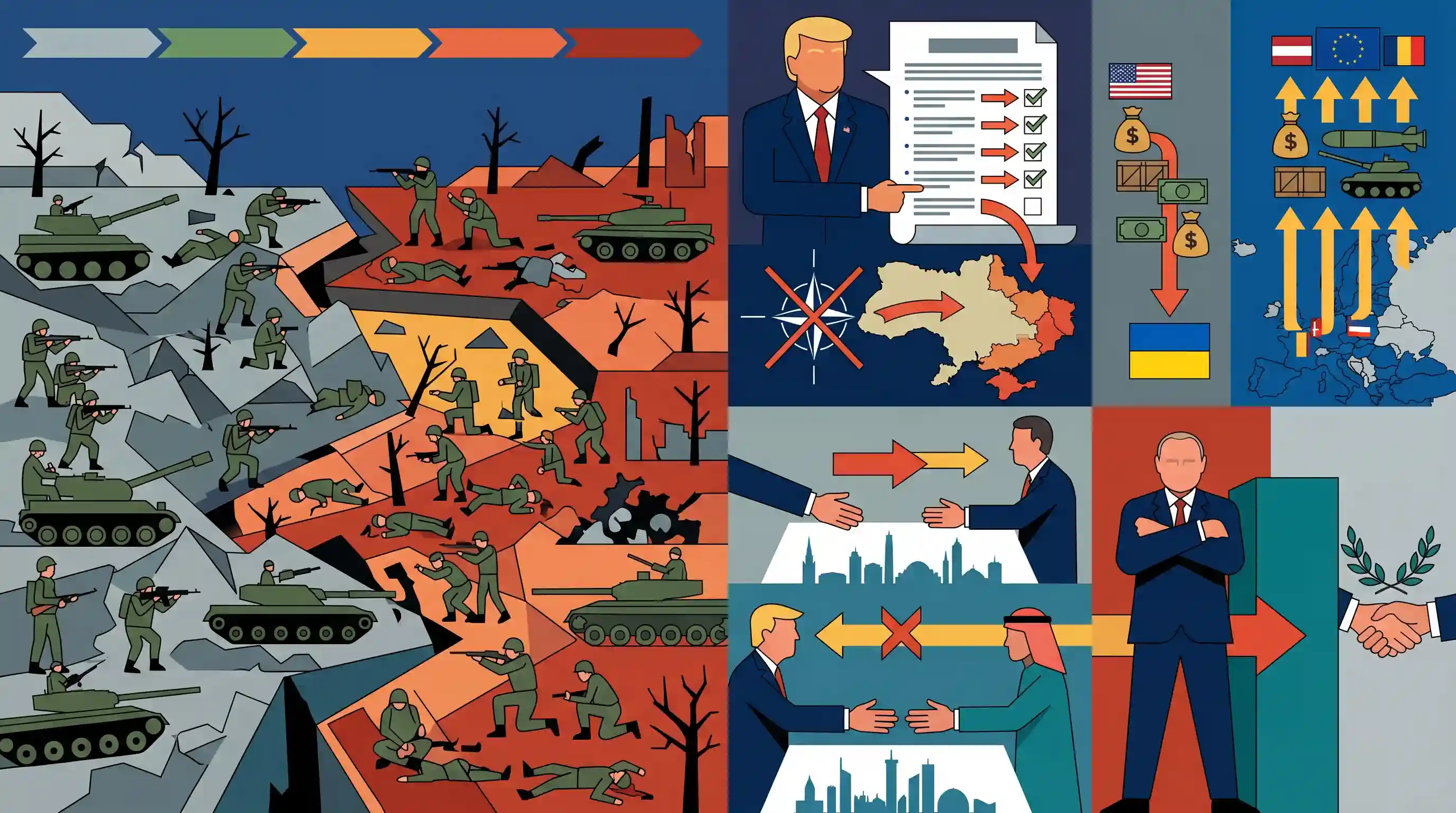
Four years into the Russia-Ukraine conflict, the war has settled into a costly war of attrition with heavy casualties and minimal territorial shifts. Despite a new US administration under Donald Trump seeking a quick resolution via a 28-point plan—which expects Ukraine to cede territory and drop NATO aspirations—peace remains distant. While US aid has decreased, European nations continue robust support for Kyiv. Ongoing diplomatic efforts, including negotiations mediated by the US in Geneva and Abu Dhabi, have yet to yield a breakthrough as Russia maintains its maximalist demands.
Key Points
- The Russia-Ukraine conflict has reached its four-year mark, devolving into an attritional war with significant casualties, including an estimated 1.2 million Russian losses.
- Russia currently controls about 20% of Ukrainian territory, with only 12% captured since the 2022 invasion.
- The US administration under Donald Trump is pushing a controversial 28-point peace plan that requires Ukraine to cede territory and abandon NATO aspirations.
- While US financial and military support for Ukraine is waning under the new administration, European allies continue to provide crucial backing for Kyiv's defense.
- Diplomatic efforts in Geneva and Abu Dhabi remain stalled as Russia continues to hold onto its maximalist demands.
Important Terms
NATO (North Atlantic Treaty Organization)

A military alliance of 32 countries (as of 2026) founded in 1949. It is based on the principle of collective defense, where an attack on one member is an attack on all.
UPSC context
GS Paper 2 (IR) & GS Paper 3 (Security); tests understanding of global security architecture and the impact of its eastward expansion.
War of Attrition
A military strategy aimed at wearing down an opponent's resources, personnel, and morale over time until their capacity to fight collapses, rather than seeking a quick decisive victory.
UPSC context
GS Paper 3 (Security/Defence); tests ability to analyze modern conflict nature, endurance, and the strategic shift from maneuver to resource-exhaustion warfare.
Center for Strategic and International Studies (CSIS)
A Washington-based bipartisan, non-profit think tank founded in 1962. It provides strategic analysis and policy solutions for international relations, defense, and global security issues.
UPSC context
GS Paper 2 (IR); tests knowledge of influential global policy organizations that monitor conflict data and shape international strategic discourse.
Collective Defence
A security arrangement where an alliance of nations commits to a joint response if any member state is attacked, exemplified by NATO’s Article 5.
UPSC context
GS Paper 2 (International Relations); tests understanding of foundational concepts in international security alliances and the legal basis for mutual aid.
Maximalist Demands
A negotiation stance where a party refuses to compromise and insists on achieving all its primary objectives, often making a diplomatic breakthrough difficult.
UPSC context
GS Paper 2 (IR); tests comprehension of diplomatic hurdles, negotiation dynamics, and conflict resolution barriers in major geopolitical crises.
28-point plan (Trump Peace Plan)
A Trump administration proposal (circa 2025) seeking to end the Russia-Ukraine war by requiring Ukrainian territorial concessions and military caps in exchange for security guarantees.
UPSC context
GS Paper 2 (IR); tests awareness of current peace mediation efforts, US foreign policy shifts, and sovereignty vs. peace trade-offs.
Prelims Trap
The United Nations or Geneva-based Western institutions hold exclusive mediation rights for the Russia-Ukraine conflict.
Middle Eastern nations, notably the UAE (Abu Dhabi), have emerged as critical independent mediators for peace talks and prisoner exchanges outside traditional UN/Western frameworks.
Static Concepts Connected
What is NATO's 'Open Door Policy' and collective defense structure?
- Open Door Policy: Based on Article 10 of the Washington Treaty, it allows any European State capable of furthering NATO principles to be invited to join the alliance.
- Article 5 mechanism: The core principle (Article 5) stating that an armed attack against one NATO member is considered an attack against all, necessitating mutual military assistance.
What defines the Transatlantic Alliance and its burden-sharing debate?
- Institutional Core: Primarily operationalized through NATO, bridging North American (US and Canada) and European security architectures established post-World War II.
- 2% GDP Target: The ongoing geopolitical friction over the mandate that NATO member states must contribute at least 2% of their national GDP to defense spending.
Cross-Topic Patterns
Rise of European Strategic Autonomy
As US military backing wanes under the new administration, Europe’s forced self-reliance feeds into the ongoing UPSC theme of EU "Strategic Autonomy" and the decoupling of European defense from American umbrellas.
Gulf States as middle-power mediators
Abu Dhabi's role in prisoner exchanges highlights the shifting of diplomatic gravity, with Gulf nations leveraging multi-alignment to pivot from mere petro-states to indispensable global geopolitical mediators.

Expect a 2026 Mains question analyzing the push for "European Strategic Autonomy" triggered by US policy shifts on NATO and Ukraine.
Linked PYQs · 3
Linked PYQs · 3
- 2023MainsGS2
‘The expansion and strengthening of NATO and a stronger US-Europe strategic partnership works well for India.’ What is your opinion about this statement ? Give reasons and examples to support your answer.
- 2025MainsGS2
"With the waning of globalization, post-Cold War world is becoming a site of sovereign nationalism.” Elucidate.
- 2025MainsGS2
"The reform process in the United Nations remains unresolved, because of the delicate imbalance of East and West and entanglement of the USA vs. Russo-Chinese alliance.” Examine and critically evaluate the East-West policy confrontations in this regard.
