Russia Ukraine Conflict and Peace Negotiations
Source:Indian Express ↗
Why It Matters
The changing stance of the US under President Trump and the resulting emphasis on European strategic autonomy fundamentally alters the global security landscape. Recognizing these shifts is crucial for understanding post-Cold War geopolitics, NATO's relevance, and the strategic environment India must navigate.
Summary
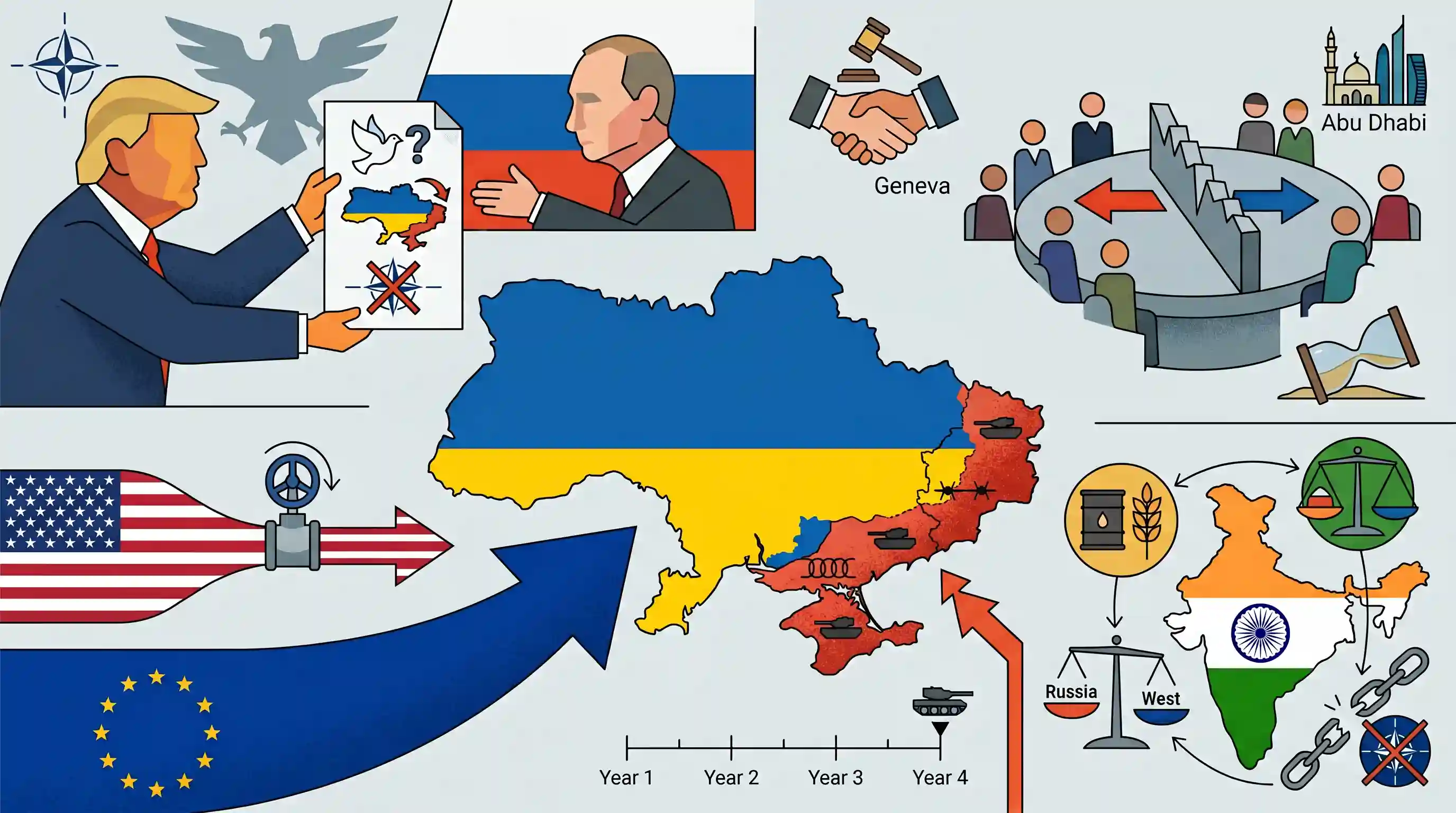
Four years into the Russia-Ukraine conflict, the situation remains a grinding war of attrition with heavy casualties and Russia holding about 20% of Ukrainian territory. US President Donald Trump is attempting to broker a US-Russia reset through a 28-point peace plan that requires Ukraine to cede land and abandon NATO aspirations. As US aid diminishes, Europe is stepping up to support Ukraine, viewing the conflict as central to its own security. Meanwhile, diplomatic efforts—including talks in Geneva and Abu Dhabi—proceed at a glacial pace, stymied by maximalist demands from Russia, making a mutually acceptable peace deal elusive.
Key Points
- The Russia-Ukraine conflict has turned into a four-year war of attrition, with Russia controlling about 20% of Ukrainian territory and suffering an estimated 1.2 million casualties.
- US President Donald Trump is advocating a 28-point peace plan aimed at a US-Russia reset, which requires Ukraine to cede territory and abandon NATO aspirations.
- With US aid to Europe drying up, European nations are throwing their full weight behind Ukraine, viewing its defense as vital to their own regional security.
- Diplomatic efforts, including US-mediated talks in Geneva and trilateral meetings in Abu Dhabi, remain stalled as Russian President Vladimir Putin maintains maximalist demands.
Important Terms
Trump’s 28-point Peace Plan

A 2026 US-brokered diplomatic framework requiring Ukraine to cede territory (Donbas, Crimea), cap its military at 600,000, and abandon NATO aspirations in exchange for security guarantees and phased sanction relief.
UPSC context
GS Paper II (International Relations). Tests knowledge of great power diplomacy and the impact of US foreign policy on global security architecture.
NATO
A 32-member intergovernmental military alliance. It serves as Europe's primary security umbrella, providing Ukraine with support while facing internal divisions over US commitment and Russian non-expansion demands.
UPSC context
GS Paper II (Global Security Architecture). Essential for understanding collective defense and the evolving security dynamics in the Euro-Atlantic region.
War of Attrition
A military strategy where opposing sides wear down the enemy through continuous losses in personnel and material, rather than decisive maneuvers. In Ukraine, this is marked by stagnant, high-casualty front lines.
UPSC context
GS Paper III (Security). Tests understanding of contemporary warfare doctrines where industrial capacity and manpower endurance are decisive factors.
Centre for Strategic and International Studies (CSIS)
A prominent US-based bipartisan think tank providing data-driven analysis on global security. Its 2026 report estimated nearly 2 million total casualties in the Russia-Ukraine conflict.
UPSC context
GS Paper II (Effect of Policies). Tests ability to use credible institutional data to analyze international security trends and foreign policy impacts.
Geneva and Abu Dhabi Talks
Direct trilateral negotiations (US, Russia, Ukraine) held in early 2026. While establishing groundwork for ceasefire mechanisms, they remained stymied by maximalist territorial demands and lack of trust.
UPSC context
GS Paper II (Diplomatic Negotiations). Illustrates the role of neutral mediators and great power brokerage in resolving intractable global conflicts.
Territorial Integrity
The international law principle (UN Charter Article 2(4)) that a state's borders are sacrosanct. This remains the core legal "sticking point" in Ukraine-Russia peace negotiations.
UPSC context
GS Paper II (International Law). Fundamental for understanding sovereignty and the legal basis for resolving interstate territorial disputes.
Security Guarantees
Formal pledges by powerful states to provide military or diplomatic support if a country is attacked; proposed in 2026 as a non-NATO alternative to ensure Ukraine's long-term safety.
UPSC context
GS Paper II (Bilateral Agreements). Tests understanding of deterrence mechanisms and legal instruments used to ensure regional stability in post-conflict zones.
Prelims Trap
The 28-point peace plan to resolve the Russia-Ukraine crisis is a multilateral framework adopted by the United Nations Security Council.
The 28-point plan is a unilateral US (Trump administration) initiative, not a UN-mandated resolution. The UN Security Council remains completely paralyzed on Ukraine due to the P5 veto mechanism.
Static Concepts Connected
What is NATO's Article 5 and its "Open Door Policy"?
- Article 5: Establishes the principle of collective defense, meaning an armed attack against one NATO member is considered an armed attack against all members.
- Open Door Policy: Rooted in Article 10 of the Washington Treaty, it allows any European state capable of contributing to North Atlantic security to join the alliance.
Why is the UN Security Council structurally paralyzed in the Ukraine conflict?
- P5 Veto Power: Article 27 of the UN Charter grants permanent members (like Russia) absolute veto over substantive resolutions, preventing binding UNSC actions against their own interests.
- Chapter VII Paralysis: While Chapter VII allows the UNSC to authorize sanctions or force to restore peace, a direct belligerent holding a veto effectively nullifies this enforcement mechanism.
Cross-Topic Patterns
European Strategic Autonomy & Defense Indigenization
As the US withdraws under 'America First', Europe's push for strategic autonomy mirrors India’s 'Atmanirbhar Bharat' in defense, emphasizing a global shift toward self-reliant security architectures.
US-Russia Reset & India's Balancing Act
A potential US-Russia détente could dilute the Sino-Russian partnership, easing India's strategic dilemma of maintaining Moscow defense ties while countering Beijing through the Quad.

A 2026 Mains question will likely link the withdrawal of US security guarantees in Europe to the global rise of 'Strategic Autonomy'.
Linked PYQs · 3
Linked PYQs · 3
- 2023MainsGS2
‘The expansion and strengthening of NATO and a stronger US-Europe strategic partnership works well for India.’ What is your opinion about this statement ? Give reasons and examples to support your answer.
- 2025MainsGS2
"The reform process in the United Nations remains unresolved, because of the delicate imbalance of East and West and entanglement of the USA vs. Russo-Chinese alliance.” Examine and critically evaluate the East-West policy confrontations in this regard.
- 2020MainsGS2
What is the significance of Indo-US defence deals over Indo-Russian defence deals? Discuss with reference to stability in the Indo-Pacific region.
