Assam Lacks Action on Construction within Kaziranga Corridors
Source:The Hindu ↗
हे का महत्त्वाचे आहे
This issue highlights the persistent friction between developmental pressures, state government autonomy, and environmental mandates issued by the judiciary. It underscores the challenges of executing environmental law, protecting ecologically fragile corridors (like those of the endangered one-horned rhinoceros), and the critical role of court-appointed bodies like the Central Empowered Committee (CEC) and civil society activists using the RTI Act.
सारांश
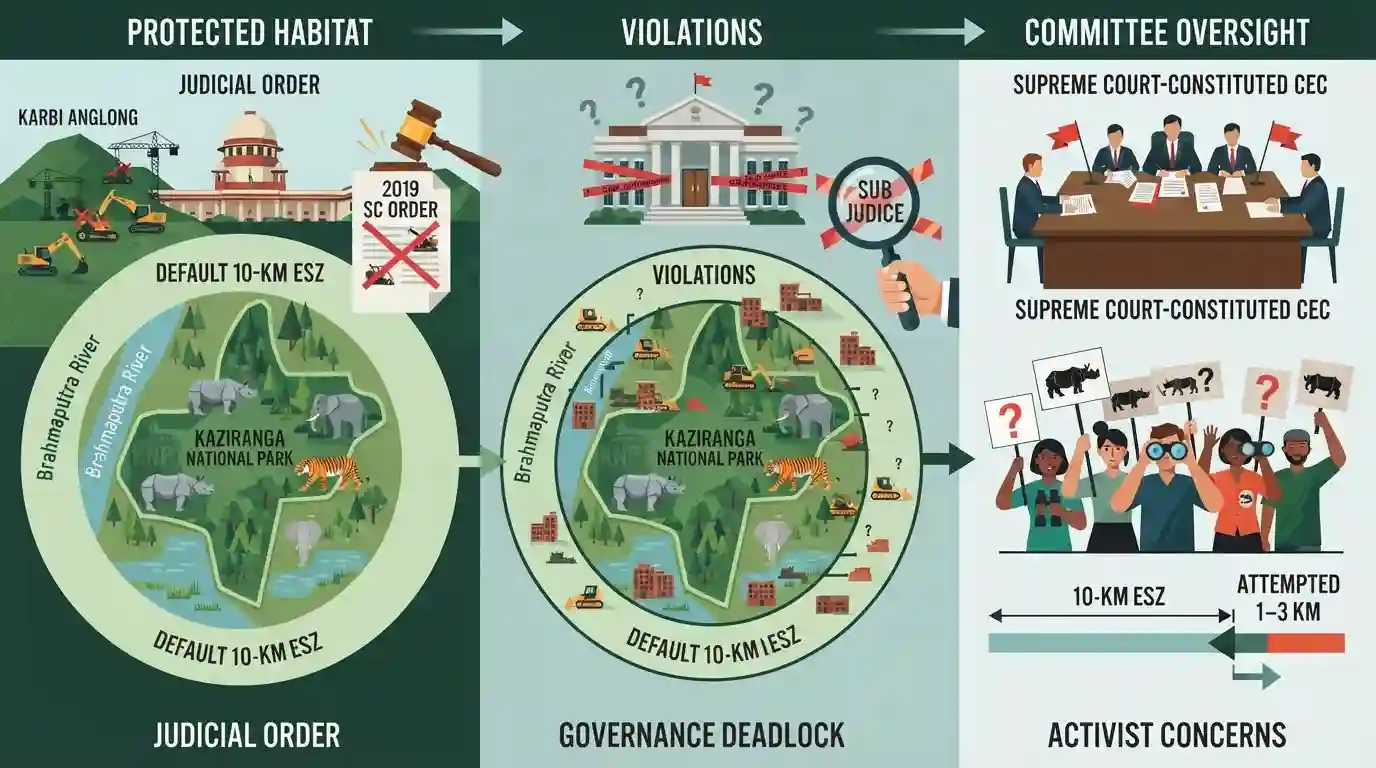
The Supreme Court-constituted Central Empowered Committee (CEC) has flagged the Assam government's prolonged silence regarding illegal construction activities within the nine animal corridors of the Kaziranga National Park and Tiger Reserve (KNPTR) and its default 10-km Eco-Sensitive Zone (ESZ). Despite repeated reminders from the CEC, the state administration has withheld crucial details, claiming the matter is 'sub judice'. The controversy stems from a landmark 2019 Supreme Court order that banned mining in the Karbi Anglong hills and halted new private construction in these critical wildlife corridors to safeguard the habitat of the one-horned rhinoceros. Activists accuse the state of delaying compliance while attempting to reduce the ESZ range to 1–3 km.
मुख्य मुद्दे
- The Supreme Court-constituted Central Empowered Committee (CEC) has faced a lack of response from the Assam government regarding construction activities in the nine animal corridors of Kaziranga National Park and Tiger Reserve.
- In 2019, the Supreme Court banned mining and stone quarrying along the southern boundary of the one-horned rhino habitat in Karbi Anglong, alongside prohibiting new constructions on private lands within the designated animal corridors.
- Activists have utilized the Right to Information (RTI) Act to reveal that despite commitments in 2022 to provide action-taken reports 'without delay', the Assam government has failed to provide information to the CEC, citing the matter as sub judice.
- The standard default Eco-Sensitive Zone (ESZ) extends up to 10 km around national parks, but the Assam Chief Minister has advocated for reducing this range to 1–3 km, sparking conservation concerns.
- Illegal activities, such as sand mining in the Deihori River (a feeder to Kaziranga's wetlands) and commercial developments like resorts, continue to threaten the ecologically fragile wildlife corridors linking Kaziranga to the Karbi Anglong hills.
महत्त्वाच्या संज्ञा
Eco-Sensitive Zone (ESZ)

Buffer zones notified by the Ministry of Environment, Forest and Climate Change (MoEFCC) around Protected Areas to regulate development, act as 'shock absorbers', and are legally backed by the Environment (Protection) Act, 1986.
UPSC context
GS Paper 3 (Conservation); tests concepts of protected area networks, human-wildlife conflicts, and land-use zoning regulations.
Central Empowered Committee (CEC)
Originally a Supreme Court-created ad-hoc body (2002) in the T.N. Godavarman case, it was made a permanent statutory body under the Environment (Protection) Act, 1986 in 2023 to monitor environmental compliance.
UPSC context
GS Paper 3 (Environment/Biodiversity) and GS Paper 2; tests environmental compliance, regulatory bodies, and judiciary's role in forest protection.
Environment (Protection) Act, 1986
An umbrella legislation empowering the central government to coordinate environmental protection activities, set pollution standards, regulate industries, and declare Ecologically Fragile Areas under Section 3.
UPSC context
GS Paper 3 (Environmental Legislation); tests statutory central powers, environmental governance, and legal tools for conservation.
Environment, Forest, and Climate Change Department (Assam)
The state administrative department responsible for safeguarding Assam’s forest cover and wildlife, managing protected networks like Kaziranga, and implementing conservation mandates and eviction of illegal encroachments.
UPSC context
GS Paper 3 (Conservation/State Governance); tests local administrative challenges, corridor protection, and regional implementation of federal ecological policies.
Wildlife (Protection) Act, 1972
India's primary law safeguarding wild fauna and flora, establishing the legal frameworks for declaring national parks and sanctuaries, and creating governing bodies like the National Board for Wildlife.
UPSC context
GS Paper 3 (Biodiversity Conservation); tests statutory frameworks, species protection schedules, and enforcement roles of state and central authorities.
पूर्वपरीक्षा सापळा
The Central Empowered Committee (CEC) is a statutory watchdog constituted under the Wildlife (Protection) Act.
The CEC was institutionalized as a statutory body under Section 3(3) of the Environment (Protection) Act, 1986, not the Wildlife (Protection) Act.
संबंधित स्थिर संकल्पना
What is the legal framework and regulatory zoning of Eco-Sensitive Zones?
- Legal Basis: Notified by the MoEFCC under Section 3 of the Environment (Protection) Act, 1986, rather than the Wildlife Protection Act.
- Zoning Classification: Activities are categorized into prohibited (mining, heavy industries), regulated (hotels, commercial tree felling), and permitted (organic farming, rainwater harvesting).
How did the Central Empowered Committee transition into a statutory body?
- Judicial Origin: Created as an ad-hoc watchdog by the Supreme Court in 2002 during the landmark T.N. Godavarman forest conservation case.
- Statutory Transition: Formally institutionalized as a permanent statutory body under Section 3(3) of the Environment (Protection) Act, 1986 in late 2023.
आंतर-विषय नमुने
Federalism vs. Ecocentrism
State demands to shrink ESZs for development clash with judicial and central conservation mandates, highlighting ongoing federal friction over ecological governance.
Flood Topography & Connectivity
Kaziranga's seasonal flood dynamics make physical overland corridors vital, illustrating how static protected-area borders fail without dynamic landscape-level connectivity.

CEC's statutory shift under EPA 1986 combined with ESZ activity classification is highly likely to feature in a multi-statement MCQ.
संबंधित PYQ · 2
संबंधित PYQ · 2
- 2014PrelimsGS1
With reference to 'Eco-Sensitive Zones', which of the following statements is/are correct? 1. Eco-Sensitive Zones are the areas that are declared under the Wildlife (Protection) Act, 1972. 2. The purpose of the declaration of Eco-Sensitive Zones is to prohibit all kinds of human activities in those zones except agriculture. Select the correct answer using the code given below.
- 2019PrelimsGS1
Consider the following statements: 1. Asiatic lion is naturally found in India only. 2. Double-humped camel is naturally found in India only. 3. One-horned rhinoceros is naturally found in India only. Which of the statements given above is/are correct?
