Strategic and economic benefits of India UK free trade agreement
Source:Indian Express ↗
Why It Matters
India is increasingly focusing on bilateral FTAs amidst stalled multilateral WTO negotiations. The India-UK FTA is critical for understanding India's evolving trade policy, efforts to boost manufacturing exports, and strategic alignment in a multipolar world.
Summary
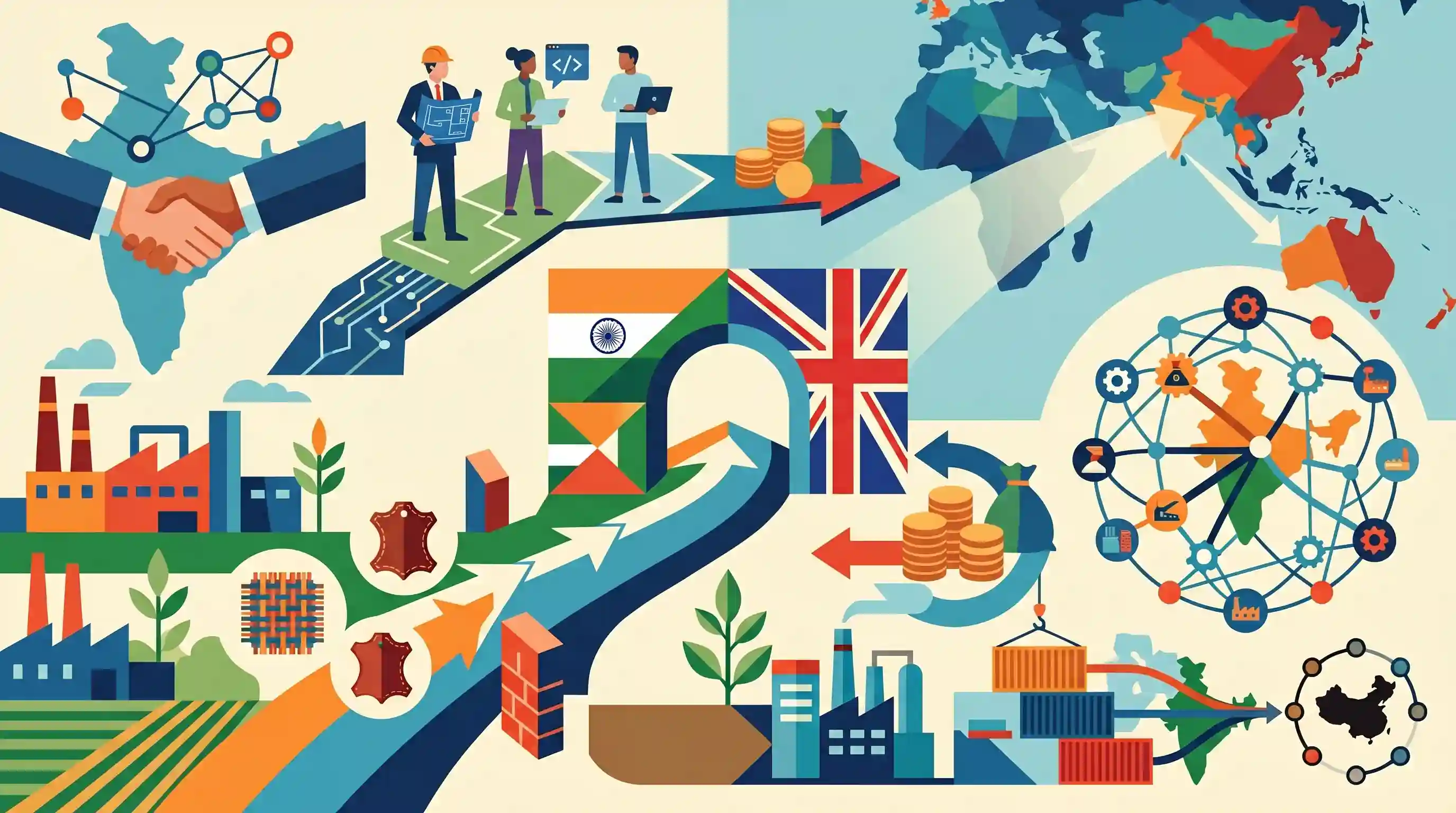
The proposed Free Trade Agreement (FTA) between India and the United Kingdom presents substantial economic and strategic benefits for India. Key gains include the removal of tariffs to boost exports in labour-intensive sectors such as textiles and leather, and provisions for easier mobility of skilled Indian professionals, significantly enhancing trade in services. Additionally, the FTA is poised to attract foreign direct investment, enabling India to integrate more deeply into Global Value Chains (GVCs). Beyond economic advantages, the deal carries geopolitical weight, reinforcing a shared vision for the Indo-Pacific region and aiding in diversifying supply chains away from China.
Key Points
- An FTA with the UK offers tariff reductions that boost the competitiveness of India's labour-intensive exports, including textiles, leather, and gems.
- The agreement facilitates improved mobility for skilled Indian professionals and service providers, benefiting sectors like IT and healthcare.
- By attracting foreign direct investment (FDI) from the UK, India can better integrate into Global Value Chains (GVCs) and expand its manufacturing base.
- A successful bilateral trade deal strengthens the strategic convergence between India and the UK, acting as a counterweight to China's influence in the Indo-Pacific.
Important Terms
India-UK Free Trade Agreement (FTA)

A comprehensive pact (formally the Comprehensive Economic and Trade Agreement or CETA) signed to eliminate tariffs on 99% of Indian exports and reduce duties on British goods like whisky.
UPSC context
GS-II/III; tests understanding of post-Brexit bilateral trade diplomacy and India's strategy for labor-intensive export growth.
Global Value Chains (GVCs)
A fragmented production model where manufacturing stages are spread across different countries. India aims to integrate here to move from raw material exports to value-added manufacturing.
UPSC context
GS-III (Indian Economy); tests knowledge of industrial policy and the "Make in India" initiative's role in global trade.
Broad-based Trade and Investment Agreement (BTIA)
The specific comprehensive trade negotiation between India and the European Union. While distinct from the UK deal, it remains a critical parallel objective for Indian trade policy.
UPSC context
GS-II (International Relations); tests ability to distinguish between India’s major trade partners and the specific regulatory hurdles in EU-India relations.
Indo-Pacific
A strategic maritime region spanning from Africa's east coast to the Pacific islands, central to India’s security and economic interests in countering regional hegemony.
UPSC context
GS-II (International Relations); tests understanding of maritime geopolitics, "Act East" policy, and strategic autonomy in a multipolar world.
World Trade Organization (WTO)
The global body regulating international trade rules. FTAs must comply with its standards, ensuring bilateral deals do not unfairly discriminate against other member nations.
UPSC context
GS-III (Economy); tests knowledge of multilateral trade governance and the compatibility of regional trade pacts with global rules.
Prelims Trap
Mode 4 services provisions in the FTA enable seamless cross-border data flows and e-commerce between the nations.
Mode 4 under WTO GATS specifically governs the temporary movement of natural persons (skilled professionals), NOT digital data flows or cross-border supply (which is Mode 1).
Static Concepts Connected
What are the four Modes of services trade under WTO GATS?
- Mode 1: Cross-border supply (e.g., telemedicine or software services delivered from India to the UK).
- Mode 2: Consumption abroad (e.g., a UK citizen traveling to India for medical tourism).
- Mode 3: Commercial presence (e.g., an Indian bank opening a physical branch in London).
- Mode 4: Presence of natural persons (e.g., Indian IT professionals traveling to the UK for project work).
How does a Free Trade Agreement differ from a Customs Union?
- Free Trade Agreement: Members eliminate tariffs among themselves but maintain their own independent tariffs against non-member countries.
- Customs Union: Members eliminate internal tariffs AND adopt a common external tariff against all third countries.
- Rules of Origin: Strict enforcement is crucial in FTAs to prevent non-members from routing exports through a low-tariff member country.
Cross-Topic Patterns
Rules of Origin & Chinese dumping
FTAs with Western nations require strict 'Rules of Origin' negotiations to ensure third countries (like China) do not route cheap manufactured goods into India via the partner country.
UK Indo-Pacific Tilt + SCRI
The UK’s Indo-Pacific strategy economically complements the Supply Chain Resilience Initiative (India, Japan, Australia) aimed at de-risking global value chains away from Chinese manufacturing hubs.

Expect a 2026 question contrasting India's rejection of mega-regionals (RCEP) with its aggressive pursuit of Western bilateral FTAs.
Linked PYQs · 2
Linked PYQs · 2
- 2025MainsGS3
What are the challenges before the Indian economy when the world is moving away from free trade and multilateralism to protectionism and bilateralism? How can these challenges be met?
- 2017PrelimsGS1
'Broad-based Trade and Investment Agreement (BTIA)' is sometimes seen in the news in the context of negotiations held between India and
