Murshidabad level crossing train collision claims student lives
Source:newindianexpress ↗
Why It Matters
Accidents at railway level crossings highlight critical gaps in transport safety, infrastructure management, and administrative accountability. Additionally, the location of the incident draws geographical attention to the Murshidabad district and the regional railway network of West Bengal, both of which are prominent topics for the WBCS Prelims.
Summary
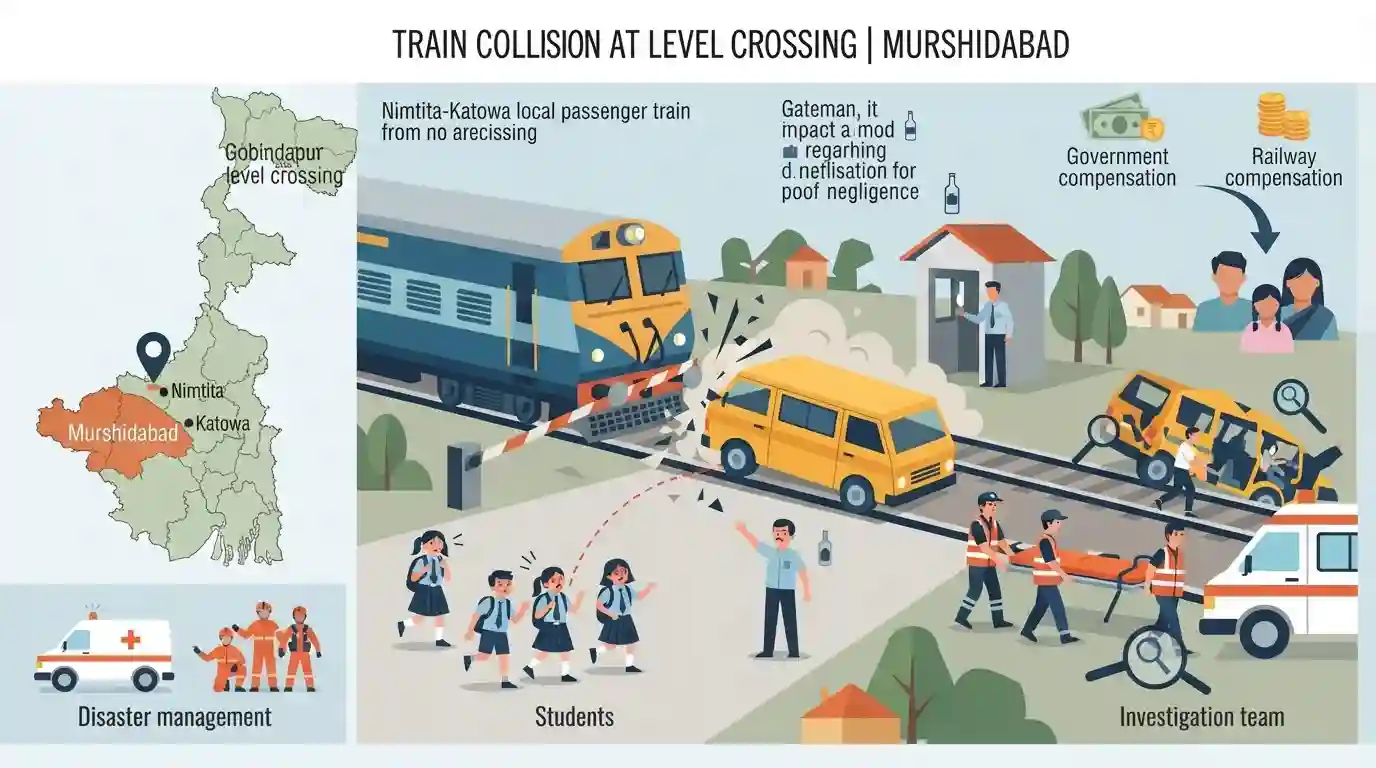
A tragic collision at an open level crossing in Murshidabad district resulted in the deaths of five people, including four students. The Nimtita-Katowa local passenger train struck a school van at the Gobindapur level crossing, reportedly due to the negligence of an allegedly intoxicated gateman. Financial compensations have been announced by the government and railway authorities as an investigation is initiated into the disaster.
Key Points
- Five people, including four schoolchildren, died after a local passenger train rammed into a school carpool vehicle at an open level crossing in West Bengal's Murshidabad district.
- The incident involved the Nimtita-Katowa local train near the Gobindapur level crossing, situated in the Azimganj-Katwa railway division.
- Locals alleged that the level crossing gate was open and accused the gateman of being intoxicated; he has been subsequently arrested.
- Ex-gratia compensation was announced for the victims, comprising Rs 10 lakh from the Railways and Rs 5 lakh from the state government.
Important Terms
Commission of Railway Safety (CRS)

A statutory body under the Ministry of Civil Aviation responsible for ensuring the safety of rail travel and investigating serious train accidents in India.
UPSC context
GS Paper 3: Security & Disaster Management. Important for administrative independence, conflict of interest avoidance, and safety regulatory mechanisms.
Rashtriya Rail Sanraksha Kosh (RRSK)
A dedicated safety fund introduced in 2017-18 to finance critical safety-related works like track renewals, bridge rehabilitation, and eliminating level crossings on Indian Railways.
UPSC context
GS Paper 3: Mobilization of Resources and Infrastructure. Tests understanding of fiscal commitments toward infrastructure modernization and passenger safety.
Level Crossing
An intersection where a railway line crosses a road or path at the same level, classified as either manned or unmanned.
UPSC context
GS Paper 3: Infrastructure Safety. Important for discussing transport network hazards, modernization initiatives, and the elimination of unmanned crossings.
Indian Railways
The state-owned national railway system of India, managed by the Ministry of Railways, operating one of the world's largest and busiest rail networks.
UPSC context
GS Paper 3: Infrastructure (Railways). Crucial for economic growth, connectivity, and national transport infrastructure policies.
Government of West Bengal
The subnational government of the Indian state of West Bengal, headed by the Chief Minister, responsible for executive, legislative, and judicial administration at the state level.
UPSC context
GS Paper 2: Federalism and State-Center Relations. Tests understanding of cooperative federalism, law and order, and joint state-central disaster response.
Disaster Management
The systematic planning and organization of resources to mitigate, prepare for, respond to, and recover from emergency events like railway accidents.
UPSC context
GS Paper 3: Disaster Management. Covers emergency response protocols, administrative coordination, and mitigation of human-induced technical disasters.
Prelims Trap
The Commissioner of Railway Safety operates directly under the Ministry of Railways to expedite independent accident investigations.
The CRS actually operates under the Ministry of Civil Aviation to maintain complete independence from the railway operator, avoiding conflicts of interest.
Static Concepts Connected
What is the role and administrative structure of the Commissioner of Railway Safety (CRS)?
- Ministry Oversight: Operates under the Ministry of Civil Aviation, not Railways, to ensure independent investigation of serious railway accidents.
- Statutory Basis: Derives its authority from the Railways Act, 1989, discharging statutory functions regarding rail safety and line clearances.
- Headquarters: Headed by the Chief Commissioner of Railway Safety (CCRS) and headquartered in Lucknow, Uttar Pradesh.
What is the Rashtriya Rail Sanraksha Kosh (RRSK)?
- Core Mandate: Introduced in 2017-18 as a non-lapsable transit safety fund dedicated strictly to critical asset renewal and safety works.
- Extension: Given an extension from 2022-23 to 2026-27 with a fresh corpus, prioritizing track renewal, signaling, and bridge rehabilitation.
Cross-Topic Patterns
Institutional independence in safety oversight
Placing CRS under Civil Aviation mirrors global regulatory models, separating the safety investigator from the operator to prevent institutional conflicts of interest.
Kavach rollout vs Level-crossing safety
While India's indigenous Kavach system automates braking to prevent collisions, physical level-crossings still remain vulnerable to manual gatekeeping errors.

UPSC may test the institutional design of the Commissioner of Railway Safety (MoCA) and the operational limits of Kavach by 2026.
Linked PYQs · 2
Linked PYQs · 2
- 2018WBCS_PRELIMSGS1
Murshidabad district is bisected into two halves by
- 2018WBCS_PRELIMSGS1
In West Bengal rail wagons are manufactured at
