AP maritime board fast tracks four new port projects
Source:The Hindu ↗
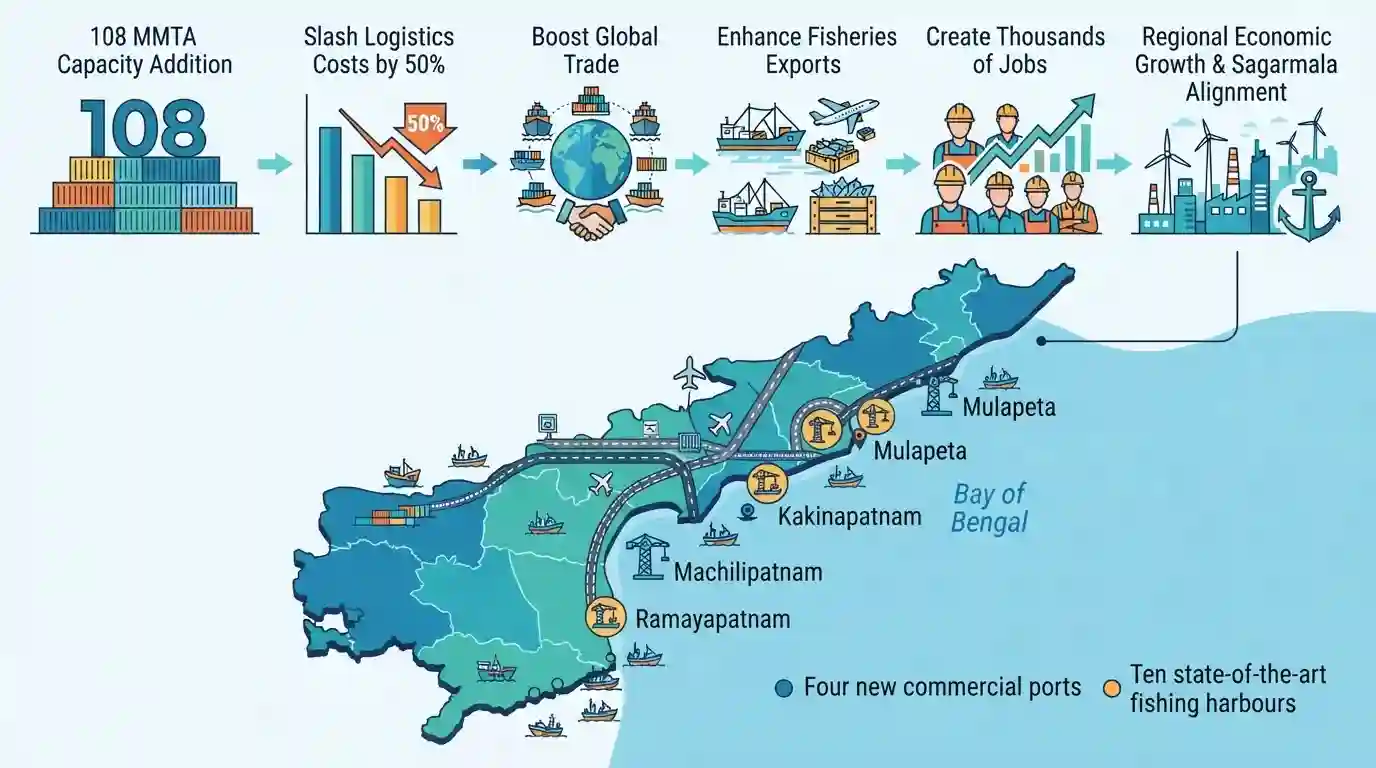
Why It Matters
Understanding state-level infrastructure projects is crucial for APPSC Group 1 Prelims, as questions frequently target regional economic development, geography (matching ports to districts), and maritime policies. Reducing logistics costs is also a vital theme in national macroeconomics.
Summary
Andhra Pradesh is undertaking massive coastal infrastructure development with the construction of four new commercial ports—Ramayapatnam, Machilipatnam, Kakinada Gateway, and Mulapeta—and ten state-of-the-art fishing harbours. Spearheaded by the Andhra Pradesh Maritime Board, these initiatives aim to add 108 MMTA in cargo handling capacity and are projected to slash logistics costs by up to 50%. This maritime push seeks to leverage the state's extensive coastline to boost global trade, enhance fisheries exports, create thousands of jobs, and stimulate regional economic growth, aligning with broader national objectives like the Sagarmala programme.
Key Points
- The Andhra Pradesh government is fast-tracking four new port projects at Ramayapatnam, Machilipatnam, Kakinada Gateway, and Mulapeta to boost maritime infrastructure.
- These ports are expected to add 108 Million Metric Tonnes Per Annum (MMTA) of cargo handling capacity to the state.
- The projects aim to reduce regional logistics costs by 30% to 50%, thereby improving export competitiveness and industrial growth.
- Alongside commercial ports, ten modern fishing harbours are being developed in phases to increase fish catch, enhance marine exports, and generate local employment.
- The Andhra Pradesh Maritime Board is spearheading these developments with significant private and public investments, while navigating necessary environmental and CRZ clearances.
Important Terms
Andhra Pradesh Maritime Board

An autonomous state government agency established in 2019 to govern, manage, and modernize ports and maritime infrastructure across Andhra Pradesh.
UPSC context
Tests AP Regional Economy and Infrastructure; crucial for understanding state-level administrative frameworks driving coastal development.
Sagarmala Programme
A flagship Union government initiative aimed at promoting port-led development by modernizing coastal infrastructure, enhancing logistics connectivity, and supporting coastal communities.
UPSC context
Relevant for National and AP Economy; tests awareness of central schemes financially supporting major state port and waterway projects.
Coastal Regulation Zone (CRZ) Notification
Rules issued under the Environment Protection Act to classify and rigorously regulate industrial, commercial, and construction activities along India's ecologically sensitive coastlines.
UPSC context
Important for APPSC Environment and Geography; evaluates knowledge of mandatory ecological clearances required for AP's new port projects.
Ramayapatnam Port
A major greenfield commercial port currently being constructed in Andhra Pradesh's Prakasam district under the Engineering, Procurement, and Construction (EPC) model.
UPSC context
Tests AP Regional Geography; essential for state-specific current affairs regarding the locations of new major economic and logistics hubs.
Prelims Trap
The newly developed ports like Ramayapatnam and Mulapeta are classified as Major Ports under the Union government.
These are non-major (state) ports spearheaded by the AP Maritime Board. Visakhapatnam is AP’s only Major Port; non-major ports fall under the Concurrent List and are managed by state authorities.
Static Concepts Connected
What is the constitutional and legal distinction between Major and Non-Major Ports?
- Constitutional Jurisdiction: Major ports fall under the Union List, while non-major (minor/intermediate) ports are under the Concurrent List, administered by State Maritime Boards.
- Governing Legislation: Major ports are governed by the Major Port Authorities Act, 2021. Non-major ports are regulated under the Indian Ports Act, 1908.
How does the Coastal Regulation Zone (CRZ) framework impact port development?
- Statutory Backing: CRZ notifications are issued by the MoEFCC under the Environment (Protection) Act, 1986 to protect coastal ecology.
- Clearance Mandates: Ports require strict environmental clearances, particularly if overlapping with CRZ-I (ecologically sensitive areas) or CRZ-IV (water areas), balancing infrastructure with marine conservation.
Cross-Topic Patterns
Blue Economy + National Logistics Policy
State port expansion directly feeds into the National Logistics Policy goal of bringing logistics costs below 10% of GDP, enhancing the state's marine export footprint.
Port-led Industrialisation + PM Gati Shakti
These maritime nodes will be integrated into the PM Gati Shakti National Master Plan to ensure seamless multi-modal connectivity for freight corridors originating in AP.

Match-the-following questions pairing new AP ports (Mulapeta, Ramayapatnam) with their specific districts (Srikakulam, Prakasam) are highly likely.
Linked PYQs · 3
Linked PYQs · 3
- 2024APPSC_PRELIMSGS1
In connection with transport and infrastructure in Andhra Pradesh, which of the following statement/statements is/are valid? I. Andhra Pradesh's first riverine project has been proposed between Muktayala and Madipadu on Krishna river. II. The Bhogapuram Greenfield International Airport had been started with a corpus fund that is sourced from National Investment and Infrastructure Fund (NIIF). III. Infrastructure investments in Andhra Pradesh are strictly implemented only with reference to strategic investments like ports and industrial corridors, but not with reference to community assets. IV. Rail Over Bridges (ROBs) are being developed in Andhra Pradesh under the Setu Bandhan Scheme. Select the correct answer using the codes given below :
- 2024APPSC_PRELIMSGS1
Which of the following statement/statements is/are incorrect regarding the Andhra Pradesh Industrial Policy 2023 - 27? I. To achieve a minimum contribution of 25% by industry in the State GDP II. To provide end-to-end facilitation in 2 weeks III. To envisage ten (10) priorities of accomplishment IV. To focus on becoming a 'Plug and Play State' for investments V. Ensuring land allotment by APIIC within a period of 2 weeks upon receipt of application Select the answer using the codes given below :
- 2024APPSC_PRELIMSGS1
Which of the following statements are valid in connection with Andhra Pradesh Green Hydrogen and Green Ammonia Policy (2023)? I. The objective is to target Green Energy production up to the capacity of 1 MPTA (Million Tonnes Per Annum) or Green Ammonia production up to the capacity of 2-0 MTPA in the next five years. II. New and Renewable Energy Development Corporation of A.P. Ltd (NREDCAP) shall act as a Nodal Agency under this policy. III. All the Ports in the State have infrastructure for storing liquid nitrogen which can then be utilized for storing Green Hydrogen for exporting to other countries. IV. The Policy prohibits the production of Green Hydrogen/Green Ammonia by using Renewable Energy and/or Biomass from 'Third-Party/Power exchange'. Select the correct answer using the codes given below :
