Glacial Lake Expansion Risks in Arunachal Pradesh Himalaya
Source:The Hindu ↗
Why It Matters
Provides a highly relevant case study (Tawang glacial lakes) and highlights specific institutional responses (NDMA's GLOF risk mitigation programme) for GS3 Disaster Management and Environment questions on climate-induced hazards.
Summary
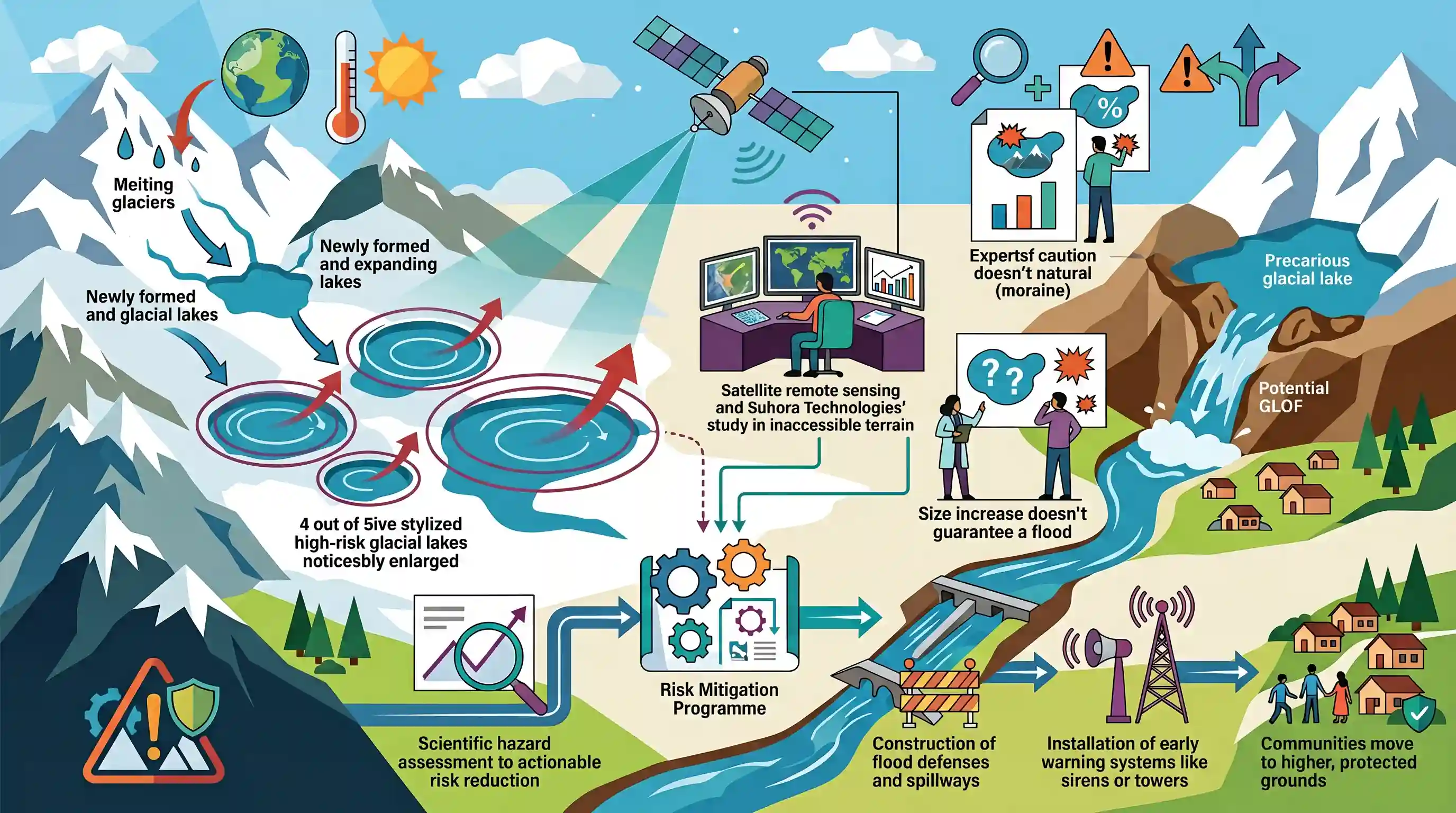
A satellite-based study by Suhora Technologies reveals that four out of five high-risk glacial lakes in Arunachal Pradesh's Tawang district have expanded over the past decade, underscoring the growing threat of Glacial Lake Outburst Floods (GLOFs) in the Eastern Himalayas. While the expansion reflects broader trends of climate-induced glacial retreat, experts caution that size increase alone does not guarantee a flood event. The findings highlight the importance of remote sensing technologies for continuous monitoring in inaccessible terrains and underscore the need for the NDMA's recently launched National Glacial Lake Outburst Floods Risk Mitigation Programme to translate scientific hazard assessments into actionable downstream risk reduction.
Key Points
- Satellite assessment of five glacial lakes in Arunachal Pradesh's Mago Chu basin (Tawang) found that four expanded between 2016 and 2026, indicating glacial retreat.
- Sanhapo Lake exhibited the most sustained growth (from 78 to 89 hectares since 2019), making it a high priority for continuous monitoring and early-warning systems.
- Experts emphasize that while lake expansion signals instability, the actual risk of a Glacial Lake Outburst Flood (GLOF) depends on factors like structural moraine stability, potential landslides/avalanches, and downstream exposure.
- Triggered by the 2023 Sikkim disaster at South Lhonak Lake, the NDMA launched the National Glacial Lake Outburst Floods Risk Mitigation Programme to monitor 189 high-risk lakes.
- The Central Water Commission is currently monitoring over 900 glacial lakes using advanced remote sensing satellites like ICEYE, PlanetScope, and LISS-IV.
Important Terms
Glacial Lake Outburst Flood (GLOF)

A sudden, catastrophic release of water from a glacial lake, often caused by the failure of unstable moraine or ice dams due to melting or seismic activity.
UPSC context
GS Paper I (Geophysical phenomena) and GS III (Disaster Management). Tests climate change impacts in the Himalayas.
National Glacial Lake Outburst Floods Risk Mitigation Programme
A ₹150 crore initiative led by NDMA to mitigate flood risks through hazard mapping, early warning systems, and lake-lowering measures in high-risk Himalayan states.
UPSC context
GS Paper III (Disaster Management). Relevant for national strategies to address cryospheric hazards and climate adaptation.
National Disaster Management Authority (NDMA)
India's apex statutory body for disaster management, chaired by the Prime Minister, responsible for formulating policies and coordinating response for various natural and man-made disasters.
UPSC context
GS Paper III (Disaster Management). Core institutional framework for disaster risk reduction in India.
Centre for Earth Sciences and Himalayan Studies (CESHS)
An autonomous research organization under the Arunachal Pradesh government focused on geoscientific studies, cryosphere dynamics, and climate resilience specifically in the Eastern Himalayan region.
UPSC context
GS Paper III (Environment/Disaster Management). Highlights state-level institutional efforts in monitoring sensitive Himalayan ecosystems.
Central Water Commission (CWC)
A premier technical organization under the Ministry of Jal Shakti that acts as the nodal agency for monitoring glacial lakes and water bodies across India.
UPSC context
GS Paper I (Geography) and GS III (Disaster Management). Tests the technical monitoring of water resources and flood forecasting.
Divecha Centre for Climate Change
A specialized research center at the Indian Institute of Science (IISc), Bangalore, dedicated to studying climate variability, glaciology, and providing scientific evidence for climate policy.
UPSC context
GS Paper III (Science & Tech/Environment). Tests the role of academic research in disaster hazard assessment and climate modeling.
Prelims Trap
An increase in a glacial lake's surface area guarantees an imminent Glacial Lake Outburst Flood (GLOF).
While lake expansion signals glacial retreat and instability, a GLOF specifically requires a dam/moraine breach, which depends heavily on structural stability and external triggers like avalanches or landslides.
Static Concepts Connected
How do moraine-dammed lakes form and why are they vulnerable to GLOFs?
- Formation (Debris accumulation): Retreating glaciers leave behind till (rocks and soil), forming a weak, unconsolidated wall (moraine) that traps meltwater to create a lake.
- Structural vulnerability: Unlike solid bedrock dams, moraines are loose and lack cohesion. They can easily fail due to hydrostatic pressure, internal piping (seepage), or overtopping.
- Trigger events: Sudden mass displacement into the lake from ice falls, avalanches, or landslides creates massive displacement waves that can instantly breach the moraine wall.
How do earth observation satellites track glacial lake hazards?
- SAR Imagery: Synthetic Aperture Radar (e.g., ICEYE) can penetrate cloud cover and operate day/night, making it crucial for monitoring lake boundaries during the cloudy monsoon season.
- Multispectral sensors: High-resolution optical sensors (like ISRO's LISS-IV) track morphological changes, vegetation line retreat, and snow cover depletion in highly inaccessible Himalayan terrains.
Cross-Topic Patterns
GLOFs and Himalayan Hydropower Risks
The 2023 Sikkim GLOF washed away the Chungthang dam (Teesta-III). Expanding lakes in Arunachal (like Sanhapo) directly threaten India's massive planned run-of-the-river hydropower push in the Brahmaputra basin.
NDMA frameworks + Sendai Framework
NDMA's National GLOF Risk Mitigation Programme shifts focus from reactive relief to proactive structural mitigation (e.g., lake-lowering measures), perfectly aligning with India's Sendai Framework commitments.

Expect a multi-statement question linking GLOF vulnerability (moraine types), NGRMP mandate (CWC vs NDMA roles), and river basins.
Linked PYQs · 4
Linked PYQs · 4
- 2014MainsGS1
Bring out the relationship between the shrinking Himalayan glaciers and the symptoms of climate change in the Indian sub-continent.
- 2020MainsGS1
How will the melting of Himalayan glaciers have a far-reaching impact on the water resources of India?
- 2020MainsGS3
Discuss the recent measures initiated in disaster management by the Government of India departing from the earlier reactive approach.
- 2024MainsGS3
What is disaster resilience? How is it determined? Describe various elements of a resilience framework. Also mention the global targets of Sendai Framework for Disaster Risk Reduction (2015–2030).
