Ujjain car stunt arrests under BNS and NSA preventive detention
Source:The Hindu ↗
Why It Matters
This case is highly relevant for the MPPSC Prelims as it combines local Madhya Pradesh district administration (Ujjain), the enforcement of newly enacted criminal laws (BNS) replacing the IPC, preventive detention under the NSA, and the cultural context of regional festive processions and Akharas in the Malwa region.
Summary
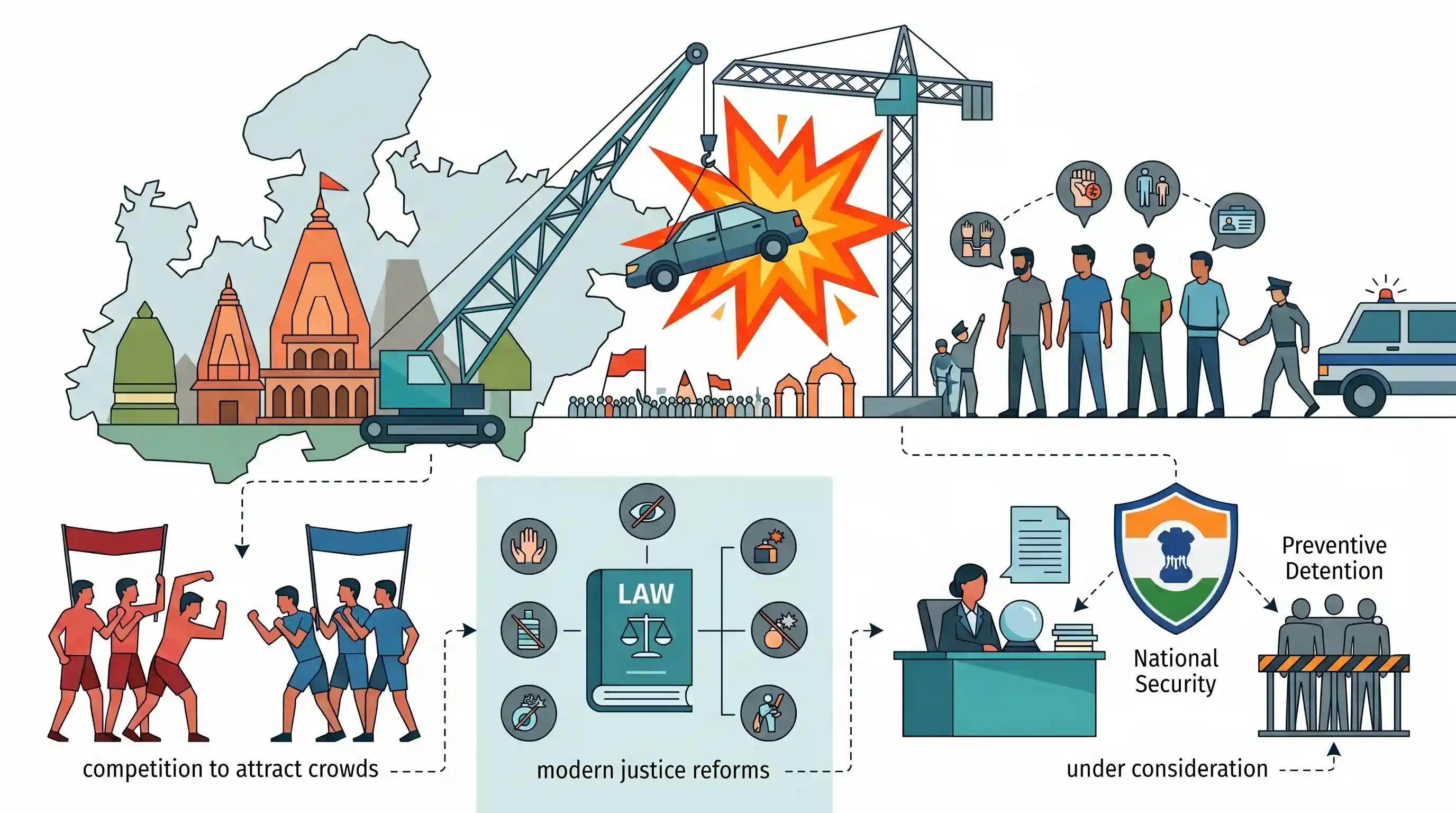
Four men were arrested in Ujjain, Madhya Pradesh, for executing a dangerous stunt where they blew up a car suspended from a crane during a Muharram procession. The Ujjain Police ruled out any communal angle, stating the incident arose from a competition between local Akharas to attract crowds. The accused have been booked under sections 125, 285, and 288 of the Bharatiya Nyaya Sanhita (BNS), and the administration is actively considering invoking the National Security Act (NSA), 1980, against them.
Key Points
- An unauthorized and dangerous stunt involving suspending a car 40 feet in the air from a crane and blowing it up with heavy firecrackers occurred during Muharram processions in Shere Adaan, Badnagar, Ujjain.
- The Ujjain District Administration and Police have ruled out any communal angle, clarifying that the act was a result of a rivalry/competition between local Akharas attempting to pull a larger crowd.
- Four individuals, including Akhara organizer Shoiab Khan, Zahid Khan, Tasleem Khan, and crane owner Gopal Mali, have been arrested. Police are searching for the crane operator.
- Charges have been filed under the newly enforced Bharatiya Nyaya Sanhita (BNS) Sections: Section 125 (endangering life/safety of others), Section 285 (danger/obstruction in public way), and Section 288 (negligent conduct with explosive substances).
- Ujjain SP Pradeep Sharma indicated that invoking the National Security Act (NSA), 1980, against the accused is being considered following local demands.
- District Collector Raushan Kumar Singh confirmed that no administrative permission was sought or given for the stunt.
Important Terms
Bharatiya Nyaya Sanhita

India's primary criminal code enacted in 2023 to replace the colonial-era Indian Penal Code (IPC), 1860, modernizing offenses and emphasizing a victim-centric justice system.
UPSC context
GS Paper II (Polity & Governance); tests legal reforms, evolution of criminal justice, and fundamental rights.
National Security Act, 1980
A key preventive detention law in India empowering the central and state governments to detain individuals without trial to maintain public order and state security.
UPSC context
GS Paper II (Polity & Constitution); tests preventive detention mechanisms, executive powers, and civil liberty safeguards.
Preventive Detention
The practice of detaining an individual without trial or formal charges, based on the anticipation that they may commit acts harmful to public order or national security.
UPSC context
GS Paper II (Polity & Constitution); tests Article 22 provisions, judicial safeguards, and civil liberties.
Akharas
Monastic orders or assemblies of Hindu saints, seers, and sadhus, historically formed to defend religious traditions, playing a major role in spiritual events like Kumbh Melas.
UPSC context
GS Paper I (Art & Culture); tests understanding of religious institutions, Indian heritage, and socio-religious history.
Prelims Trap
The 44th Amendment successfully reduced the maximum period of preventive detention without Advisory Board approval from three to two months.
While the 44th Amendment Act of 1978 proposed this reduction, that specific clause was never officially notified or brought into force by the government. The limit remains three months.
Static Concepts Connected
What are the constitutional safeguards for preventive detention under Article 22?
- Constitutional Exception: Article 22(3) denies key arrest protections (like the right to legal counsel) to enemy aliens and individuals held under preventive detention laws.
- Advisory Board Limit: Detention cannot exceed three months unless an independent Advisory Board, comprising High Court judges or those qualified, approves an extension.
- Disclosure of Grounds: The detaining authority must communicate the grounds of detention to the detainee but can withhold facts deemed prejudicial to public interest.
What is the historical significance of ancient Ujjain (Avantika)?
- Mahajanapada Era: Known as Avantika, it was the capital of the Avanti kingdom, one of the sixteen Mahajanapadas of ancient India.
- Imperial Centers: Served as the Western provincial seat under Mauryan Viceroy Ashoka and the second capital of Gupta Emperor Chandragupta II.
- Ancient Prime Meridian: Historically designated as the prime meridian of ancient India for major mathematical and astronomical calculations.
Cross-Topic Patterns
Preventive detention vs Article 21
NSA application to local law-and-order highlights the delicate balance between state preventive security powers and the judiciary's strict protection of Article 21.
Traditional Akharas and modern policing
The evolution of traditional institutions like Akharas into competitive public spectacles poses unique crowd management and public safety challenges for district administrations.

Article 22's advisory board limits and the un-notified 44th Amendment clauses remain high-yield fodder for multi-statement polity MCQs.
Linked PYQs · 2
Linked PYQs · 2
- 2018MPPSC_PRELIMSGS1
The ancestors of Shungas originated from
- 2024MPPSC_PRELIMSGS1
In which district of Madhya Pradesh was the production of soybean initially started?
