Ujjain procession car blast arrests and administrative action
Source:The Hindu ↗
Why It Matters
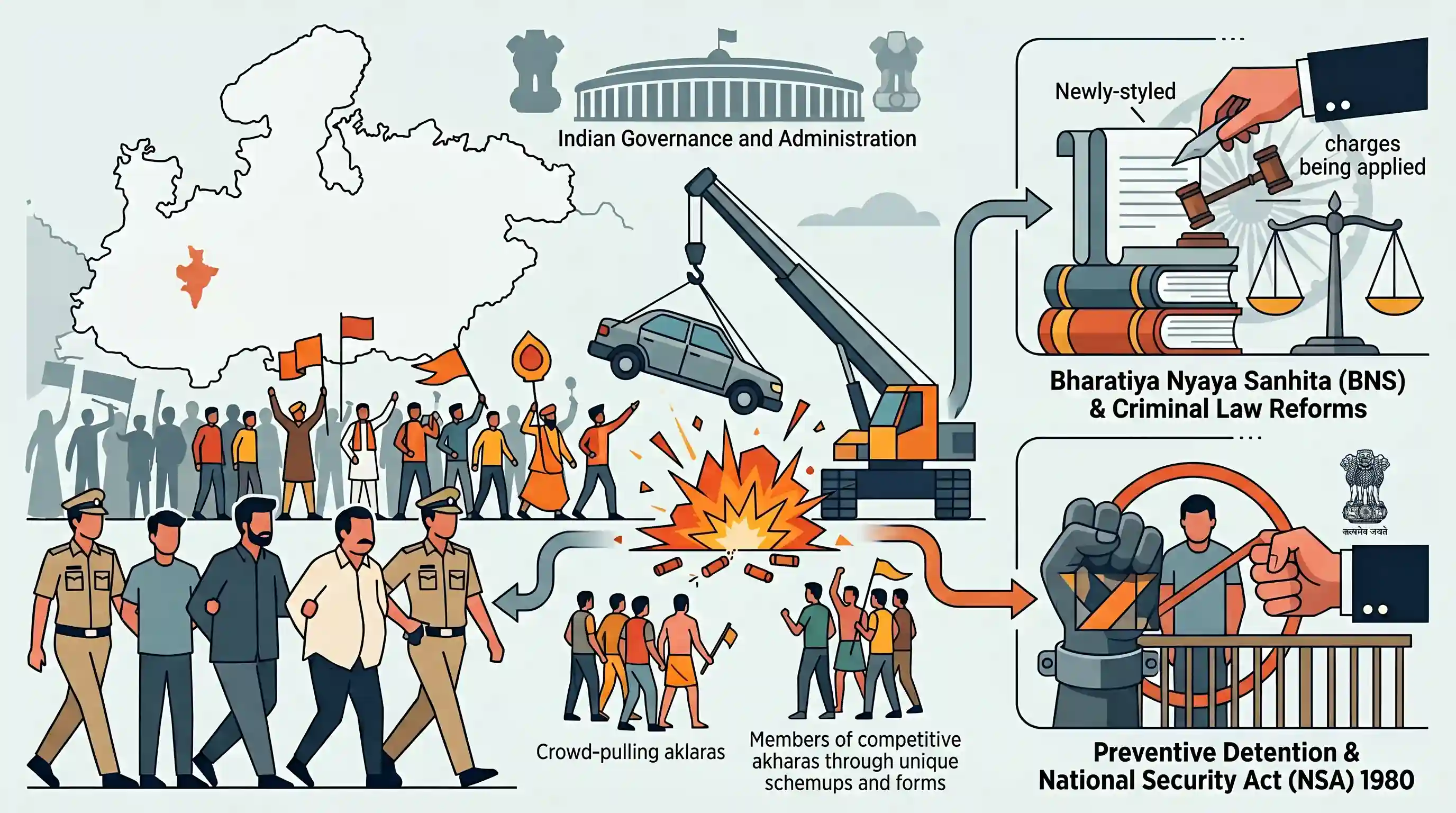
This incident illustrates the practical application of the new Bharatiya Nyaya Sanhita (BNS) provisions and the administrative considerations around invoking the National Security Act (NSA) 1980 to maintain public order during local festivities in Madhya Pradesh.
Summary
Four men, including an Akhara organizer, were arrested in Ujjain, Madhya Pradesh, for a high-risk stunt during a Muharram procession where a car suspended from a crane was blown up using firecrackers. The police officially ruled out any communal angle, identifying it as a competitive crowd-pulling event organized by local akharas. The accused have been booked under various sections of the newly enacted Bharatiya Nyaya Sanhita (BNS), and the administration is considering invoking the National Security Act (NSA), 1980.
Key Points
- On June 24, 2026, a stunt involving a car suspended 40 feet in the air by a crane and blown up with strong firecrackers took place during a Muharram procession in Badnagar, Ujjain, Madhya Pradesh.
- Four individuals—Shoiab Khan (prime accused and Akhara organizer), Zahid Khan and Tasleem Khan (flag-wavers), and Gopal Mali (crane owner)—were arrested.
- The police filed an FIR under Bharatiya Nyaya Sanhita (BNS) Sections 125 (endangering life or personal safety), 285 (danger or obstruction in a public way), and 288 (negligent conduct with respect to explosive substances).
- The administration, led by Collector Raushan Kumar Singh and SP Pradeep Sharma, confirmed no prior permission was sought for the stunt, and a flag march was held to maintain order.
- The police investigation ruled out any communal angle, clarifying that the dangerous stunt was part of a competitive effort by local 'akharas' to pull crowds.
- Local demands have been raised to invoke the National Security Act (NSA), 1980, which the police and district administration are actively considering.
Important Terms
National Security Act (NSA) 1980

A preventive detention law enacted in 1980 that allows the central or state governments to detain individuals without trial to prevent them from acting prejudicially to national security, public order, or essential services.
UPSC context
GS Paper II (Polity/Governance); tests understanding of preventive detention, personal liberty (Article 22), and the balance between security and individual rights.
Bharatiya Nyaya Sanhita (BNS) 2023
India's official criminal code enacted in December 2023 (effective July 1, 2024) to replace the colonial-era Indian Penal Code (IPC) of 1860, modernizing substantive criminal law and justice delivery.
UPSC context
GS Paper II (Polity/Governance); tests knowledge of criminal justice reforms, statutory revisions, and the transition from colonial-era legal frameworks.
Local Akharas
Traditional Indian institutions serving as wrestling arenas or monastic orders of saints. Historically established to protect religious traditions, they manage major festivals and play key roles in local socio-cultural gatherings.
UPSC context
GS Paper I (Art and Culture/Indian Society); tests knowledge of traditional monastic lineages, physical culture, and socio-religious institutions.
Prelims Trap
The constitutional limit for preventive detention without Advisory Board approval is two months under the 44th Amendment.
Although the 44th Amendment (1978) reduced the maximum detention period without Advisory Board approval to 2 months, this specific provision was never officially notified, meaning the constitutional limit remains 3 months.
Static Concepts Connected
What are the constitutional protections and exceptions for preventive detention under Article 22?
- Exemptions from safeguards: Article 22(3)(b) explicitly denies basic procedural rights (like legal counsel of choice) to individuals arrested under preventive detention laws.
- Constitutional timeline: No law can authorize preventive detention beyond 3 months unless an Advisory Board finds sufficient cause before the expiration of that period.
- Legislative competence: Parliament holds exclusive power for defense/foreign affairs/security of India, while both Parliament and State Legislatures hold concurrent power for public order.
How does the statutory framework of the National Security Act (NSA), 1980 operate?
- Grounds communication: The detaining authority must communicate the grounds of detention to the detainee within 5 days, extendable to 10 days in exceptional circumstances.
- Advisory Board timelines: The government must refer the matter to the Advisory Board within 3 weeks; the Board must submit its report within 7 weeks from the detention date.
- No legal representation: Section 11(4) of the Act explicitly denies detainees the right to be represented by a legal practitioner before the Advisory Board.
Cross-Topic Patterns
Preventive detention vs Article 21
The tension between public order measures (like the NSA) and Article 21 has seen major Supreme Court rulings requiring strict compliance with procedural safeguards to prevent arbitrary detention.
Criminal Law Reform and Public Safety
The transition from IPC to BNS changes statutory definitions of public safety offenses, altering how local police and administrators handle crowd control and hazardous public stunts.

Executive powers of preventive detention under Article 22 and strict statutory timelines under the NSA are high-yield areas for UPSC 2026.
Linked PYQs · 2
Linked PYQs · 2
- 2018MPPSC_PRELIMSGS1
Under which one of the following Sections of the Scheduled Castes and Scheduled Tribes [Prevention of Atrocities] Act, 1989 is anticipatory bail prohibited?
- 2024MPPSC_PRELIMSGS1
In which district of Madhya Pradesh was the production of soybean initially started?
